
Math Function Calculator: Evaluate, Solve, and Understand Functions
Input a function, upload your question, get guided steps to solve and learn.


What Is a Function in Math?
A function definition is a rule that connects each input to exactly one output. If you enter a value for x, the function uses its rule to produce a value such as f(x).
For example, if f(x) = 2x + 3, then f(4) = 11. The input is 4, the rule is 2x + 3, and the output is 11. Function definitions help describe how values change together in math, science, engineering, finance, and everyday situations.


How to Evaluate a Function?
To evaluate a function, replace the variable with the given input and simplify the expression. For example, if f(x) = x^2 - 4x + 7, then evaluating f(5) means replacing every x with 5.
A function evaluation calculator can help you check substitutions, simplify the result, and see the steps behind the answer. This is especially useful when a function includes powers, fractions, roots, or several operations.

Function Notation, Domain, and Range
Function notation shows the relationship between an input and its output. In f(x), the f names the function, x is the input, and f(x) is the resulting output. It does not mean f multiplied by x.
The domain is the set of input values a function can accept. The range is the set of possible outputs. To find a domain, check for restrictions such as a denominator that cannot equal zero, a square root that cannot contain a negative value, or a logarithm that needs a positive input.

How to Find an Inverse Function?
An inverse function reverses the original function. If a function takes an input from x to y, its inverse takes that output back to the original input. To find an inverse, write the function as y, switch x and y, and solve for y. For example, if f(x) = 2x + 3, switch the variables to get x = 2y + 3. Solving for y gives f^-1(x) = (x - 3) / 2.
A function must be one-to-one to have an inverse function. In simple terms, different inputs cannot produce the same output.

How to Read and Compare Function Graphs?
A graph can show whether a relationship is a function, where it crosses an axis, and how its values change. If a vertical line touches a graph more than once, the graph does not represent a function because one input would have more than one output.
When comparing functions, look at their intercepts, rate of change, highest or lowest values, and long-term behavior. For exponential functions, focus on whether the graph shows growth or decay. These details help answer questions about maximum values, domain, range, and what the graph represents.
Types of Functions and Examples


Linear Function: f(x) = mx + b
A linear function has a constant rate of change and creates a straight-line graph.
Quadratic Function: f(x) = ax^2 + bx + c
A quadratic function includes an x^2 term and usually creates a U-shaped or upside-down U-shaped graph.
Cubic Function: f(x) = ax^3 + bx^2 + cx + d
A cubic function includes an x^3 term and may change direction more than once on a graph.
Exponential Function: f(x) = a(b^x)
An exponential function has a variable in the exponent and models rapid growth or decay.
Inverse Function: f^-1(x)
An inverse function reverses the input-output relationship of the original function. A function must be one-to-one to have an inverse function.
Hyperbolic Function: f(x) = cosh(x)
Hyperbolic functions are based on exponential functions and are commonly used in calculus, physics, and engineering.
What Makes This Functions Calculator Useful?

Step-by-step function solving
Input f(x) or function questions. Get full solving workflows instead of only final answers.
Reinforce your math skills
Watch video tutorials and practice similar problems for linear, exponential and inverse functions.
Spot substitution mistakes instantly
See how values substitute for x. Catch common errors in exponents, negatives and parentheses.
Tackle inverse & domain problems
Learn to reverse functions, find domain limits and verify one-to-one relationships.
How to Use the Calculator for Function?
Step 1
Type or upload your function problem
Enter the function directly, paste a question, or upload a clear image, screenshot, or PDF.
Step 2
Review step-by-step explanations
Follow the solution steps to understand the substitution, simplification, or method used.
Step 3
Keep practicing the skill
Use a video explanation for extra support, then generate similar questions to reinforce the topic.
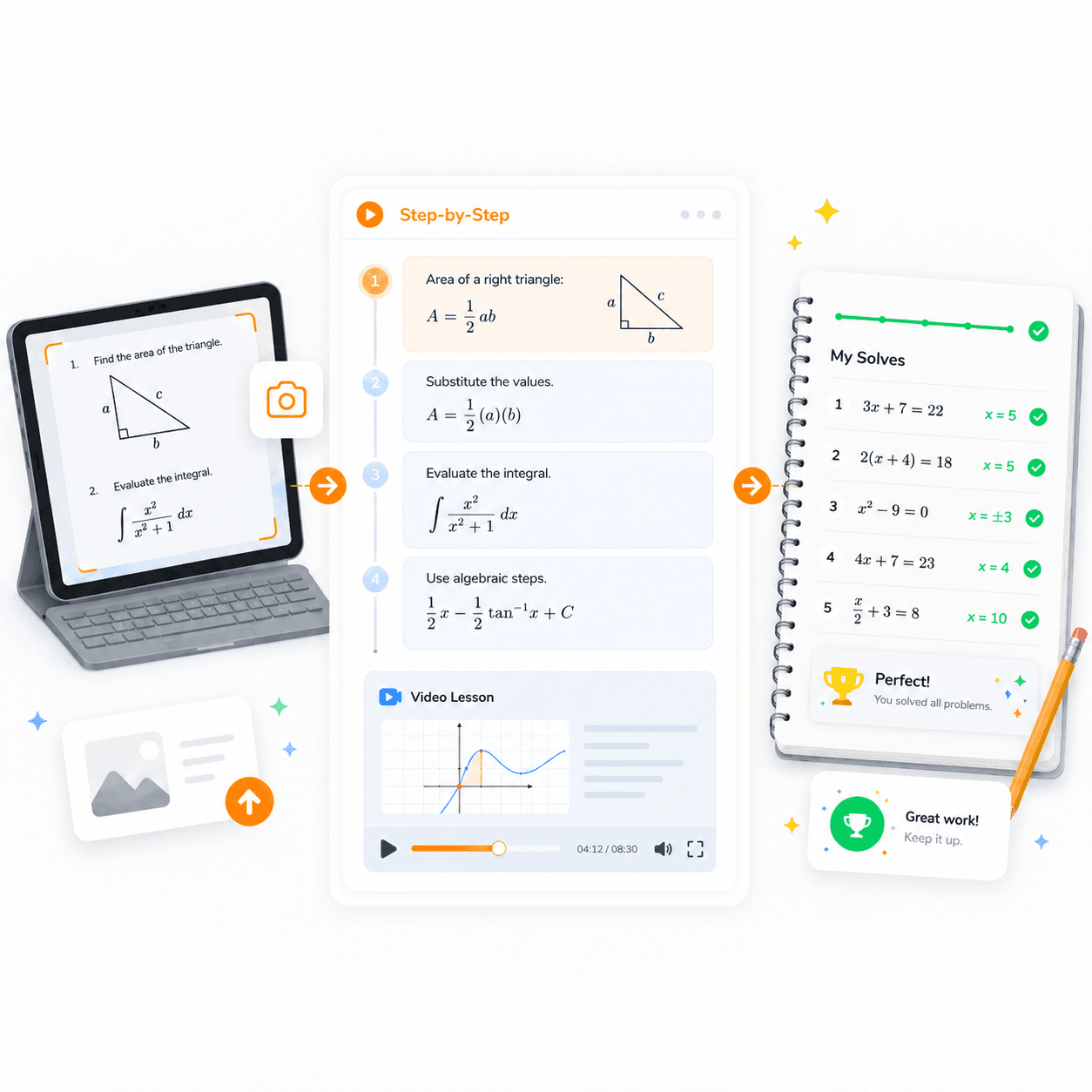
Can a Function X Calculator Help You Learn Math?
Yes. A solving functions calculator like Tenorshare AI Math can help you practice the skills that appear throughout algebra and precalculus, including evaluating f(x), finding a domain, recognizing function types, and solving inverse-function questions.
Try the problem independently first, then compare your work with the explanation. This makes it easier to identify whether the mistake came from notation, substitution, algebra, or the function concept itself.
Discover Free Tools to Take Your Math Learning Further
Do You Have Questions?
We have answers & AI tool resources for you.
What Is a One-to-One Function?
A one-to-one function gives different outputs for different inputs. This matters because only one-to-one functions can have an inverse that is also a function.
How Do I Check Whether Two Functions Are Inverses?
Substitute one function into the other. If both f(g(x)) and g(f(x)) simplify to x, the two functions are inverses.
What Is the Domain of an Exponential Function?
For a standard exponential function such as f(x) = a(b^x), the domain is all real numbers. Its range is positive when a and b are positive.
How Do I Graph an Exponential Function?
Start by finding the initial value at x = 0, then calculate a few values on either side of zero. Plot the points to see whether the graph shows exponential growth or decay.
Which Statement Best Describes the Function Represented by a Graph?
Check the graph's intercepts, direction, rate of change, highest or lowest points, and any restrictions. Use the vertical line test first to confirm that the graph represents a function.
Can a Function Evaluation Calculator Help Me Check My Work?
Yes. A function evaluation calculator can help you compare your substitution and simplification steps with a clear solution, especially when the expression includes powers, fractions, or parentheses.
Solve Functions & Master the Logic with this Function Calculator
Tenorshare AI Math breaks down function problems, evaluates expressions and helps you master key concepts.
