
Limit Calculator with Steps: Solve Calculus Limits & Understand the Reasoning Behind
Master limit notation, simplification and one-sided behavior with step-by-step help for limit questions.


What Is a Limit in Calculus?
A limit describes the value a function approaches as its input gets close to a particular number. The function does not always need to equal that value at the point; calculus focuses on its behavior nearby. Limit notation is commonly written as: lim as x approaches a of f(x) = L
This means that when x gets close to a, f(x) gets close to L. This limit definition is the foundation for continuity, derivatives, and many calculus problems.


How Do You Find a Limit?
Start by substituting the approaching value into the expression. If the result is a defined number, that number is the limit.
If substitution gives an indeterminate form such as 0 / 0, simplify before evaluating. Depending on the expression, you may factor, cancel common terms, rationalize a denominator, or apply a known rule. A limit calculator with steps can help you identify the method and check each stage.
Limit Examples and Common Calculus Problems


Direct substitution: lim as x approaches 3 of (2x + 1)
Use direct substitution method to calculate function limits.
Factor and cancel: lim as x approaches 2 of (x^2 - 4) / (x - 2)
Simplify rational expressions by factoring and cancel common terms for limit calculation.
One-sided behavior: lim as x approaches 0 from the left of 1 / x
Analyze left-hand and right-hand one-sided limits of functions.
Infinite limits: lim as x approaches 1 of 1 / (x - 1)^2
Study limits where function values grow without bound near a point.
Special trig limits: lim as x approaches 0 of sin(5x) / x
Solve limit problems using standard trigonometric limit identities.

What Can a Limit Tell You About a Function?
Limits reveal how a function behaves near a point, even when the function is undefined there. They can show whether a graph is continuous, has a hole, jumps between values, or grows without bound. One-sided limits examine a function from a single direction. A left-hand limit uses values below the target, while a right-hand limit uses values above it. A two-sided limit exists only when both sides approach the same result.
Limits can also describe infinity. For example, a function may approach positive or negative infinity near a vertical asymptote, or it may approach a fixed value as x becomes very large.
Which Rules and Techniques Are Used to Solve Limits?
Limit laws help simplify complex expressions through sum, product, quotient, and power rules. Other useful methods include factoring, cancelling, rationalizing, and applying special trig limits, such as: lim as x approaches 0 of sin(x) / x = 1
Limits also define derivatives: f(x) = lim as h approaches 0 of [f(x + h) - f(x)] / h This measures a function's rate of change at a specific point.

How Does This Calculator for Limits Work?
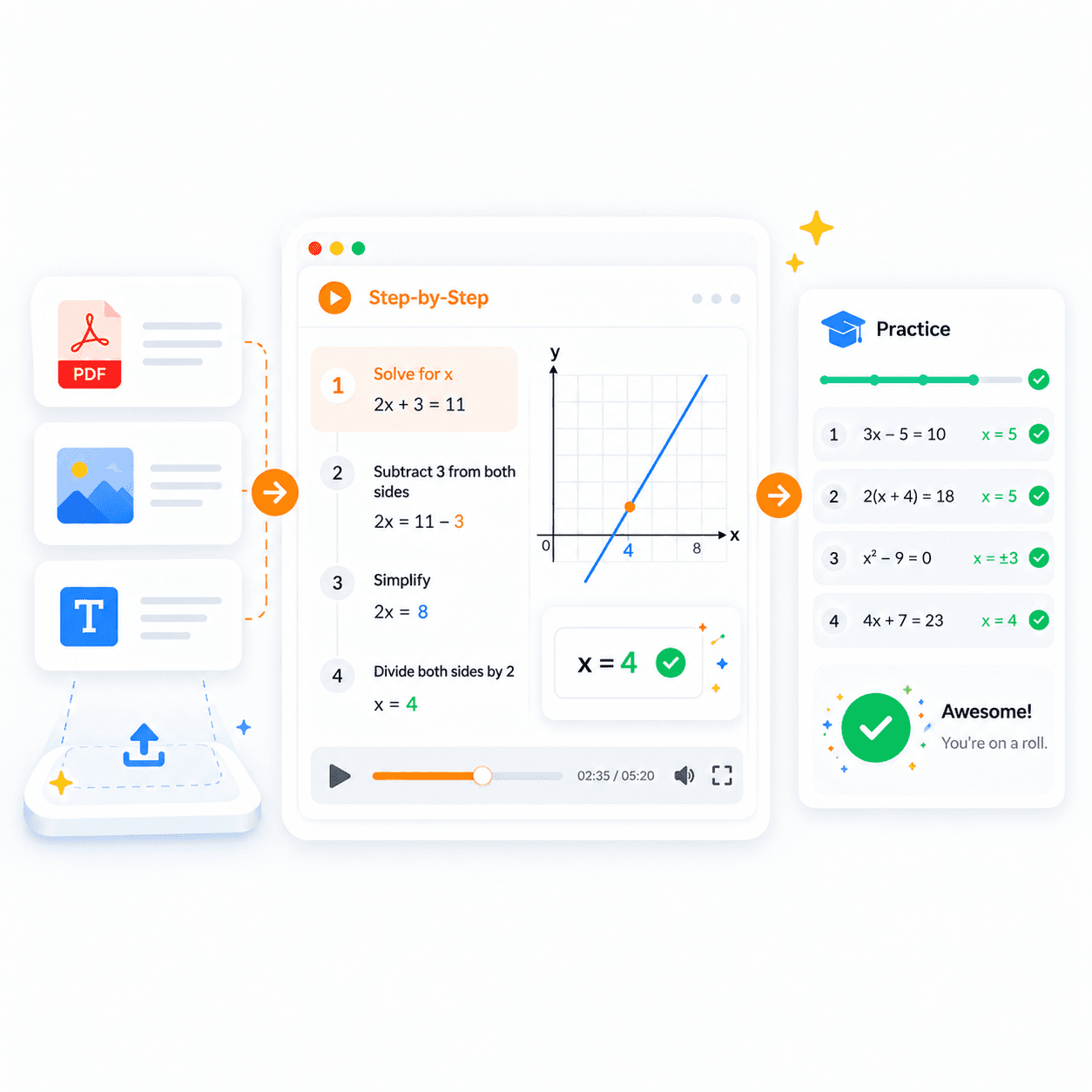
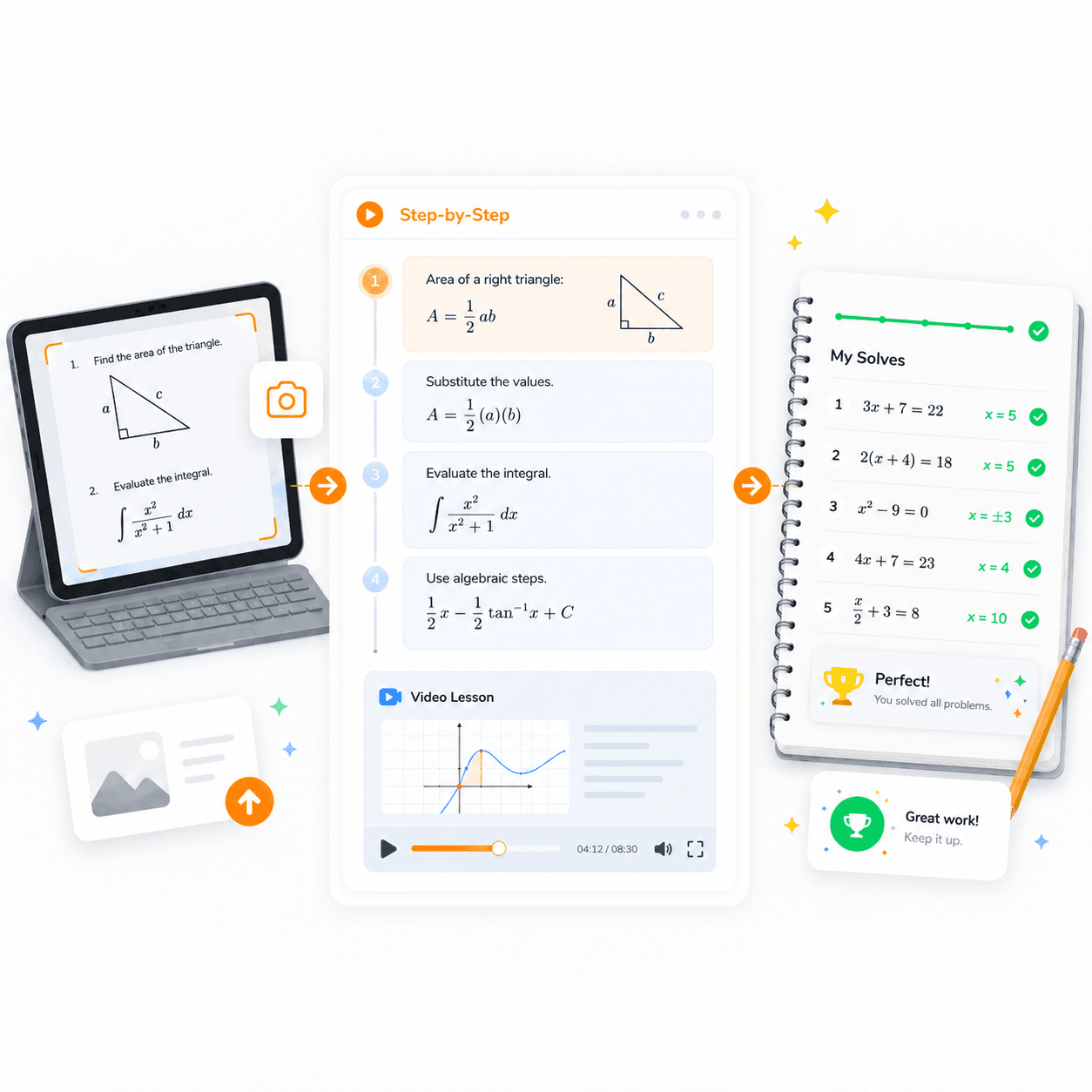
Tenorshare AI Math accepts typed limit expressions as well as clear problem images and PDFs. It evaluates the problem, presents a step-by-step solution, and helps you review the reasoning behind the answer.
After solving, you can ask follow-up questions, watch a video explanation, or use similar practice questions to strengthen the concepts that appeared in your limit problem.
Why Use This Limit Calculator?
Tenorshare AI Math is designed to support both solving and learning.

Solve from text, images, or PDFs
Type a limit expression or upload a clear JPG, PNG, WEBP image, or PDF instead of rewriting a complex question manually.
Get step-by-step limit solutions
Follow how the expression is substituted, simplified, factored, or evaluated rather than seeing only a final result.
Ask follow-up questions when stuck
Clarify an indeterminate form, a one-sided limit, or a specific calculation step directly after receiving the solution.
Learn with video explanations
Watch an explanation that makes abstract concepts such as infinite limits, limit laws, and function behavior easier to follow.
Practice similar limit questions
Reinforce the method with related exercises after solving, helping you prepare for calculus homework, quizzes, and exams.
How to Use the Solving Limits Calculator?
Step 1
Upload or enter your limit question
Type formulas directly, or import JPG, PNG, WEBP and PDF files with the limit problem.
Step 2
Get a step-by-step explanation
See how the limit is simplified and evaluated step by step.
Step 3
Use additional learning tools
Watch explanations and work on similar calculus questions to reinforce learning.
Is a Calculus Limit Calculator with Steps Good for Math?
Yes. A calculus limit calculator with steps can help you compare your solution with a clear approach instead of relying only on the final answer. It is especially useful for finding where an algebraic simplification, sign, or one-sided interpretation changed your result.
For the best learning outcome, try the problem first, then use the explanation to check your method. This turns the calculator into a study tool for limits, continuity, and derivatives.
Discover Free Tools to Take Your Math Learning Further
Do You Have Questions?
We have answers & AI tool resources for you.
Are There Any Free Limits Solvers Online?
Yes. Tenorshare AI Math provides a free online limits solver for typed questions, uploaded images, and PDFs. You can review the answer, steps, and additional learning support in one place.
How to Calculate a Limit From the Left?
Use input values slightly smaller than the target number and observe what the function approaches. This is written as lim as x approaches a from the left of f(x) and is useful for piecewise functions, jumps, and asymptotes.
How Do I Determine Limit in Maths?
Substitute the approaching value first. If the expression is defined, you have the limit; if it produces an indeterminate form, simplify the expression or apply an appropriate limit rule before evaluating again.
What Is the Limit Comparison Test?
The limit comparison test is a method for determining whether an infinite series converges or diverges by comparing it with another positive-term series. Although it uses limits, it is different from finding the limit of a function.
How Do Special Trig Limits Work?
Special trig limits use known relationships near zero, such as lim as x approaches 0 of sin(x) / x = 1. Rewrite the expression so it matches a standard form, then apply the relevant limit rule.
How Do I Use a Graphing Calculator to Find a One-Sided Limit?
Inspect values or graph behavior just to the left and just to the right of the target input. If both sides approach the same output, the two-sided limit exists; if they approach different outputs, it does not.
Solve Limits and Understand Every Step with Limit Calculator
Evaluate expressions, learn solving methods and build calculus confidence with Tenorshare AI Math
