
Online Exponent Calculator with Steps: Solve and Simplify Exponents
Solve exponent problems and understand the rules behind every power.


What Is an Exponent?
An exponent shows how many times a base is multiplied by itself. In 3^4, 3 is the base, and 4 is the exponent. 3^4 = 3 * 3 * 3 * 3 = 81
Exponent notation provides a shorter way to write repeated multiplication. It appears in algebra, scientific notation, geometry, growth models, and many other areas of math.

What Types of Exponents Are There?

Positive integer exponents
2^3 = 2 * 2 * 2 = 8
Zero exponents
For any nonzero number, a^0 = 1
Negative exponents
2^-3 = 1 / 2^3 = 1/8
Fractional exponents
9^(1/2) = sqrt(9) = 3
Variable exponents
Expressions such as 2^x are common in exponential equations and growth models.
What Are the Laws of Exponents?
The laws of exponents help simplify powers without expanding every multiplication. These properties of exponents apply only when the expression matches the rule.

Product of powers:
a^m * a^n = a^(m + n)
Quotient of powers:
a^m / a^n = a^(m - n), where a != 0
Power of a power:
(a^m)^n = a^(m * n)
Power of a product:
(ab)^n = a^n * b^n
Negative exponent rule:
a^-n = 1 / a^n
Fractional exponent rule:
a^(m/n) = (nth_root(a))^m

How to Solve for an Exponent?
Start by identifying the base, exponent, and operation in the expression. If the exponent is a positive whole number, multiply the base by itself the required number of times.
For more complex expressions, apply the relevant exponent law before calculating. Convert negative exponents into reciprocals and fractional exponents into roots when needed. An algebra calculator with exponents can help you see which rule applies before simplifying the final expression.
Exponent Examples and Real-World Applications
These examples show why an exponent solver is useful for both basic arithmetic and advanced algebra.

Repeated multiplication
5^3 = 125
Fractional exponents
27^(2/3) = 9
Negative exponents
10^-2 = 1/100
Area and volume
A square with side length s has area s^2, while a cube has volume s^3.
Growth and decay
Exponents model compound interest, population growth, radioactive decay, and repeated doubling.
Scientific notation
Expressions such as 6.02 * 10^23 represent very large quantities clearly.

How Does This Exponent Calculator Work?
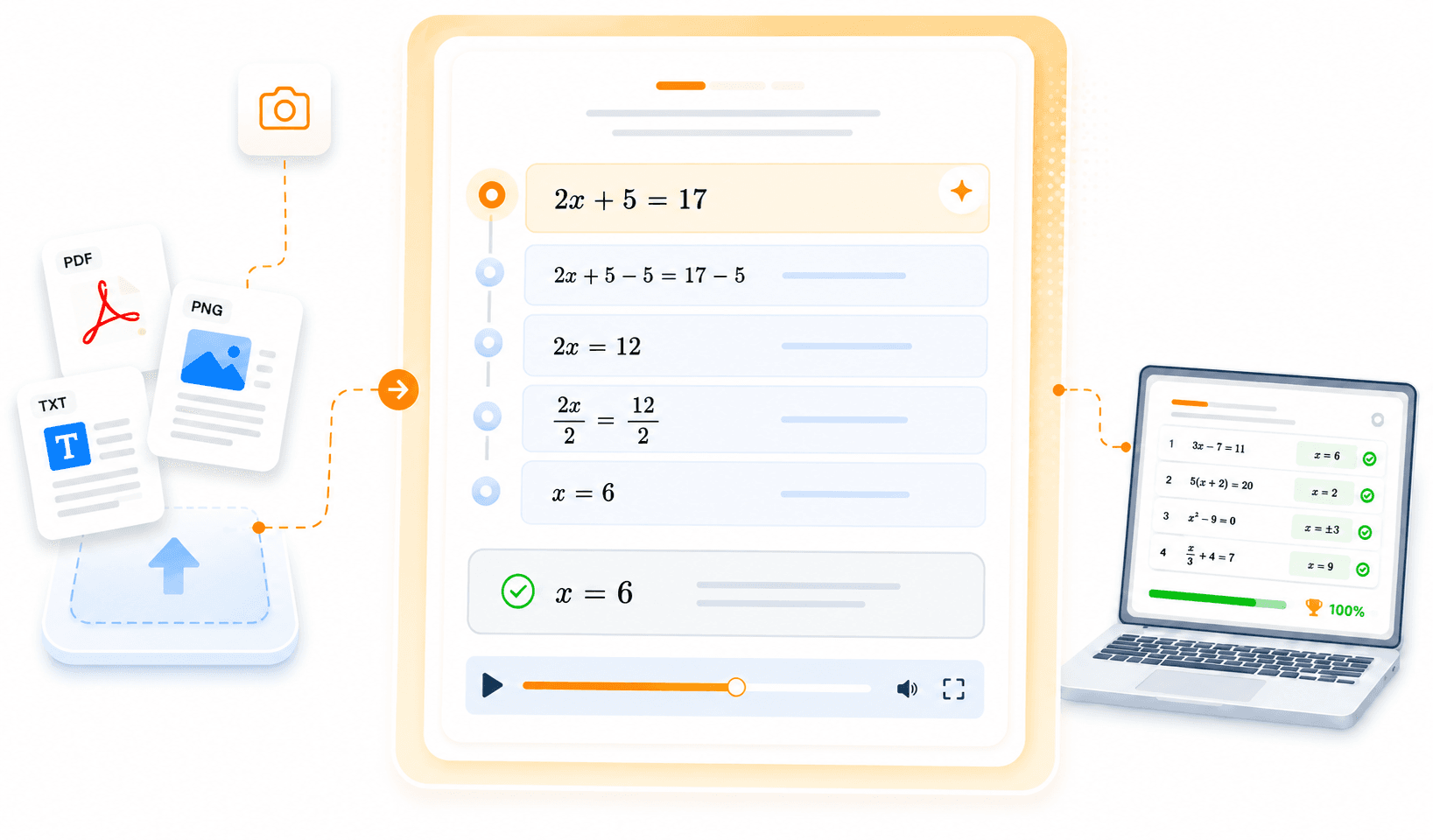
Tenorshare AI Math lets you type an exponent expression or upload a JPG, PNG, WEBP image, or PDF of the problem. It provides the answer with step-by-step explanations, helping you follow how powers, roots, fractions, or variables are simplified. You can also use video explanations and similar practice problems to reinforce the exponent rule used in the solution.
Why Use This Exponent Calculator?
Tenorshare AI Math helps you handle exponent questions as learning tasks, not just calculations.

Solve expressions from any format
Type an exponent problem or upload a worksheet image or PDF.
Get step-by-step solutions
See how exponent rules are applied to powers, fractions, negative exponents, and variables.
Generate a video explanation
Watch the solution method explained clearly when an exponent rule feels difficult.
Practice with similar questions
Generate related exponent exercises to strengthen your algebra skills after solving.
How to Use the Exponents Calculator?
Step 1
Upload or enter your exponent problem
Type your expression directly, or upload JPG, PNG, WEBP, or PDF with the question.
Step 2
Get a step-by-step explanation
Review how the exponent rule is applied and how the expression is simplified.
Step 3
Use additional learning tools
Watch a video explanation and practice similar exponent problems to strengthen your skills.

Is an Algebra Exponent Solver Good for Learning Algebra?
An exponent calculator with steps can help you compare your own method with a clear solution process. It is especially useful for checking negative exponents, fractional exponents, variables, and expressions with several exponent rules.
Try the problem first, then use the explanation to identify where the calculation changed. This turns the calculator into a practical study tool for algebra, precalculus, and scientific notation.
Discover Free Tools to Take Your Math Learning Further
Do You Have Questions?
We have answers & AI tool resources for you.
What Is the Difference Between a Base and an Exponent?
The base is the number or expression being multiplied, while the exponent shows how many times it is used as a factor. In 5^3, 5 is the base and 3 is the exponent.
How to Do Exponents on a Calculator?
On a scientific calculator, use the exponent key, often shown as ^, x^y, or y^x. Enter the base, press the exponent key, enter the exponent, and calculate. For expressions with variables, fractions, or several rules, use Tenorshare AI Math to enter or upload the problem and review the steps.
How to Calculate Fractional Exponents?
A fractional exponent represents a root. In a^(m/n), the denominator n gives the root, and the numerator m gives the power. For example, 27^(2/3) means cube root of 27, then square the result: 3^2 = 9.
How to Calculate Negative Exponents?
A negative exponent moves the base to the other side of the fraction bar. For example, 5^-2 = 1 / 5^2 = 1/25. The negative sign changes the position of the base, not the sign of the answer.
How to Calculate a Lyapunov Exponent?
A Lyapunov exponent measures how quickly nearby paths diverge in a dynamic system. It is calculated from repeated model iterations or time-series data, so it is different from simplifying a standard algebra exponent expression.
What Is a Good Calculator to Solve Exponents?
A good calculator should handle exponent notation, fractional and negative powers, variables, and multi-step algebra while showing how the rule is applied. Tenorshare AI Math supports typed problems, image and PDF uploads, step-by-step explanations, video support, and similar practice questions.
Solve Mixed Numbers and Understand Every Step
Calculate, convert, and master mixed number fractions with Tenorshare AI Math.
