
Inverse Function Calculator: Work Through Inverse Functions With Step-by-step Support
Solve for function inverses and understand the underlying logic with Tenorshare AI Math.


What Is an Inverse Function?
An inverse function reverses the effect of an original function. If a function sends an input x to an output y, its inverse sends that output back to the original input. If: f(x) = y then: f^-1(y) = x
The notation f^-1(x) means the inverse function, not 1 / f(x). A function and its inverse undo each other.


What Makes a Function Invertible?
A function must be one-to-one to have an inverse over its full domain. This means that every output is paired with only one input.
The horizontal line test is a useful visual check: if any horizontal line crosses a graph more than once, the function is not one-to-one on that domain. Some functions can still have an inverse after a domain restriction.
What Types of Inverse Functions Are Common?
Inverse functions appear in several common function families.

Linear functions
f(x) = 2x + 3 has the inverse f^-1(x) = (x - 3) / 2.
Quadratic functions with a restricted domain
A quadratic gains an inverse by limiting the domain to one side of its parabola.
Exponential and logarithmic functions
f(x) = 2^x and f^-1(x) = log base 2 of x form a pair of inverse functions.
Rational functions
Fractions with variables can usually be rearranged to solve for their inverse.
Inverse trigonometric functions
sin(x), cos(x) and tan(x) use restricted domains to create inverses like arcsin(x), arccos(x), arctan(x).
How Do You Find the Inverse of a Function?

Write the function as y
Replace f(x) with y to make the variable relationship clear.
Interchange x and y
Swap the input and output variables to reverse the function’s mapping.
Solve for y
Rearrange the new equation until y is isolated.
Write the inverse notation
Replace y with f^-1(x).
Check the result
Confirm that the original function and its inverse compose to x, and make sure the domain and range have switched correctly.
How Are Direct and Inverse Functions Related?
A direct function maps an input to an output, while an inverse function reverses that mapping. Their domain and range switch places. If the domain of f(x) is the set of allowed inputs and the range is the set of resulting outputs, then the domain of f^-1(x) becomes the range of f(x). Likewise, the range of f^-1(x) becomes the domain of f(x).
Their graphs are reflections of each other across the line: y = x

How Does This Calculator of Inverse Function Work?
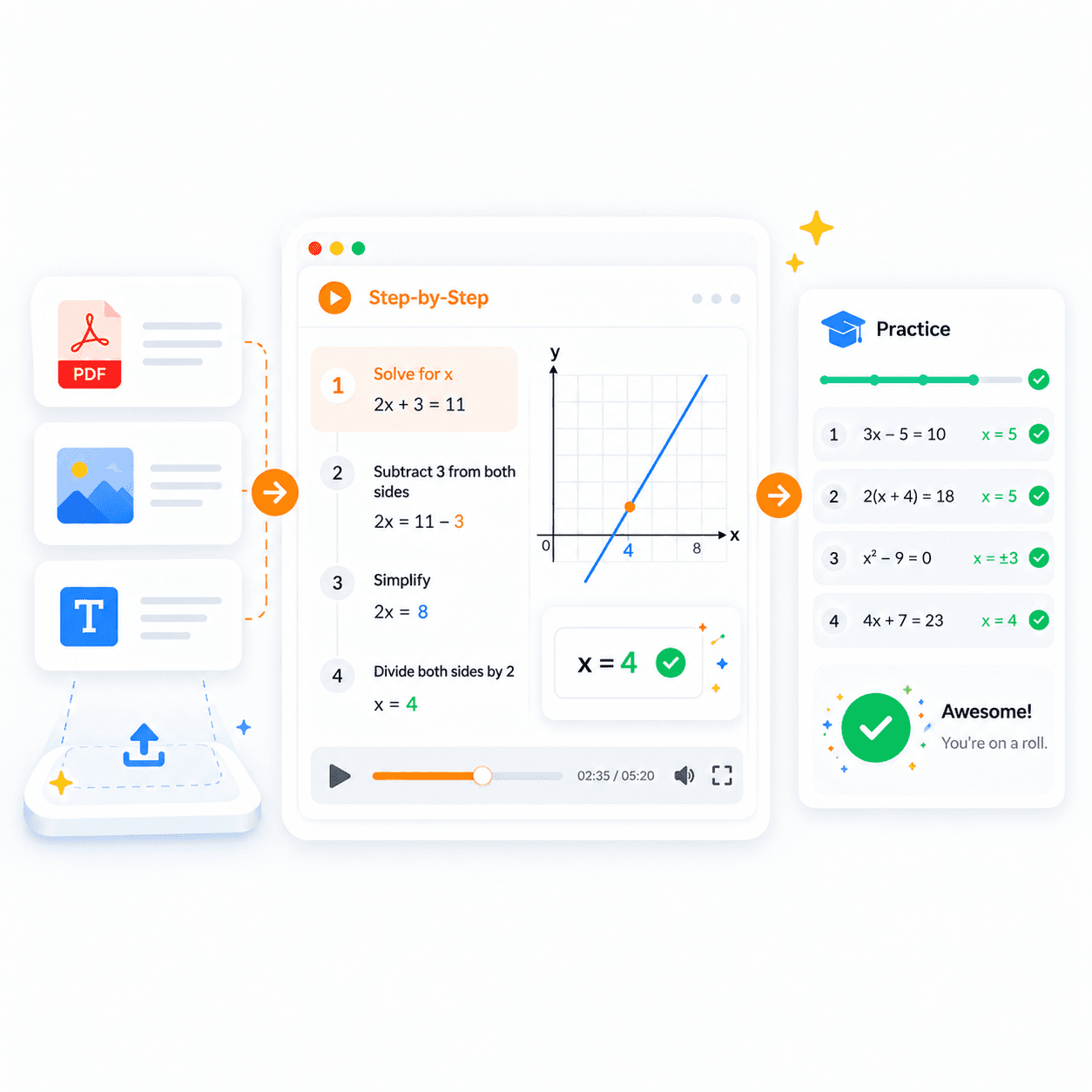
This function inverse calculator lets you type a function directly or upload a JPG, PNG, WEBP image, or PDF of the problem. It provides an inverse function result with steps that show how variables are interchanged and how the new equation is solved. You can also use video explanations and similar practice problems to reinforce the rules behind inverse functions.
Why Use This Online Inverse Function Calculator?

Work from the problem you already have
Type a function, upload worksheet images or PDFs. No need to retype complex math notation manually.
See how the inverse is built
Follow variable swapping, equation rearrangement and key domain restrictions step by step.
Avoid common inverse-function errors
Distinguish f^-1(x) from reciprocals, confirm one-to-one functions and test results via composition.
Strengthen related skills
Learn with video guides and practice problems for functions, inverse trig and calculus topics.
How to Calculate Inverse Function Online?
Step 1
Upload or enter your function
Type the function directly, or upload an image or PDF containing the problem.
Step 2
Get a step-by-step explanation
Review how the variables are interchanged and how the inverse expression is found.
Step 3
Use additional learning tools
Watch a video explanation and practice similar inverse function questions.

Is This Inverse Functions Calculator Good?
This inverse of function calculator can help you compare your own method with a clear solution, especially when isolating a variable or applying a domain restriction becomes difficult.
Try to find the inverse yourself first, then use the steps to check your reasoning. This supports algebra, precalculus, trigonometry, and derivative practice without relying only on a final answer.
Discover Free Tools to Take Your Math Learning Further
Do You Have Questions?
We have answers & AI tool resources for you.
Can an Inverse Function Table Calculator Find an Inverse From a Table?
Yes. To find an inverse from a table, switch every input-output pair. If the original table contains (a, b), the inverse table contains (b, a). Each output must appear only once in the original table for the inverse to be a function.
Can I Use an Inverse Trig Functions Calculator?
Yes. An inverse trigonometric functions calculator can help with functions such as arcsin(x), arccos(x), and arctan(x). Remember that inverse trig functions use restricted domains so that each output corresponds to one input.
What Are the 7 Types of Functions?
There is no single universal list of exactly seven function types. Common categories include linear, quadratic, cubic, rational, exponential, logarithmic, and trigonometric functions. Some of these can have inverses directly, while others need a domain restriction.
Can Every Function Have an Inverse?
No. A function must be one-to-one to have an inverse function over its domain. If different inputs produce the same output, restrict the domain first or the inverse will not be a function.
What Grade Are Inverse Functions Taught?
Inverse functions are commonly introduced in Algebra 2 or precalculus, although the exact grade depends on the school curriculum. Inverse functions and their derivatives are usually studied later in calculus.
What Is the Difference Between Inverse Functions and Derivatives?
An inverse function reverses a function’s input and output. If f(x) takes an input to an output, f^-1(x) returns that output back to the original input. A derivative calculates a function’s instantaneous rate of change. Though connected in calculus, they serve different purposes: one undoes the function mapping, and the other measures how fast the function changes.
Find Inverse Functions and Understand Every Step
Calculate inverse functions, check domain restrictions, and build confidence with Tenorshare AI Math.
