
AI Math Solver That Can Read Graphs: 5 Best Tools Reviewed
Graphs are one of the most challenging parts of many math problems because they require more than just calculation. Students often need to understand curves, coordinate points, trends, labels, and relationships between variables before solving a question.
Traditional math solvers usually work best when users manually enter equations or numbers. However, AI math solvers with image recognition can now analyze screenshots, photos, and graph-based questions, helping users understand and solve problems more efficiently. Many AI math tools now support image uploads and provide step-by-step explanations instead of only showing final answers.
In this guide, we review five AI math solvers that can read graphs and help with different types of math problems. We compare their features, strengths, and ideal use cases to help you choose the right AI graph reader.
Best AI Graph Readers at a Glance
| AI Math Solver | Best For | Main Advantage |
|---|---|---|
| Tenorshare AI Math | Overall AI math learning | Complete workflow from solving to understanding |
| Solvely AI | Homework help | Fast image-based solutions |
| Mathos AI | Learning math concepts | AI tutoring and practice features |
| ThetaWise AI | Interactive tutoring | Conversation-based learning |
| Gauth AI Math | Quick answers | Fast problem solving |
All five AI math solvers on this list support image-based math solving, allowing users to upload photos, screenshots, or other visual inputs instead of manually typing complex equations and problems.
However, the difference between these tools is not only whether they can read graphs or images. Each product is designed with a different focus. Some prioritize fast homework solutions, some provide more detailed step-by-step explanations, while others focus on AI tutoring and helping students understand mathematical concepts.
Therefore, the best AI math solver that can read graphs depends on your specific needs.
5 Best AI Math Solvers That Can Read Graphs
Tenorshare AI Math
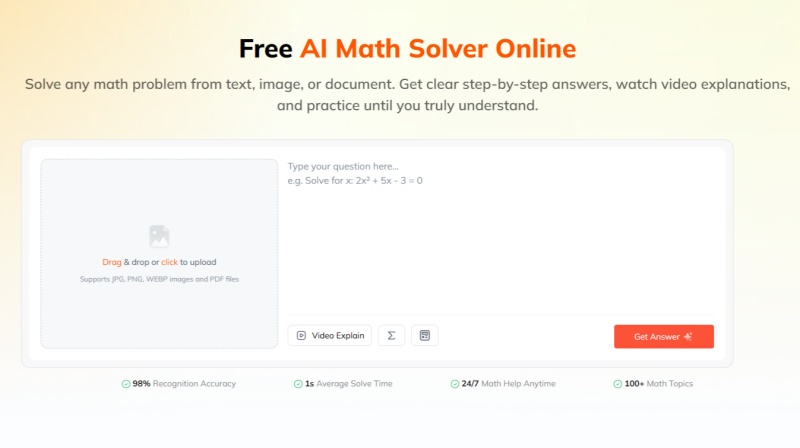
Tenorshare AI Math is designed for students who want a more complete workflow from uploading a math problem to understanding the solution. Instead of manually entering equations or describing graph information, users can upload images, screenshots, or documents and let AI analyze the problem.
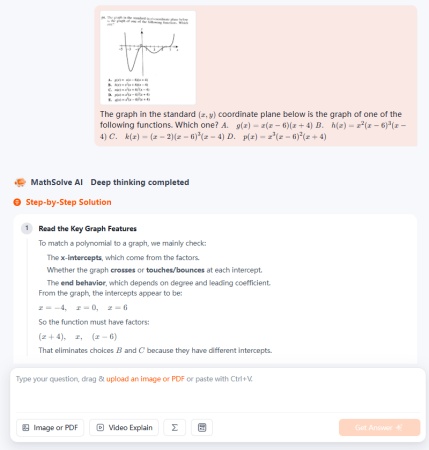
Compared with simple AI answer generators, Tenorshare AI Math focuses more on helping users understand how a solution is reached. After recognizing the uploaded problem, it provides step-by-step explanations and helps users follow the logic behind each calculation.
For graph-related questions, this approach is useful because many problems require users to understand visual information first, such as identifying points, relationships, or trends before applying formulas.
Key Features
-
Supports text, image, and PDF inputs, allowing users to solve math problems from different formats.
-
Provides step-by-step solutions that explain the solving process instead of only showing final answers.
-
Generates video explanations with visual guidance to help users understand difficult concepts.
-
Creates similar practice questions after solving problems to reinforce learning.
- More complete learning workflow beyond solving one question
- Suitable for students who frequently use screenshots or photos
- Explanations make complex solutions easier to follow
- Users looking only for instant answers may find the learning-focused approach more detailed than necessary
Best for: Students who want an AI math solver that combines graph reading, problem solving, and learning support.
Solvely AI Math Solver
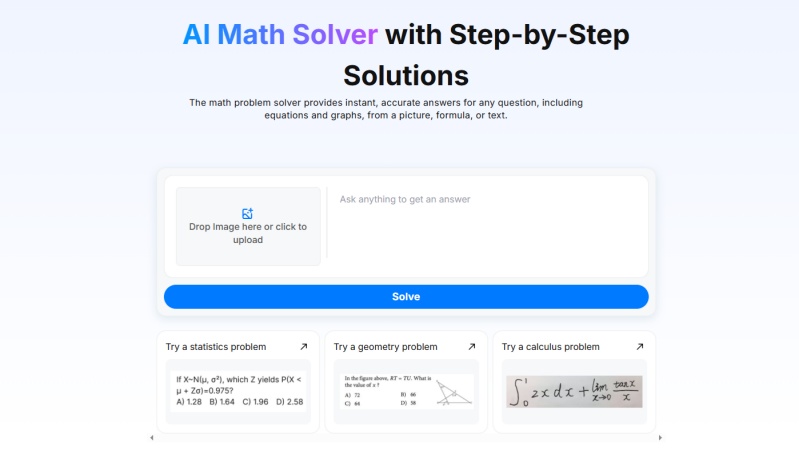
Solvely AI focuses on helping students solve homework problems through image recognition and AI-generated explanations. Users can upload photos, screenshots, or text questions and receive solutions without manually typing complicated formulas.
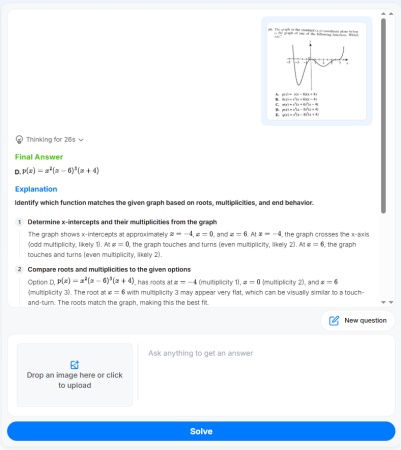
Its main advantage is convenience . For students dealing with many homework questions, especially problems from textbooks or worksheets, the ability to quickly scan and solve questions can save significant time.
For graph-based math problems, Solvely can help interpret uploaded images and provide explanations. However, its main positioning is broader homework assistance rather than being a specialized graph analysis tool.
Key Features
-
Photo-based math problem solving
-
Step-by-step solution generation
-
Supports multiple math subjects
-
Includes additional study features such as notes and quizzes
- Easy workflow for homework questions
- Good support for image-based input
- Suitable for students who need fast assistance
- Learning features may not be as focused on deep mathematical tutoring compared with dedicated AI tutor tools
Best for: Students who need a convenient AI homework helper for everyday math questions.
Mathos AI
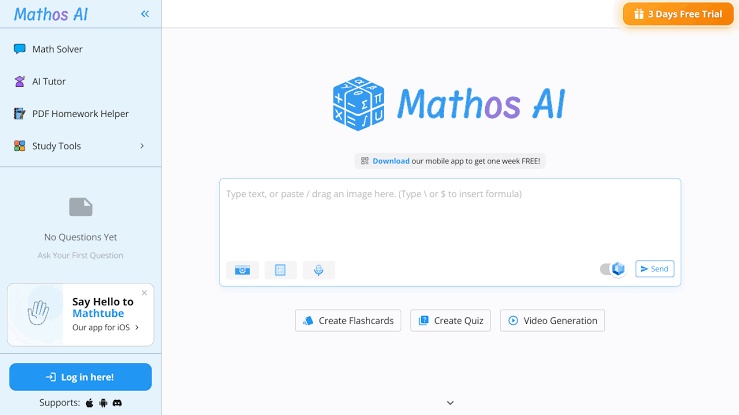
Mathos AI positions itself as more than a traditional math solver. Instead of only answering questions, it combines AI solving features with tutoring and learning tools designed to help students improve their understanding.
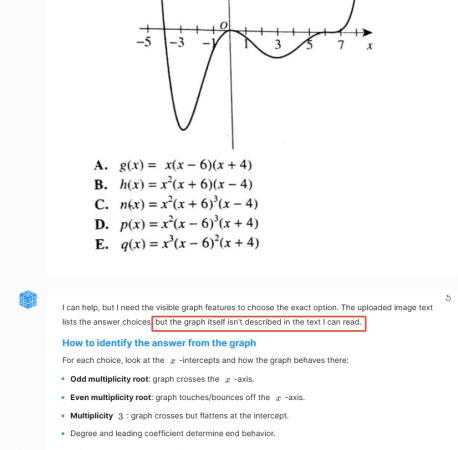
Users can submit problems through different input methods, including images, and receive explanations. Beyond solving individual questions, Mathos AI also provides learning features that help students review concepts and continue practicing.
For graph-related problems, Mathos AI can handle common math questions and provide explanations based on mathematical concepts.
However, when working with screenshots that require detailed visual interpretation, such as identifying specific graph features, reading small labels, or matching graph details with answer choices, the image analysis results may vary depending on image clarity and complexity.
Key Features
-
AI math solver with step-by-step explanations
-
Multiple input methods including images
-
AI tutoring features
-
Learning resources and practice support
- Strong focus on learning rather than answer generation
- Suitable for students who want continuous improvement
- Combines solving and tutoring functions
- The image analysis experience may be less consistent when solving graph problems that require precise visual understanding from complex or unclear screenshots.
Best for: Students who want an AI math tutor with learning support rather than only a graph-solving tool.
ThetaWise AI
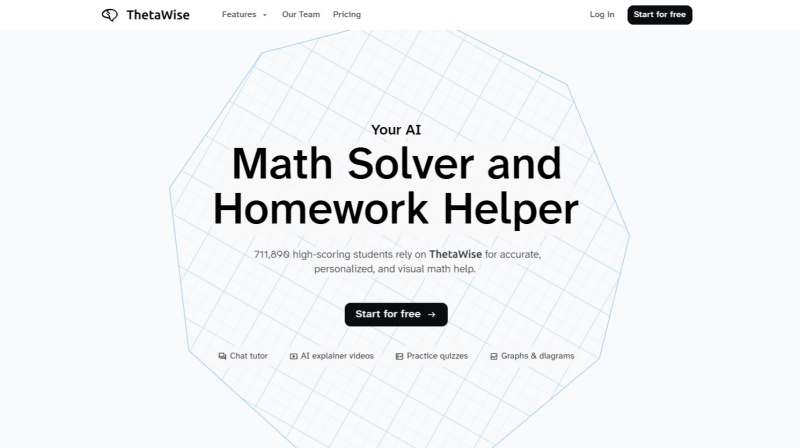
ThetaWise AI focuses on creating a tutoring-style math experience. It combines an AI math solver with interactive learning features, allowing users to ask follow-up questions and receive explanations based on their understanding level.
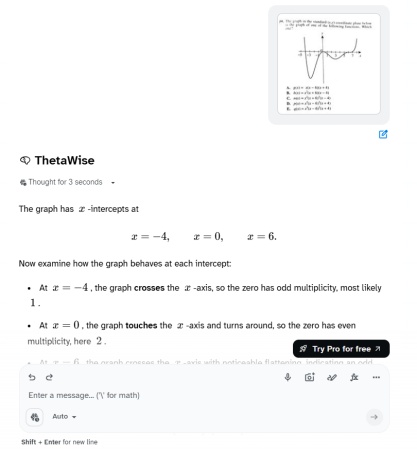
Unlike tools designed mainly for quick answers, ThetaWise emphasizes conversation and guided learning. This can be helpful for graph problems where students need help understanding concepts such as functions, curves, and relationships between variables.
Key Features
-
AI math solver with image and document input
-
Interactive tutor mode
-
Step-by-step explanations
-
Additional learning features such as practice and lessons
- More interactive than traditional math solvers
- Good for users who need explanations and follow-up questions
- Suitable for deeper math learning
- More features may create a slightly more complex user experience
Best for: Students who prefer learning through AI tutoring conversations.
Gauth AI Math
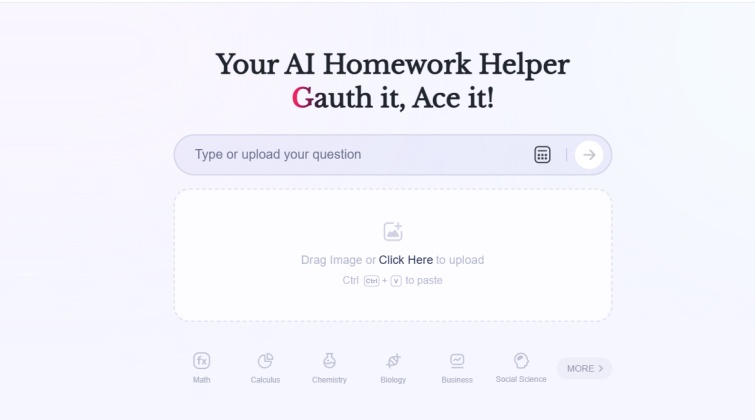
Gauth AI Math focuses on speed and accessibility. Users can upload math questions through images and receive AI-generated solutions and explanations.
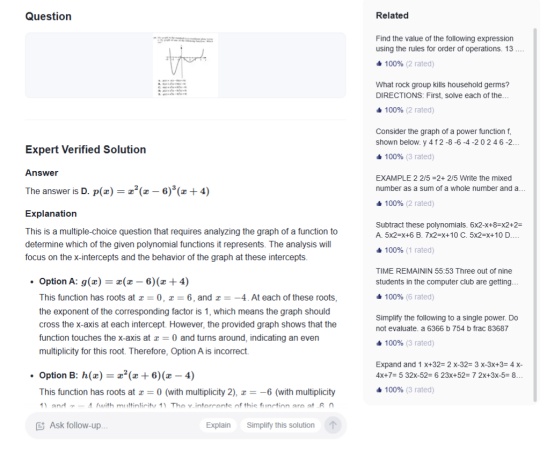
Compared with learning-focused platforms, Gauth is more suitable for students who want quick help when they encounter difficult homework problems.
For graph-related questions, it can help analyze uploaded images and provide solutions, making it a practical choice for everyday math assistance.
Key Features
-
Image-based math solving
-
Quick AI-generated answers
-
Supports various math subjects
-
Mobile-friendly workflow
- Fast and convenient
- Simple process for solving homework questions
- Suitable for quick checks
- Less focused on building a complete learning system
Best for: Students who mainly need quick answers and homework support.
How to Choose the Best AI Graph Reader for Math Problems
Not every AI math solver provides the same experience. When choosing an AI graph reader, consider the following factors.
Graph Recognition Ability
The most important feature is whether the AI can understand visual information from graphs.
A useful AI graph reader should be able to identify:
-
Coordinate axes
-
Labels and values
-
Curves and lines
-
Important points
-
Trends and relationships
The ability to read a graph image is different from simply solving a typed equation. A good tool should understand both the visual information and the mathematical meaning behind it.
Solution Explanation Quality
A good AI math solver should not only provide an answer but also explain how it reached that result.
For students, step-by-step explanations are often more valuable than a final answer because they help users understand:
-
Which formula was used
-
Why a method works
-
How to solve similar problems independently
Many users specifically look for AI tools that explain the process rather than only outputting answers.
Supported Math Topics
Different AI math solvers may perform better in different areas.
Before choosing a tool, check whether it supports:
-
Algebra
-
Calculus
-
Geometry
-
Statistics
-
Graph analysis
A general AI math solver may handle common graph questions, but advanced topics may require a more specialized tool.
Can AI Read and Solve Different Types of Math Graphs?
AI math solvers can analyze many graph-based problems by combining image recognition and mathematical reasoning. When the image is clear, most tools can identify basic elements such as axes, labels, curves, and data points. However, understanding a graph requires more than visual recognition --- the AI also needs to interpret the mathematical meaning behind those elements.
For simple graphs like linear functions, AI can often identify key information and explain the solving process. More complex graphs, such as polynomial functions or statistical charts, may require deeper reasoning, and results can vary depending on image quality and problem complexity. Current AI systems still face challenges in combining visual understanding with multi-step mathematical reasoning.
When choosing an AI graph reader, users should consider not only whether it can read graph images but also whether it can provide clear explanations and support the learning process.
Final Verdict
The best AI Math Solver That Can Read Graphs depends on what you need from an AI math tool. While most modern AI math solvers support image input and can analyze graph-based questions, their main differences come from solution explanations, learning features, and overall user experience.
Tenorshare AI Math is a strong choice for users who want an all-around image-based math solver with detailed explanations, while Solvely AI, Mathos AI, ThetaWise AI, and Gauth AI Math each focus on different use cases, from homework assistance to AI tutoring and quick problem solving.
When choosing an AI graph reader, consider whether you need fast answers or a tool that helps you better understand the solving process. The right AI math solver should not only read graphs but also help you learn from each solution.

Tenorshare AI Math
- Solve math from text, images & PDFs at 98% accuracy
- Deliver step-by-step answers with detailed logic breakdown
- Access video explanations for deeper math concept understanding
- Generate matching practice tests to solidify knowledge

FAQ
-
Can AI Read Graphs?
Yes. Modern AI tools can read many types of graph images, including coordinate graphs, function graphs, and statistical charts. They use image recognition and mathematical reasoning to understand visual information and provide explanations. However, the accuracy depends on factors such as image quality, graph complexity, and the AI model being used.
-
What AI Can Read and Solve Math Graphs?
Several AI math solvers can analyze graph-based math problems, includingTenorshare AI Math, Solvely AI, Mathos AI, ThetaWise AI, and Gauth AI Math. General AI assistants such as ChatGPT can also analyze graph images when image input is available.
-
Can ChatGPT Read Graphs and Solve Math Problems?
Yes. ChatGPT can analyze uploaded images containing graphs and help explain mathematical concepts. It can assist with interpreting trends, identifying graph features, and solving related questions. However, dedicated AI math solvers may provide more specialized workflows for homework-style problems.
-
Can AI Read Handwritten Math Graphs?
Many AI math solvers can recognize handwritten math problems and graph images, but results depend on handwriting clarity. Clear images with readable labels and numbers usually produce better results than blurry or incomplete photos.
-
What Is the Best AI Graph Reader?
The best AI graph reader depends on your goal. For quick image-based math solving, an AI math solver with strong photo input support is usually the most convenient choice. For students who want deeper explanations, tools with AI tutoring features may be more suitable. When selecting a tool, consider graph recognition, solution quality, supported topics, and learning features rather than only the ability to generate an answer.
You Might Also Like
- Tenorshare AI Math Review 2026: Is It a Good AI Math Solver?
- Monica AI Math Solver Review 2026: Can It Really Help With Math?
- Julius AI Math Solver Review: How Does It Compare in 2026?
- AskMath AI Math Solver Review 2026: A Complete Guide for Students
- EduBrain AI Math Solver Review: Is It a Reliable AI Homework Helper?
- EaseMate AI Math Solver Review: Features, Alternatives & How It Compares

Tenorshare AI Math: Solve any math problems with AI
Turn math questions into clear solutions, tutorial videos & targeted practice setsTenorshare AI Math: Instant Solutions
Steps, videos & practice for every problem
Tenorshare AI Math: Solve any math problems with AI