
5 Best AI Tools for Advanced Math Proofs & Proof-Based Math (2026)
Proof-based math demands strict logical reasoning, step-by-step derivation, and clear comprehension of abstract theorems. Students, competition participants, and research mathematicians all search for the best AI for advanced math proofs to streamline homework, competition training, and formal research work. There are dozens of available options, ranging from professional symbolic computation engines and advanced reasoning LLMs to lightweight free ai math solver platforms for entry-level learning.
This 2026 guide objectively breaks down the full workflow of mastering math proofs, reviews top industry AI tools, and also recommends a AI math helper that can help you deepen mathematical understanding, organize proof logic, and build the reasoning skills needed to study math proofs more effectively.
Key Steps to Master Math Proofs
Learning and completing solid math proofs follows a fixed, repeatable workflow, and each stage relies on specific functional support from AI tools.
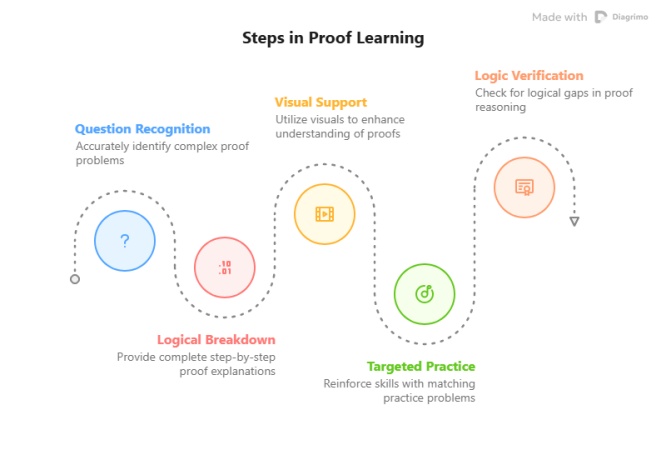
The first critical step is accurate question recognition. Many proof problems contain complex formulas, handwritten geometry graphs, or multi-paragraph text descriptions. Tools that support scanning images, PDFs, and typed text can avoid misinterpretation that breaks the entire proof logic. This foundational scanning feature removes manual transcription errors and speeds up access to solution breakdowns.
Second, users need complete step-by-step logical breakdowns. Raw final answers cannot help learners grasp proof construction. Effective AI should label every deduction rule, theorem reference, and transformation method within each stage of the proof , so users can track how each conclusion connects to prior statements.
Third, abstract proof logic requires visual support for full understanding. Text-only explanations often fail to clarify dynamic concepts like geometric auxiliary lines, epsilon-delta limit convergence, or matrix transformation paths. Visual walkthroughs and animated demonstrations turn dense theoretical reasoning into intuitive content, lowering barriers for new learners who struggle to follow written proof chains. Tools with dedicated video explanation features deliver this visual learning advantage that standard text solvers lack.
Fourth, targeted practice reinforces proof-writing skills. After understanding a sample proof, learners need matching practice problems to test their ability to replicate reasoning independently. AI that generates customized similar proof questions closes the learning loop, helping users turn passive reading into active mastery.
The final essential step is logic verification. Even advanced learners make subtle logical gaps in long proofs. Reliable AI tools can cross-check reasoning chains, flag invalid deductions, and confirm whether a constructed proof meets rigorous mathematical standards, serving as a quick self-review resource.
Best AI Tools for Advanced Math Proofs
This section covers five leading professional AI platforms built to generate, derive, and check advanced math proofs, separated by core strengths and target use cases.
Wolfram Alpha
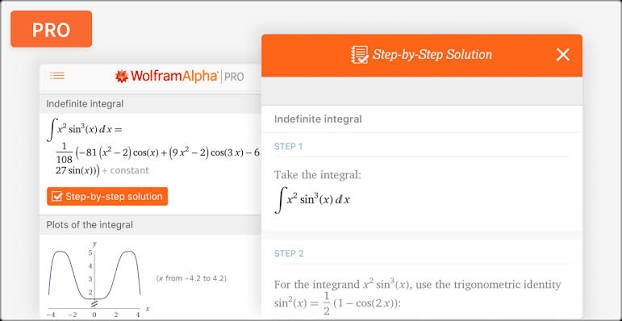
Wolfram Alpha is best suited for students who need reliable symbolic derivations in undergraduate-level advanced math. It is especially useful for calculus, linear algebra, differential equations, limits, integrals, and series-based proofs.
Unlike predictive AI chatbots, Wolfram Alpha runs mathematical algorithms rather than generating answers from language patterns. This makes it a strong choice when accuracy and symbolic consistency matter more than open-ended proof discussion.
Best for:
-
Standard college proof homework
-
Calculus and linear algebra derivations
-
Step-by-step symbolic transformations
-
Visualizing functions, limits, and convergence behavior
Its Pro tier provides fuller step-by-step breakdowns, showing algebraic manipulation, limit evaluation, integral derivation, and related theorem support. It can also generate static function plots, which helps when explaining epsilon-delta arguments or series convergence.
However, Wolfram Alpha is less effective when users need a conversational proof strategy from scratch.
Gemini Deep Think
Gemini Deep Think is better positioned for olympiad-style and competition-level math proofs. It is strongest when a problem requires long-chain reasoning, auxiliary constructions, contradiction arguments, or multi-case proof structures.
| Strength | How It Helps in Math Proofs |
|---|---|
| Long-chain reasoning | Builds full proof frameworks before filling in details |
| Auxiliary lemma creation | Introduces supporting claims when direct proof is difficult |
| Competition-style logic | Handles combinatorics, geometry, and number theory problems well |
| Structured proof output | Presents complex deductions in a clearer sequence |
Its biggest advantage is autonomous reasoning. For difficult advanced math proofs, Gemini Deep Think can often propose a proof direction, identify useful intermediate steps, and organize the argument before writing the final solution.
It can also support graduate-level workflows when paired with formal verification tools, but users usually need to manually convert its natural language output into Lean or Coq format.
Compared with symbolic tools like Wolfram Alpha, it is less efficient for routine undergraduate homework. Access to its strongest reasoning mode may also depend on a paid plan.
GPT-5
GPT-5 is one of the strongest options for writing readable, student-friendly math proofs. It is especially useful when the goal is not only to get the answer, but to present the proof in a clear academic style.
For proof-based assignments, GPT-5 performs well in tasks such as:
-
Rewriting messy draft proofs into coherent final versions
-
Explaining why each proof step is needed
-
Structuring induction, existence, uniqueness, and contradiction proofs
-
Identifying weak or incomplete reasoning in a user's draft
-
Answering follow-up questions about specific proof gaps
Its main value is narrative clarity. Instead of only listing symbolic transformations, GPT-5 can explain the motivation behind the proof, connect each deduction naturally, and produce a more submission-ready structure.
The limitation is that GPT-5 is still not a formal verification engine. On highly specialized graduate-level theorems, it may occasionally introduce subtle inaccuracies or unsupported claims.
Maple
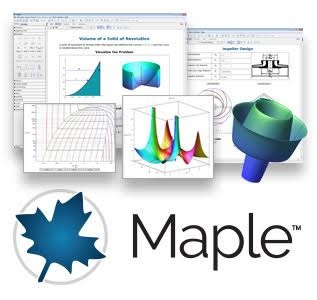
Maple is a professional symbolic mathematics platform built for more advanced computational proof work. It is especially useful for graduate-level users working with abstract algebra, Riemannian geometry, partial differential equations, or long symbolic derivations.
Its strength lies in handling complex symbolic structures while preserving assumptions and parameters across multiple steps. Users can test conjectures, adjust variable constraints, and refine derivations through Maple's built-in assumption logic.
Maple also includes interactive visualization tools and step-by-step assistants that can flag invalid simplifications. This makes it useful for researchers who need computational support before converting results into a formal paper or proof document.
The main downsides are cost, installation, and difficulty. Maple has a higher licensing price, requires desktop setup, and comes with a steeper learning curve. It is too advanced for most K12 or entry-level college proof practice and lacks the instant accessibility of web-based AI math solvers.
LeanDojo
LeanDojo is designed for users who need formal, machine-checkable math proofs rather than ordinary natural language explanations. It is mainly suitable for PhD students, pure mathematics researchers, and users already working with the Lean4 theorem prover.
LeanDojo connects large language models with Lean4, helping translate proof ideas into executable Lean tactic code. Unlike standard AI writing tools, a proof step is not accepted simply because it sounds correct. It must pass Lean's formal logic checks.
Best for advanced proof verification:
-
Formal theorem proving
-
Lean4 proof development
-
Research-level proof automation
-
Machine-checkable mathematical logic
-
Reducing hallucination risk in proof generation
LeanDojo also includes benchmark datasets of formalized theorems, allowing it to retrieve relevant lemmas during proof construction. This can speed up research workflows where users need verified mathematical arguments rather than informal proof drafts.
However, LeanDojo is not a beginner-friendly math solver. It requires coding knowledge, familiarity with formal proof assistants, and a clear understanding of theorem-proving workflows. For routine undergraduate homework, olympiad preparation, or general math learning, it is far too specialized.
To Improve Math Proof Skills, Try Tenorshare AI Math
AI tools can help students explore complex mathematical concepts, but they cannot completely replace the reasoning process required for advanced math proofs. A strong proof requires understanding definitions, connecting theorems, checking each logical step, and identifying whether an argument is valid.
Instead of relying on AI to generate a complete solution, students can use AI as a learning assistant to improve their mathematical thinking. Reviewing step-by-step explanations, visualizing abstract concepts, and practicing similar problems can help build a stronger foundation for proof-based math.
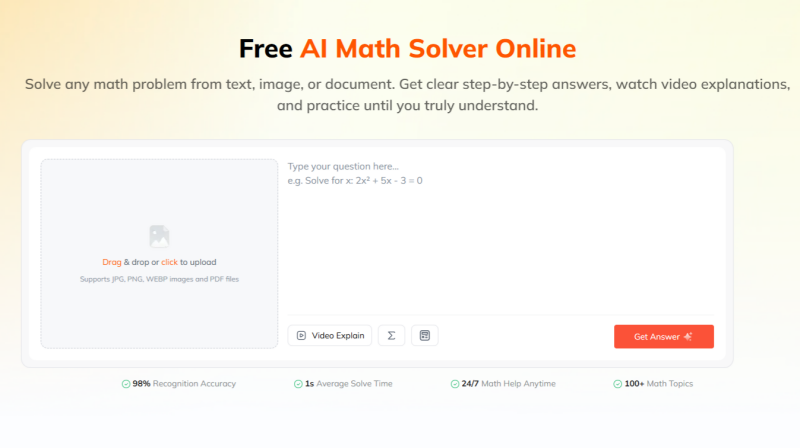
For students who want to strengthen their math understanding before tackling more advanced proofs, Tenorshare AI Math provides a structured learning workflow that combines problem solving, explanations, and practice features.
- Step-by-Step Explanations: Break down solutions into clear steps, helping students understand how each calculation connects to the final answer.
- Visual Video Explanations: Turn solutions into easier-to-understand lessons with visual explanations, making abstract concepts more accessible.
- Personalized Practice: Generate similar problems after solving to help students reinforce concepts and improve problem-solving skills.
By using AI as a guide rather than simply copying generated answers, students can gradually improve their ability to analyze problems, follow mathematical logic, and develop stronger reasoning skills.
Conclusion
Choosing the right tool depends on your proof difficulty level and learning goals. Different AI solutions serve different purposes, from symbolic computation and advanced reasoning to formal verification. However, AI should be used as a learning assistant rather than a replacement for mathematical thinking, as understanding concepts and evaluating logical steps remain essential for mastering proofs.
Ultimately, there is no single best AI for advanced math proofs. Wolfram Alpha, Gemini Deep Think, GPT-5, Maple, and LeanDojo each support different stages of mathematical reasoning. For students who want to strengthen their math foundation through clearer explanations, visual learning, and practice, Tenorshare AI Math provides a structured workflow to improve problem-solving and logical thinking skills.

Tenorshare AI Math
- Solve math from text, images & PDFs at 98% accuracy
- Deliver step-by-step answers with detailed logic breakdown
- Access video explanations for deeper math concept understanding
- Generate matching practice tests to solidify knowledge

FAQs
-
Which Is the Best AI Tool for Math Proofs for Undergraduate Students?
Wolfram Alpha is the best choice for standard undergraduate proof work, especially calculus, linear algebra, and entry-level real analysis. Its symbolic engine gives reliable derivations.
-
What's the Best AI Model for Math Proofs for Competition Math?
Gemini Deep Think is the strongest option for olympiad and competition-level math proofs. It performs well on complex combinatorics, number theory, and geometry problems, and can build multi-step proof strategies with limited prompting.
-
Can I Use AI for Proof-Based Math Homework Effectively?
Yes. Use AI to understand proof structure, verify steps, and review confusing logic, but do not copy answers directly. Rewriting the proof in your own words helps you retain reasoning skills and avoid hidden errors.
-
What's the Best AI for Writing Math Proofs?
GPT-5 is best for writing clear, readable math proofs. It can organize induction, contradiction, and constructive proofs into a formal academic style, but symbolic steps should still be checked with tools like Wolfram Alpha.
You Might Also Like
- Best AI Math Solvers 2026: Honest Comparison for All Math Problems
- 10 Best Math Homework Help Tools in 2026: AI Solvers for Step-by-Step Answers
- AskMath AI Math Solver Review 2026: A Complete Guide for Students
- EduBrain AI Math Solver Review: Is It a Reliable AI Homework Helper?
- Gauth AI Math Review 2026: Is It Worth Using for Homework Help?
- Is ThetaWise AI Worth It in 2026? Honest Review, Features & Pricing

Tenorshare AI Math: Solve any math problems with AI
Turn math questions into clear solutions, tutorial videos & targeted practice setsTenorshare AI Math: Instant Solutions
Steps, videos & practice for every problem
Tenorshare AI Math: Solve any math problems with AI