
Is Claude Better at Math Than ChatGPT? Honest 2026 Review
Claude and ChatGPT can both solve a wide range of math problems, from routine algebra to advanced mathematical reasoning. However, their accuracy depends on the model version, the complexity of the problem, and whether tools such as code execution are available.
So, is Claude better at math than ChatGPT ? The latest benchmark results do not point to one universal winner. Some tests favor specific Claude models, while others put OpenAI's models ahead. The more useful question is which model performs best for the type of math you need to solve.
This guide compares published benchmark results, reasoning and explanation quality, common limitations, and practical use cases to help you choose between Claude and ChatGPT.
Catalogs:
Claude vs ChatGPT for Math: A Quick Comparison
ChatGPT is a practical starting point for users who want to solve a wide range of math problems, while Claude is worth trying when you need to explore a solution or understand a multi-step explanation.
Neither tool is consistently better across every type of math, and the specific model you choose can matter more than the product name.
| Your priority | Which to try first | Why |
|---|---|---|
| Quick calculations and routine algebra | ChatGPT | A convenient starting point for everyday math questions, with options to check calculations using available tools. |
| Understanding a solution step by step | Either; compare the explanations | Both can explain their reasoning. Choose the one that makes each step easier for you to follow and verify. |
| Calculus and multi-step equations | Try both on a representative problem | These tasks can expose different reasoning errors. Compare the intermediate steps, not just the final answer. |
| Advanced or competition-level math | ChatGPT first, then cross-check with Claude | Some recent FrontierMath evaluations favor the tested GPT models, although other benchmarks produce different rankings. |
| Reviewing your own working | Either, with your solution included | Ask the model to identify the first incorrect step and explain why it is wrong. |
| Checking a high-stakes or research calculation | Neither as the sole source of verification | Confirm the result with a symbolic solver, numerical computation, or a formal proof method where appropriate. |
For everyday calculations, algebra, and general math questions, ChatGPT is a sensible starting point.
For step-by-step explanations, try both Claude and ChatGPT and choose the one whose reasoning is easier to follow and verify.
If you're tackling advanced calculus, proofs, or other demanding problems, compare their solutions on the same question rather than assuming either tool will be more accurate.
Before paying for a subscription, test both tools on a routine problem, a multi-step problem, and a question with a known answer. Compare not only correctness but also explanation quality and usage limits.
ChatGPT vs. Claude for Math: Latest Math Benchmark Results
To compare Claude and ChatGPT more objectively, it helps to look at published math benchmark results. The rankings vary across tests, however, so the key is to examine which models were tested, what types of problems they faced, and how their results compare.
FrontierMath: Performance on Advanced Mathematical Problems
Epoch AI's FrontierMath Tiers 1--3 benchmark evaluates models on expert-written mathematics problems spanning advanced undergraduate work through early-career research. Its October 15, 2026 update provides a useful comparison of newer reasoning models.
| Model | Reported accuracy |
|---|---|
| GPT-6.1 Sol (max) | 93.7% ± 1.4 |
| GPT-6 Astra (max) | 93.7% ± 1.4 |
| Claude Opus 5.5 (max) | 91.2% ± 1.7 |
| Claude Fable 5.1 (max) | 90.2% ± 1.8 |
| GPT-6 Sol (max) | 89.8% ± 1.8 |
| Claude Sonnet 5.5 (max) | 88.8% ± 1.9 |
Source: Epoch AI, FrontierMath Tiers 1--3 v2. Scores and uncertainty ranges are reproduced from the published leaderboard.
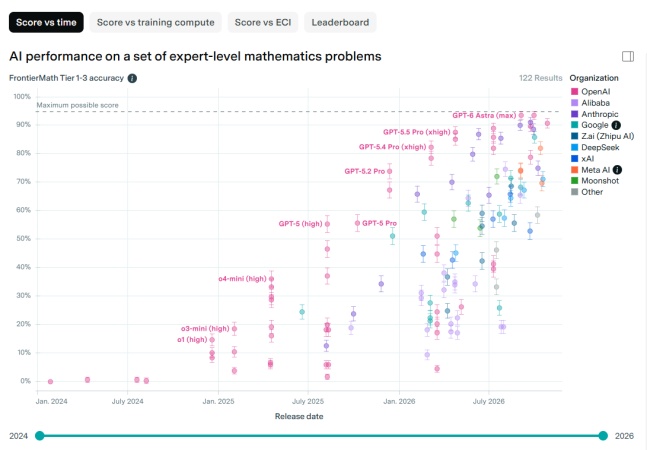
In this evaluation, GPT-6.1 Sol and GPT-6 Astra recorded higher scores than the listed Claude models. However, the results do not establish that every ChatGPT model is better at math than every Claude model. The comparison concerns specific model versions under particular evaluation settings, and the reported uncertainty ranges should also be considered.
FrontierMath is particularly relevant to advanced mathematical reasoning. It is less representative of everyday questions such as calculating percentages, solving a basic equation, or explaining a high-school formula.
FrontierMath Tier 4: A More Difficult Research-Level Test
A separate FrontierMath Tier 4 comparison published by OpenAI reports results for a more difficult set of research-level mathematical problems. In the published table, GPT-6 Astra scored 97.6% , compared with 87.8% for Claude Fable 5.1 and 73.2% for Claude Opus 5 .
These figures suggest that the tested GPT-6 Astra configuration performed strongly on this particular evaluation. They should still be interpreted in context: the results are reported by OpenAI, the models and settings are specific, and a benchmark score does not guarantee that the same ranking will hold for other mathematical tasks.
For readers comparing Claude and ChatGPT, the key takeaway is that model-level differences can be substantial. It is more useful to compare named models on the same benchmark than to make a blanket judgment about either product.
MATH-500: A Standardized Mathematical Reasoning Benchmark
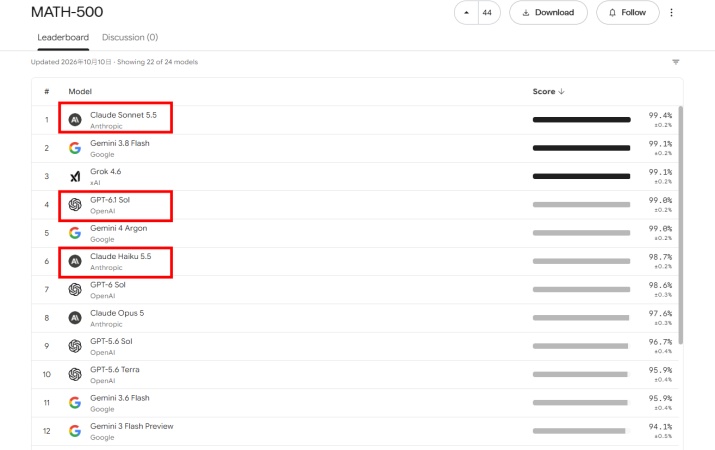
The MATH-500 leaderboard , last updated on October 10, 2026, reports 99.4% for Claude Sonnet 5.5 , 98.7% for Claude Haiku , and 99% for GPT-6.1 Sol .
This result provides an important counterpoint to the FrontierMath comparisons: Claude Sonnet 5.5 leads the listed models on this version of MATH-500, while the FrontierMath results favor the listed GPT-6 models. The rankings differ because benchmarks measure different problem sets and may distinguish models differently.
MATH-500 is useful for comparing mathematical problem-solving on a defined collection of questions, but scores near the top of a benchmark can make small differences difficult to interpret. A higher score on one dataset does not automatically mean a model will be more accurate on a student's particular homework or research problem.
A Small Direct Test: Useful Examples, Limited Evidence
The independent LLMWise Claude vs. ChatGPT math comparison , updated in October 2026, reports results from five math prompts tested across multiple Claude and GPT models. In that small sample, the tested Claude models passed all 30 reported runs, while the tested GPT models passed 19 of 20.
The authors also report that several models from both families answered all five prompts correctly. This makes the test useful for examining individual responses, but the sample is too small to establish a general winner. A handful of prompts cannot represent all levels of mathematics, and the results may depend on the prompts, model versions, and test setup.
What Do These Benchmarks Actually Tell Us?
The published results do not support a universal claim that Claude is better at math than ChatGPT , or the reverse. They show that performance depends on the model and the benchmark:
-
On the cited FrontierMath Tiers 1--3 and Tier 4 results, the listed GPT models score higher than the listed Claude models .
-
On the cited MATH-500 leaderboard, Claude Sonnet 5.5 ranks above GPT-5.6 Sol .
-
In a small five-prompt comparison, multiple models from both families perform well , but the sample is not large enough to establish broad superiority.
There are also differences in how results are produced. Some evaluations use extended reasoning settings, and others may involve tools or multiple attempts. Scores from different benchmarks should not be compared as if they came from one standardized exam.
For a fair comparison, look for the exact model names, the benchmark and version, the evaluation date, whether tools were allowed, and the number of attempts. These details help explain why two credible sources may reach different conclusions.
Should You Use Claude or ChatGPT for Math?
The benchmark results show that neither Claude nor ChatGPT consistently outperforms the other across every math test . Some GPT models lead on certain advanced-math benchmarks, while Claude models perform better on others. For everyday use, this means you should choose based on the type of problem you need to solve , rather than assuming one AI is always better at math.
For Homework and Learning Math
ChatGPT is a good starting point for beginners, younger students, and anyone who wants guided help with homework.
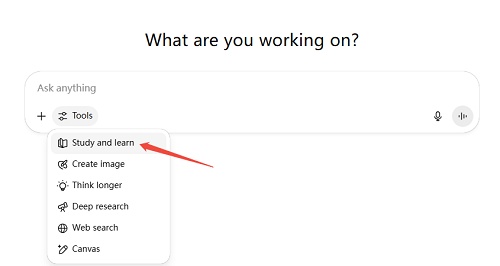
Its Study Mode can break problems into smaller steps, ask questions instead of immediately revealing the answer, and adjust explanations to the learner's level. It also supports uploaded worksheets and images when those features are available. These features make it easier to use ChatGPT as a learning aid rather than just an answer generator.
Claude is worth trying if you prefer its explanations or want to explore an alternative approach. Some students report that Claude walks them through formulas and reasoning more patiently, although these are individual experiences rather than evidence that it teaches math better overall.
A practical approach:
-
Start with ChatGPT Study Mode if you are new to a topic or need help understanding the basics.
-
Try Claude if ChatGPT's explanation feels too brief, too complicated, or difficult to follow.
-
In either tool, ask for hints first and attempt the next step yourself before requesting the full solution.
For Advanced Math and Research
For calculus, competition problems, and research-level mathematics, ChatGPT is a reasonable first choice to try , given the strong results of some GPT models on advanced math benchmarks. However, this does not mean it will outperform Claude on every problem.
For difficult questions, use Claude as a second opinion rather than assuming one tool is always more accurate. Compare their assumptions, intermediate calculations, and reasoning, especially when working on proofs or multi-step derivations. For research calculations and formal proofs, verify the results with a suitable computational tool or formal verification method.
| Your situation | Recommended approach |
|---|---|
| Advanced problem-solving and competition math | Try ChatGPT first, then compare Claude on difficult problems |
| Exploring a different proof or solution method | Ask Claude to solve the problem independently |
| Research calculations or formal proofs | Use AI to explore the solution, then verify it with appropriate mathematical tools |
For Checking and Verifying Solutions
If you have already solved a problem, either tool can help review your work . The most useful approach is to provide your original calculations and ask the model to identify the first incorrect step, explain why it is wrong, and check the solution independently.
This is more informative than simply asking whether your answer is correct. It also helps you distinguish between a wrong final answer and a mistake in the reasoning.
For better results:
-
Include the original problem and your complete working.
-
Ask the model to check each transformation rather than only the final result.
-
Request an independent solution and compare the two.
-
Verify important answers through substitution, a calculator, or a suitable symbolic solver.
If both models agree, that can be reassuring, but it does not prove the answer is correct. Both can make the same mistake.
Get Instant Math Solutions Without Adjusting Prompts
General-purpose AI chatbots are useful for discussing concepts and exploring different approaches, but you may not want to refine prompts every time you need to solve a worksheet problem. A dedicated AI math solver can offer a more direct workflow by focusing on problem input and solution steps.
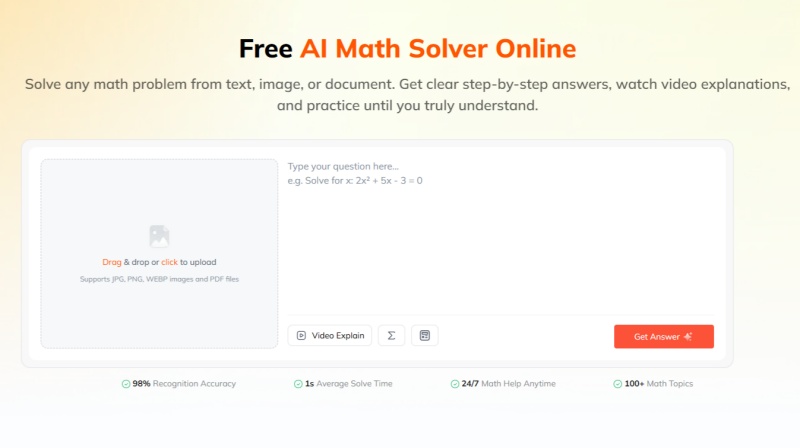
Tenorshare AI Math is an option for students who want to enter a math problem and review its solution in one place. It combines powerful AI models with built-in math-solving prompts, so you don't have to repeatedly adjust instructions or copy and paste prompts every time you need help. It also supports multiple ways to submit math problems, making it easier to get help with different types of questions, from typed equations to problems provided in images or documents.
Key features include:
-
Multiple Input Options: Submit math problems through text, images, or PDF files to suit different study situations.
-
Step-by-Step Solutions: Follow the solution process to understand how an answer is derived, rather than receiving only a final result.
-
AI Video Explanations: Use visual explanations to make challenging concepts and solution steps easier to follow.
-
Practice Question Generation: Create additional practice problems to reinforce what you've learned.
-
Built-In Calculator: Handle calculations as part of your math-solving workflow.
Whichever tool you use, review the steps instead of relying solely on the final answer, especially for complex equations or graded assignments.
Final Verdict: Is Claude or ChatGPT Better at Math?
So, is Claude better at math than ChatGPT?
Neither tool is consistently better across every type of math problem. ChatGPT is a practical starting point for everyday calculations and advanced problem-solving, while Claude is worth trying when you want to explore a different solution method or compare step-by-step explanations. The best choice depends on the specific model, the problem, and how clearly you can verify the result.
If you want a more direct way to solve math problems without repeatedly adjusting prompts, Tenorshare AI Math offers built-in math-solving prompts, multiple input options, and step-by-step solutions. You can try it alongside Claude and ChatGPT to find the workflow that best fits your needs.

Tenorshare AI Math
- Solve math from text, images & PDFs at 98% accuracy
- Deliver step-by-step answers with detailed logic breakdown
- Access video explanations for deeper math concept understanding
- Generate matching practice tests to solidify knowledge

FAQs
-
Is Claude Reliable With Math?
Claude can solve many mathematical problems, but accuracy varies by model and difficulty. It may make calculation errors or produce incomplete reasoning. Check intermediate steps and verify important answers independently.
-
Is Claude or Gemini Better at Math?
Neither is consistently better across all math tasks. Results depend on the specific models, benchmark, and problem type. Compare recent results from the same evaluation and test the tools on problems relevant to your needs.
-
Which Claude Model Is Better for Math?
There is no single best Claude model for every mathematical task. In the cited MATH-500 results, Claude Sonnet 5.5 scored higher than the listed GPT-5.6 Sol model, while other benchmarks produce different rankings. Choose based on the model's performance on the type of math you need to solve.
-
Is Claude Actually Smarter Than ChatGPT?
Neither tool is universally smarter. Different models have different strengths, and their performance varies by task. For math, compare the specific models and judge whether their answers are accurate and their reasoning can be verified.
-
Can Claude Solve Calculus and Complex Equations?
Yes. Claude can help solve calculus problems and complex equations and explain the steps involved. However, difficult problems can still produce errors, so verify important calculations and proof steps independently.
You Might Also Like
- Is Gemini or ChatGPT Better at Math? Gemini vs. ChatGPT for Math
- Is Gemini Good at Math? Gemini Math Solver Review 2026
- Is Grok Good at Math? A Complete Review of Grok 4.5 Math Capabilities
- Why Is AI Bad at Math? Understand AI Math Mistakes & Pick a Trustworthy AI Math Tool
- Mathway vs Wolfram Alpha: Which One Wins in 2026?
- 2026 Gauth vs Photomath: Which AI Math Solver Is Best for Math?

Tenorshare AI Math: Solve any math problems with AI
Turn math questions into clear solutions, tutorial videos & targeted practice setsTenorshare AI Math: Instant Solutions
Steps, videos & practice for every problem
Tenorshare AI Math: Solve any math problems with AI