
How to Solve Math Word Problems Step by Step: Strategies, Tips & Tool
Math word problems are often challenging for students because they require more than simply applying a formula. Unlike regular equations, word problems require children to understand the situation described in the question, identify important information, recognize relationships between quantities, and translate words into mathematical expressions.
Whether a child is solving basic addition problems, algebra questions, percentage calculations, or distance problems, developing a structured problem-solving approac h can make these questions easier to understand.
This guide explains how to solve math word problems step by step , common mistakes to avoid, and how AI math solver can support your learning processcan provide additional support for problem-solving practice.
What Are Math Word Problems?
Math word problems are questions that describe a real-world situation using words and require mathematical reasoning to find a solution. Unlike regular equations, word problems do not provide the formula or operation directly. Students must first understand the meaning behind the information before performing calculations.
Math word problems appear in many forms, including:
-
Addition and subtraction problems
-
Algebra word problems
-
Percentage problems
-
Distance and rate problems
-
Money and measurement problems
Different types of word problems require different strategies, but the basic approach remains the same: understand the situation, identify the relationship, create a mathematical model, and solve.
Addition Word Problems
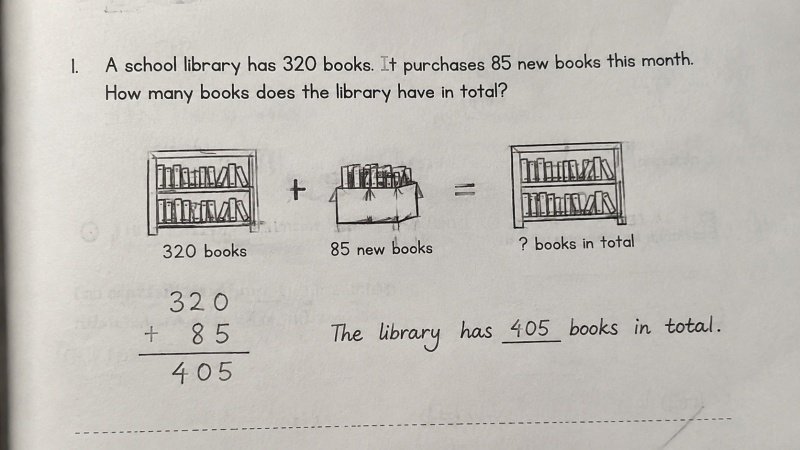
Addition word problems involve situations where two or more quantities are combined to find a total amount. They usually describe things being added together, such as objects, people, money, or measurements.
A school library has 320 books. It purchases 85 new books this month. How many books does the library have in total?
These problems often appear in everyday situations where the goal is to find the combined value of different quantities .
Algebra Word Problems
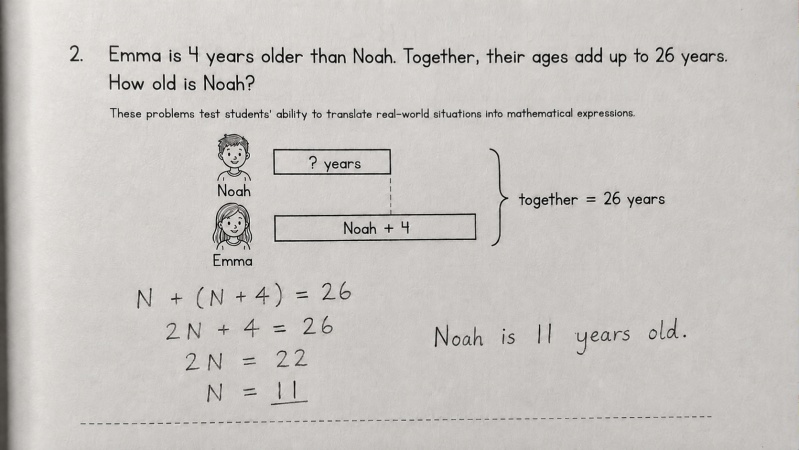
Algebra word problems describe relationships between unknown values and require students to represent these relationships using variables or equations . They are commonly used to solve problems involving ages, numbers, quantities, or comparisons.
Emma is 4 years older than Noah. Together, their ages add up to 26 years. How old is Noah?
These problems test students' ability to translate real-world situations into mathematical expressions.
Percentage Word Problems
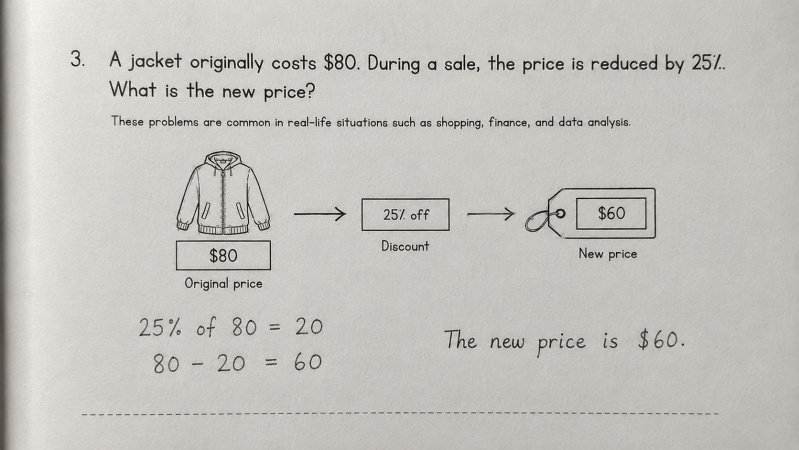
Percentage word problems involve situations related to parts of a whole, changes in value, comparisons, discounts, taxes, or growth rates. Students need to understand how percentages connect to the original quantity .
A jacket originally costs $80. During a sale, the price is reduced by 25%. What is the new price?
These problems are common in real-life situations such as shopping, finance, and data analysis.
Distance Word Problems
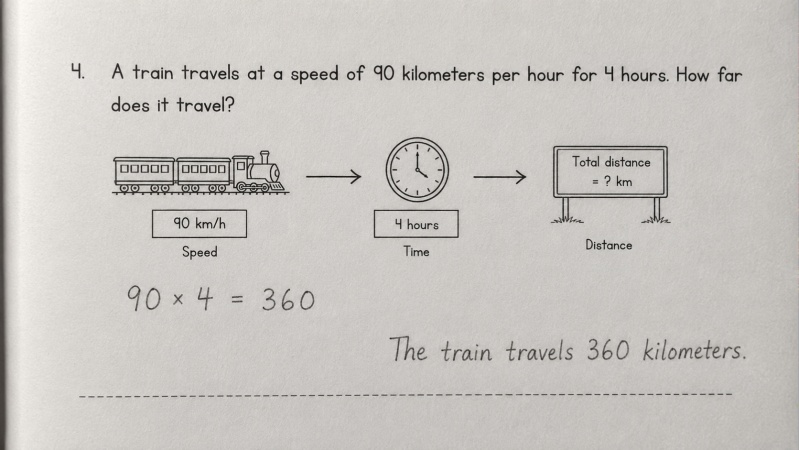
Distance word problems involve relationships between distance, speed, and time. They often describe movement scenarios, such as vehicles traveling between locations or people walking at different speeds. The relationship is commonly represented as distance = speed × time .
A train travels at a speed of 90 kilometers per hour for 4 hours. How far does it travel?
These problems require students to identify the connection between different measurements and determine the missing value.
How to Solve Math Word Problems Step by Step
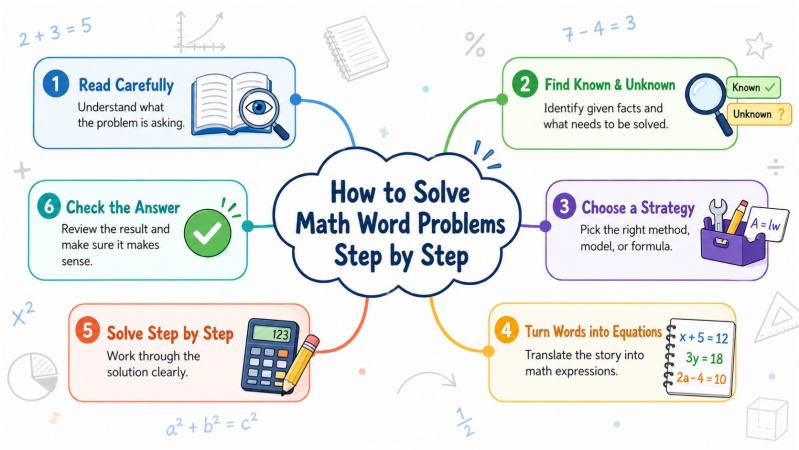
A structured problem-solving method can help students approach different types of math word problems with more confidence. Instead of encouraging children to immediately search for numbers or formulas, parents and teachers can guide students through a consistent process: understanding the problem, identifying key information, choosing the right strategy, and checking the final answer.
Step 1: Guide Students to Read the Problem Carefully
Before starting calculations, encourage students to read the entire problem and understand the situation being described.
Parents and teachers can ask questions such as:
-
What situation does the problem describe?
-
What information is provided?
-
What is the problem asking the student to find?
Students should avoid focusing only on numbers or formulas before understanding the meaning of the question.
Step 2: Help Students Identify Known and Unknown Information
Guide students to separate the information into two categories: known values and the unknown value.
Known values are the numbers, facts, or relationships already provided in the problem. The unknown value is the quantity the student needs to determine.
For example, in the problem "A train travels 300 miles in 5 hours. What is its speed?", students should identify:
-
Known information: distance = 300 miles, time = 5 hours
-
Unknown information: speed
This step helps students clearly understand what information is useful before choosing a calculation method.
Step 3: Help Students Choose the Right Strategy or Formula
After identifying the important information, encourage students to determine the mathematical relationship behind the problem.
Start by helping them think about what type of problem it is, rather than jumping directly to keywords or memorized rules. This builds stronger conceptual understanding.
Step 4: Teach Students to Translate Words Into Equations
One of the biggest challenges in word problems is converting a written situation into a mathematical expression.
For example: A number increased by 7 equals 20.
Students can represent the unknown number as x: x + 7 = 20
Writing an equation allows students to organize the information clearly and reduces confusion when solving multi-step problems.
Step 5: Encourage Students to Solve Step by Step
Once the equation or strategy is clear, students can work through the calculation carefully.
Encourage students to:
-
Show each calculation step
-
Avoid skipping important reasoning
-
Review their work if they make a mistake
Writing down the process helps students understand their mistakes and develop stronger problem-solving habits.
Step 6: Help Students Check Their Answers
After completing a problem, encourage students to review whether the answer makes sense.
Students can check:
-
Does the answer match the question?
-
Are the units correct?
-
Does the result fit the original situation?
For example, if a word problem asks for the number of students in a classroom and the answer is a negative number, students should recognize that the solution needs to be reviewed.
Common Mistakes When Solving Word Problems
Students often make mistakes in word problems because they focus on calculations before fully understanding the situation. Helping children recognize these common mistakes can improve their problem-solving habits.
Relying only on keywords can lead to incorrect solutions. Many students assume words like "more" always mean addition or "less" always mean subtraction. However, keywords only provide clues, and students should focus on the relationship between quantities instead of memorizing operation rules.
Using every number in the problem can create unnecessary confusion. Word problems may include extra information that is not needed to find the answer. Parents and teachers should encourage students to identify which details are relevant before choosing a solution method.
Skipping the equation setup can make multi-step problems harder to solve. Some students try to calculate directly without representing the relationship between quantities. Teaching children to write equations or models helps them organize information and understand the reasoning behind each step.
Failing to check the final answer can allow simple mistakes to remain unnoticed. Students should develop the habit of reviewing whether their answer is reasonable and matches the original situation. A quick sense check can help identify calculation errors or incorrect assumptions.
Solve Math Word Problems Free With Tenorshare AI Math
Math word problems often involve multiple steps, different problem types, and complex reasoning, which can make it difficult for students to solve them independently. When children struggle to understand the logic behind a solution, parents and teachers may also need to spend extra time explaining concepts and guiding each step.
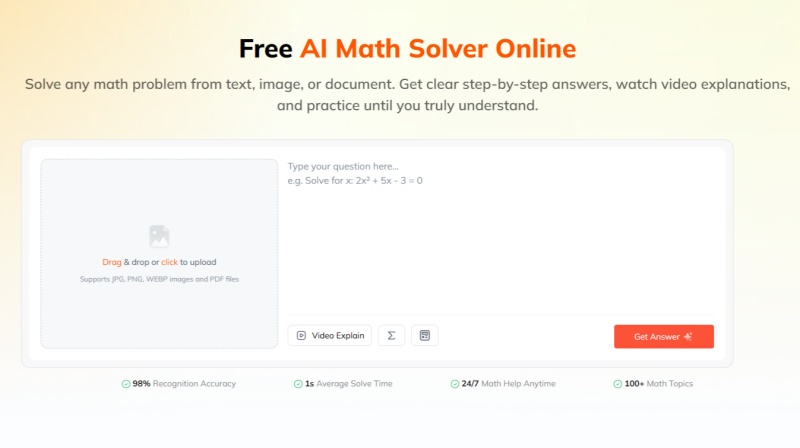
In these situations, an AI-powered math solver can provide additional learning support. Tenorshare AI Math is an AI-powered math assistant designed to help students work through math problems with clear explanations instead of only providing answers. By breaking complex word problems into understandable steps , it helps students see how information is organized, how equations are created, and why each calculation is needed.
Key features include:
-
Solve Problems From Different Formats: Students can upload questions from text, images, or PDF files, making it easier to get help with textbook exercises, worksheets, and homework problems.
-
Understand the Reasoning Behind Each Step: Instead of showing only the final result, Tenorshare AI Math explains the solution process step by step, helping students learn how to approach similar problems independently.
-
Turn Solutions Into Visual Lessons: Video explanations help students review difficult concepts and better understand the mathematical ideas behind each solution.
-
Practice Similar Problems After Solving: Generated practice questions allow students to apply the same problem-solving method and strengthen their understanding.
With support for solving, explaining, and practicing, Tenorshare AI Math helps students move beyond simply finding answers and develop better problem-solving skills for different types of math word problems.
Conclusion
Math word problems become easier when students follow a structured process: understand the question, identify important information, create an equation, solve step by step, and check the answer.
Different problem types may require different formulas, but the core skill remains the same -- translating real-world situations into mathematical relationships.
For students who need extra support, AI math tools such as Tenorshare AI Math can provide step-by-step explanations, visual learning support, and practice opportunities to make problem-solving more effective.

Tenorshare AI Math
- Solve math from text, images & PDFs at 98% accuracy
- Deliver step-by-step answers with detailed logic breakdown
- Access video explanations for deeper math concept understanding
- Generate matching practice tests to solidify knowledge

FAQs
How to Solve Math Word Problems With Answers?
To solve math word problems, students should first understand what the question asks, identify the known and unknown information, choose the right strategy, create an equation, and check the final answer. Worked examples can help students recognize common problem types and improve their solving skills.
How to Solve Math Word Problems Easily?
Math word problems become easier when students follow a consistent process instead of trying to solve everything at once. Guiding children to understand the situation, identify key information, and explain their reasoning can help build stronger problem-solving habits.
What Is the Best Strategy for Solving Math Word Problems?
The best strategy is to focus on the relationship between quantities rather than relying only on keywords. Students should learn to analyze the situation, translate the information into a mathematical model, and verify whether the answer makes sense.
Can AI Solve Math Word Problems?
Yes. AI math solvers can analyze word problems, explain solution steps, and help students understand how to approach different types of questions. However, students should use AI as a learning assistant to understand the reasoning process instead of only checking the final answer.
Is There a Free Math Word Problem Solver?
Yes. Many free math word problem solvers are available online, but students should choose tools that provide explanations and learning support rather than only giving answers. AI-powered tools such as Tenorshare AI Math can help students solve problems while understanding the steps behind each solution.
You Might Also Like
- What Happened to Microsoft Math Solver? Why It Was Discontinued and What to Use Instead
- Is Gemini Good at Math? Gemini Math Solver Review 2026
- Is Claude Good for Math? A Student Guide to Claude's Math Ability
- Is ChatGPT a Good Math Solver? 2026 Complete Review and Comparison
- 10 Best Math Homework Help Tools in 2026: AI Solvers for Step-by-Step Answers
- 5 Best AI Tools for Advanced Math Proofs & Proof-Based Math (2026)

Tenorshare AI Math: Solve any math problems with AI
Turn math questions into clear solutions, tutorial videos & targeted practice setsTenorshare AI Math: Instant Solutions
Steps, videos & practice for every problem
Tenorshare AI Math: Solve any math problems with AI