
15 Hardest Digital SAT Math Questions With Answers & Strategies
If you are aiming for an 800 SAT Math score, the hardest questions are where your preparation is truly tested.
Most students can solve routine SAT Math problems, but the questions that separate a good score from a perfect score usually require deeper reasoning, multiple steps, and a strong understanding of advanced concepts. These problems often appear in the harder second Math module of the Digital SAT, where students encounter challenging Algebra, Functions, Geometry, and Data Analysis questions.
In this guide, we'll cover the hardest SAT Math questions , explain what makes them difficult, share strategies for solving them faster, and provide 15 challenging Digital SAT Math problems with answers to help you prepare for top scores.
What Is the Hardest Math Question on the SAT?

There is no single "hardest" SAT Math question because difficulty depends on a student's strengths, familiarity with concepts, and problem-solving approach.
The hardest SAT Math questions usually share several characteristics:
-
They combine multiple math concepts in one problem.
-
They require several reasoning steps.
-
They use unfamiliar wording or real-world scenarios.
-
They test whether students can choose the right method quickly.
For example, a difficult SAT question may combine:
-
quadratic equations and functions
-
geometry and algebra
-
ratios and data interpretation
-
equations with unknown parameters
High-scoring students often find these questions challenging not because the math concepts are advanced, but because the problems require flexible thinking and careful interpretation.
Where Do the Hardest SAT Math Questions Appear?
In the Digital SAT, the most difficult Math questions usually appear in the harder second module.
The Digital SAT Math section uses an adaptive format. Students who perform well in the first Math module receive a more challenging second module, which contains more advanced problems.
The hardest questions are commonly found near the end of the second Math module and often involve:
-
Advanced Algebra
-
nonlinear equations
-
complex functions
-
multi-step modeling problems
-
challenging geometry applications
Students aiming for an 800 score should expect to encounter these types of questions.
What SAT Math Topics Are Most Difficult?
The hardest SAT Math topics are usually not difficult because they require advanced calculations. Instead, they challenge students because they require deeper reasoning, multiple steps, and the ability to connect different math concepts.
For students aiming for a high SAT Math score, the most challenging questions often come from the following areas:
| SAT Math Topic | Why It Is Difficult | Common Hard Question Types |
|---|---|---|
| Advanced Algebra | Multi-step reasoning | Quadratics, equations, systems |
| Functions | Understanding relationships | Function notation, graphs |
| Geometry | Visual problem solving | Circles, triangles, coordinate geometry |
| Trigonometry | Applying concepts correctly | Right triangles, angles |
| Data Analysis | Interpreting information | Statistics, probability, modeling |
Students preparing for the highest SAT Math scores should pay special attention to problems that combine multiple skills. A question may not involve an advanced formula, but it can become challenging when it requires students to identify the right approach, connect different concepts, and complete several steps accurately.
Among these topics, Advanced Algebra and Functions often appear in some of the most challenging SAT Math problems because they require students to work with abstract relationships instead of direct calculations. Geometry and Trigonometry questions can also become difficult when diagrams include hidden relationships or require multiple properties to solve.
Data Analysis questions are usually less about complex calculations and more about interpretation. Students need to understand what information matters, choose the correct model, and avoid being distracted by unnecessary details.
For Digital SAT test takers aiming for an 800 score, practicing mixed-topic questions is especially important. The most difficult problems often combine areas such as algebra, functions, and data interpretation in a single question, making flexible problem-solving more valuable than memorizing individual formulas.
How to Solve Hard SAT Math Questions Faster
Solving difficult SAT Math questions is not only about knowing more formulas. For high-difficulty problems, the biggest challenge is usually choosing the right approach quickly and avoiding unnecessary steps.
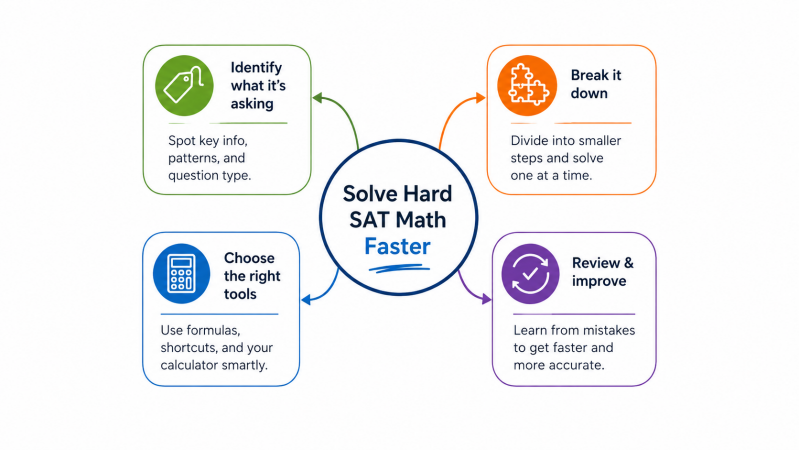
A useful strategy is to build a consistent process: identify what the question is testing, simplify the problem, use the right resources when available, and review mistakes after practice.
Identify the Question Type Before Solving
Before doing calculations, spend a few seconds identifying the main concept behind the problem.
Hard SAT Math questions often include extra information or unfamiliar wording that can make a simple concept appear more complicated. Recognizing the question type helps you choose the correct method instead of trying random approaches.
For example:
- A quadratic problem may require factoring or analyzing a graph.
- A function problem may require understanding how values change.
- A geometry problem may require identifying a hidden relationship before applying a formula.
This step is especially useful during timed practice because it reduces time spent exploring incorrect methods.
Break Complex Problems Into Smaller Steps
Many difficult SAT Math questions are challenging because they combine several smaller tasks into one problem.
Instead of trying to solve everything at once:
- Identify the information you need.
- Define the variables.
- Solve one relationship at a time.
- Check whether your answer matches the question.
Breaking a problem into smaller parts reduces calculation errors and makes complicated questions easier to manage under time pressure.
Use Calculators and Tools Strategically
Tools can help, but they should support your reasoning rather than replace it.
For the Digital SAT, students can use the built-in Desmos graphing calculator during the Math section. It can be especially useful for tasks such as:
- checking intersections of equations
- analyzing graphs
- solving some equation-based problems
However, not every hard SAT Math question is faster with a calculator. Many high-difficulty questions still require understanding the concept first.
During regular practice, students can also use additional tools to check solutions, review mistakes, and understand alternative solving methods. The goal is not to depend on tools, but to learn when they are helpful.
Review Mistakes From Hard Questions
Practicing difficult questions only helps if you understand why you missed them.
After solving a challenging problem, review:
- Did you misunderstand the question?
- Did you choose the wrong method?
- Did you make a calculation mistake?
- Did you miss a shortcut or pattern?
Keeping track of repeated mistakes helps you identify weak areas and prevents the same errors from appearing on test day.
For students aiming for an 800 SAT Math score, the goal is not to solve every difficult problem with complicated methods. The goal is to recognize patterns, choose efficient strategies, and solve unfamiliar questions with confidence.
15 Hardest SAT Math Questions | Copy & Paste
The following questions are SAT-style practice problems created to simulate the format, difficulty level, and problem-solving skills required for challenging Digital SAT Math questions.
These questions are not official College Board questions . They are designed as practice examples to help you become familiar with unfamiliar problem structures and prepare for difficult situations that may appear on the SAT.
Try solving each question on your own first and compare your answers with the correct answers provided below. If you want to understand the reasoning behind each solution or learn step-by-step approaches, you can use AI tools, AI math solvers , or other learning resources to review the problem-solving process.

Question 1
A company uses a quadratic model to represent the profit, in thousands of dollars, from selling x hundred units of a product.
The profit function is defined by:
P(x) = ax² + bx + c
The company determines that the maximum profit occurs when x = 30. The profit when no units are sold is $50,000, and the profit when 60 hundred units are sold is also $50,000.
If the maximum profit is $230,000, what is the value of b?
A) -10
B) -15
C) -20
D) -30
Answer: C
Question 2
A polynomial function p is defined by:
p(x) = x³ + ax² + bx + c
When p(x) is divided by x - 2, the remainder is 10. When p(x) is divided by x + 1, the remainder is -2.
The graph of y = p(x) passes through the point (0, 6), and the coefficient a is twice the coefficient b.
What is the value of a?
A) -6
B) -4
C) 4
D) 6
Answer: B
Question 3
A population of bacteria is modeled by the function:
P(t) = A(b)^t
where t is the number of hours after an experiment begins, A is the initial population, and b is a constant growth factor.
After 4 hours, the population is 3,200. After 7 hours, the population is 25,600.
The researchers modify the model by adding a constant amount of bacteria every hour:
Q(t) = P(t) + k
If Q(0) = 1,100, what is the value of k?
A) 100
B) 200
C) 300
D) 400
Answer: C
Question 4
Two functions f and g are defined as follows:
f(x) = x² + mx + n
g(x) = f(x + 3)
The graph of g(x) has its vertex at (2, -5).
If f(0) = 4, what is the value of f(5)?
A) -4
B) 0
C) 4
D) 9
Answer: A
Question 5
A rectangular garden is designed so that its length is 6 meters greater than its width.
A path of uniform width is built around the outside of the garden. The total area including the path is 320 square meters.
The path increases both the length and width of the rectangle by the same amount.
If the original garden area is 192 square meters, what is the width of the path?
A) 1 meter
B) 2 meters
C) 3 meters
D) 4 meters
Answer: B
Question 6
A circle in the coordinate plane is defined by the equation:
(x - h)² + (y - k)² = r²
The circle passes through the points (2, 8) and (10, 4). The center of the circle lies on the line y = x - 2.
The radius of the circle is greater than 5 and less than 10.
What is the value of h + k?
A) 6
B) 8
C) 10
D) 12
Answer: B
Question 7
A right triangular prism has a triangular base with legs of lengths 9 centimeters and 12 centimeters.
The volume of the prism is 540 cubic centimeters.
The length of the prism is increased by 20%, while the lengths of both legs of the triangular base are decreased by the same percentage.
After these changes, the volume remains unchanged.
What is the percentage decrease in each leg of the triangular base?
A) 5%
B) 10%
C) 15%
D) 20%
Answer: B
Question 8
A line in the coordinate plane passes through the points (4, 11) and (10, 23).
A second line has a slope that is the negative reciprocal of the first line's slope.
The second line passes through the point (7, 5).
A third line is parallel to the second line and passes through the point (1, 13).
What is the y-intercept of the third line?
A) 12
B) 14
C) 16
D) 18
Answer: C
Question 9
A data analyst studies the average number of hours students spend studying each week.
A group of 12 students has a mean study time of 14 hours.
When one additional student's study time is included, the mean increases to 15 hours.
The additional student's study time is then removed, and the student with the greatest study time in the original group is also removed. The new mean becomes 13 hours.
What was the greatest study time among the original 12 students?
A) 24
B) 26
C) 28
D) 30
Answer: C
Question 10
The height of a projectile launched from the ground is modeled by the function:
h(t) = -16t² + vt
where t is the time in seconds after launch and v is the initial velocity in feet per second.
The projectile reaches a maximum height of 144 feet.
A second projectile is launched with an initial velocity that is 25% greater than the first projectile.
What is the maximum height reached by the second projectile?
A) 180 feet
B) 216 feet
C) 225 feet
D) 288 feet
Answer: B
Question 11
A school surveyed students about their participation in three activities: mathematics club, science club, and robotics club.
The survey showed that 55% of students participate in mathematics club, 40% participate in science club, and 30% participate in robotics club.
Additionally, 20% of students participate in both mathematics club and science club, 15% participate in both mathematics club and robotics club, and 10% participate in both science club and robotics club.
If 5% of students participate in all three clubs and 400 students were surveyed, how many students participate in exactly one of the three clubs?
A) 220
B) 240
C) 260
D) 280
Answer: C
Question 12
A rational function is defined as:
f(x) = (x² + ax + b) / (x - 4)
The graph of f has a vertical asymptote at x = 4 and a removable discontinuity at x = -2.
After simplifying the function, the resulting linear function has a slope of 3.
If the remainder when the original numerator is divided by x - 4 is 12, what is the value of a + b?
A) 10
B) 12
C) 14
D) 16
Answer: B
Question 13
A researcher models the spread of information through a social network using the function:
N(t) = A(1.5)^t + C
where t is the number of days after the information is released.
On day 0, the number of people who have received the information is 50. On day 2, the number is 140. On day 4, the number is 410.
The researcher wants to estimate the number of people who will have received the information after 6 days using the same model.
Which value is closest to N(6)?
A) 980
B) 1,120
C) 1,250
D) 1,480
Answer: D
Question 14
A triangle is inscribed in a circle with radius 13.
Two sides of the triangle have lengths 10 and 24, and the angle between these two sides is 90 degrees.
A line segment is drawn from the center of the circle to the midpoint of the triangle's longest side.
What is the length of this segment?
A) 5
B) 6
C) 8
D) 13
Answer: D
Question 15
A sequence of functions is defined recursively.
The first function is:
f₁(x) = x² + 2x
Each following function is created by:
fₙ₊₁(x) = fₙ(x + 1) - fₙ(1)
The process continues until f₅(x) is created.
If f₅(2) = k, what is the value of k?
A) 24
B) 32
C) 40
D) 48
Answer: B
To Get Step-By-Step Solutions, Try Tenorshare AI Math
Solving the hardest SAT Math questions is only the first step. To improve your score, you also need to understand why a solution works and how to apply the same approach to similar problems.
When reviewing difficult SAT Math problems, students often struggle to identify where their reasoning went wrong. They may understand the final answer but still not know how to approach a similar question on the actual test.

Tenorshare AI Math helps students analyze challenging SAT Math problems by providing detailed solution guidance and learning support throughout the review process.
With Tenorshare AI Math, you can:
-
Solve SAT Math problems in different ways: Submit questions using flexible input methods and quickly review challenging problems.
-
Understand step-by-step solutions: Follow detailed explanations to learn the reasoning behind each solution method.
-
Learn through visual explanations: Build a deeper understanding of difficult concepts and problem-solving approaches.
-
Generate additional practice questions: Strengthen weak areas with more SAT-style problems based on your learning needs.
For students preparing for an 800 SAT Math score, an AI Math Solver can make difficult problem review more efficient by turning each challenging question into a learning opportunity. Instead of simply checking whether an answer is correct, students can focus on improving their reasoning process and mastering the strategies needed for high-difficulty Digital SAT questions.
Final Verdict
The hardest SAT Math questions are not necessarily the ones with the longest calculations. The most challenging problems usually test whether students can recognize patterns, interpret information accurately, and choose an efficient solving strategy under time pressure.
For students aiming for an 800 SAT Math score, practicing high-difficulty questions is only part of the preparation process. The more important step is understanding why a solution works, identifying mistakes, and learning how to approach unfamiliar question formats.
A strong preparation strategy should combine challenging Digital SAT Math practice with careful review of mistakes, targeted improvement of weak areas, and effective use of available tools like Tenoshare AI Math during practice.
By becoming familiar with difficult question types and improving problem-solving flexibility, students can build the accuracy and confidence needed to handle the hardest questions on the SAT Math section.

Tenorshare AI Math
- Solve math from text, images & PDFs at 98% accuracy
- Deliver step-by-step answers with detailed logic breakdown
- Access video explanations for deeper math concept understanding
- Generate matching practice tests to solidify knowledge

FAQs
How many questions can you miss to get an 800 SAT Math score?
The exact number of questions a student can miss while still receiving an 800 SAT Math score is not fixed. The Digital SAT uses a scaled scoring system, meaning the final score depends on factors such as question difficulty and performance across both Math modules.
Are Digital SAT Math questions harder than the old SAT?
Digital SAT Math questions are not necessarily harder, but the format is different. The adaptive testing system can give high-performing students a more challenging second Math module, where many of the hardest questions appear.
Can you use Desmos for the hardest SAT Math questions?
Yes. The Digital SAT includes an embedded Desmos calculator that can help with graphing, checking equations, and analyzing functions. However, students still need to understand the underlying math concepts because many difficult questions require reasoning before calculation.
Where can I find hardest SAT Math questions PDF?
You can find challenging SAT Math practice materials from SAT preparation websites, educational platforms, and test prep resources. The most useful resources include difficult SAT-style questions, answer keys, and explanations for reviewing mistakes.
How do I practice the hardest SAT Math questions?
Practice difficult SAT Math questions by solving them independently first, then reviewing your mistakes and understanding the correct approach. Focusing on repeated errors and weak topics is more effective than simply completing more questions.
You Might Also Like
- How to Be Good at Math: A Complete Guide to Improve Your Math Skills
- How to Solve Math Word Problems Step by Step: Strategies, Tips & Tool
- What Happened to Microsoft Math Solver? Why It Was Discontinued and What to Use Instead
- Tenorshare AI Math Review 2026: Is It a Good AI Math Solver?
- Is Wolfram Alpha Math Solver Good for Math? A Complete Review
- Is Grok Good at Math? A Complete Review of Grok 4.5 Math Capabilities

Tenorshare AI Math: Solve any math problems with AI
Turn math questions into clear solutions, tutorial videos & targeted practice setsTenorshare AI Math: Instant Solutions
Steps, videos & practice for every problem
Tenorshare AI Math: Solve any math problems with AI