
How to Be Good at Math: A Complete Guide to Improve Your Math Skills
Many students ask, "How can I become better at math?" when they struggle with difficult problems, forget formulas, or feel like they are simply not "good at numbers." However, improving at math is not about having a natural talent. It is about building the right skills, using effective learning strategies, and practicing in a way that helps you truly understand concepts.
In this guide, you will learn how to be good at math step by step , from strengthening your basic knowledge and improving problem-solving skills to developing mathematical thinking. We will also explore how modern AI math solvers can support your learning process.
Why Are Some Students Struggling With Math?
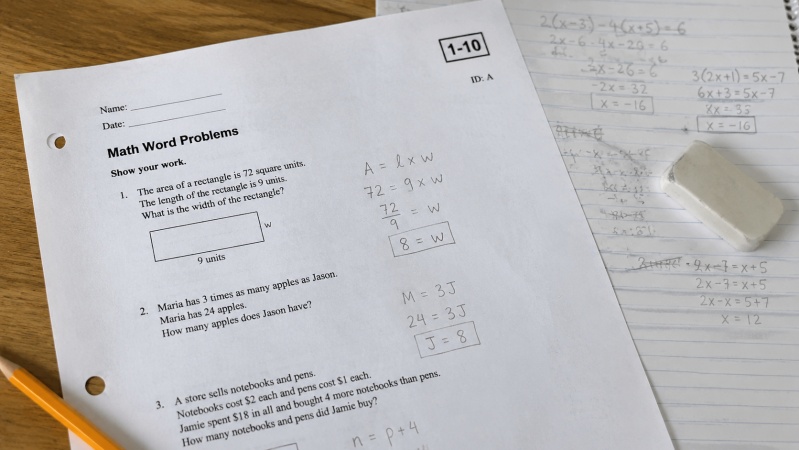
Many students struggle with math not because they lack ability, but because they develop gaps in their learning process. Since math concepts are connected, small difficulties in earlier topics can create bigger challenges later.
Common reasons include:
-
Weak foundations: Math builds step by step. If students struggle with basic operations, fractions, algebra, or formulas, more advanced topics can become difficult to understand.
-
Memorizing instead of understanding: Some students focus only on remembering formulas without knowing why they work. This makes it harder to apply knowledge to new types of problems.
-
Lack of problem-solving strategies: Many math questions require students to analyze information, identify patterns, and choose the right approach instead of simply calculating an answer.
-
Fear of making mistakes: Math improvement requires practice and correction. Students who avoid difficult problems may miss opportunities to strengthen their skills.
-
Ineffective practice methods: Repeating the same easy exercises may create familiarity but does not always improve deeper understanding or problem-solving ability.
Understanding these challenges is the first step toward building a better math learning strategy.
How to Be Good at Math Step by Step
Build Strong Foundations
A strong foundation is the starting point for improving math skills. Before trying to master advanced topics, students should make sure they understand essential concepts clearly.
Key skills that support future math learning include:
-
Arithmetic operations
-
Fractions and decimals
-
Percentages
-
Equations
-
Basic algebra concepts
These fundamental skills are used throughout many areas of mathematics. Instead of rushing into harder problems, focus on identifying weak areas and improving them one by one. A solid foundation makes it easier to understand new concepts and solve more complex problems later.
Understand Concepts Instead of Memorizing Formulas
Memorizing formulas can help solve certain problems quickly, but understanding the ideas behind formulas leads to stronger math ability.
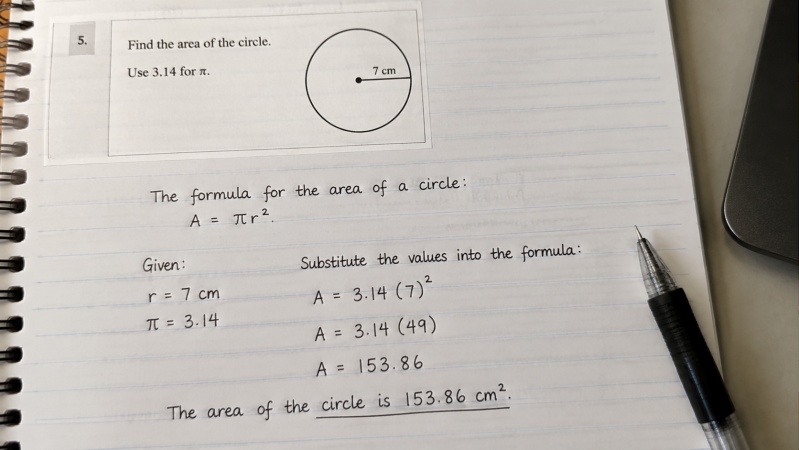
For example, instead of only remembering the formula for the area of a circle, students should understand:
-
what the formula represents
-
why the relationship works
-
when the formula should be used
Conceptual understanding helps students adapt when problems appear in unfamiliar formats.
A better learning process is:
Understand the concept → Learn the method → Practice applying it → Explain the reasoning
Students who focus on understanding usually develop stronger problem-solving skills than those who only memorize steps.
Practice Math Effectively
Practice is essential for improving math, but the quality of practice matters more than simply spending more time.
Effective math practice includes:
-
Practice consistently: Regular short sessions are usually more effective than studying only before exams.
-
Solve different types of problems: Working on varied questions helps students recognize patterns and choose appropriate methods.
-
Gradually increase difficulty: Start with basic problems, then move toward more challenging applications.
-
Review previous mistakes: Repeating the same errors slows improvement. Understanding why an answer was wrong helps prevent future mistakes.
The goal of practice is not just to complete more questions, but to improve understanding and problem-solving ability.
Improve Problem-Solving Skills
Being good at math is not only about calculation. Many challenging problems require logical thinking and the ability to translate information into mathematical models.
A useful problem-solving process is:
-
Understand the problem
Read carefully and identify what information is given and what needs to be found.
-
Choose the right strategy
Decide whether the problem requires an equation, formula, diagram, pattern, or another approach.
-
Solve step by step
Break complex problems into smaller parts instead of trying to solve everything at once.
-
Check the answer
Review whether the result makes sense and whether the solution matches the original question.
This approach is especially useful for word problems, where many students struggle not because of calculation, but because they cannot identify the mathematical structure behind the question.
Learn From Mistakes
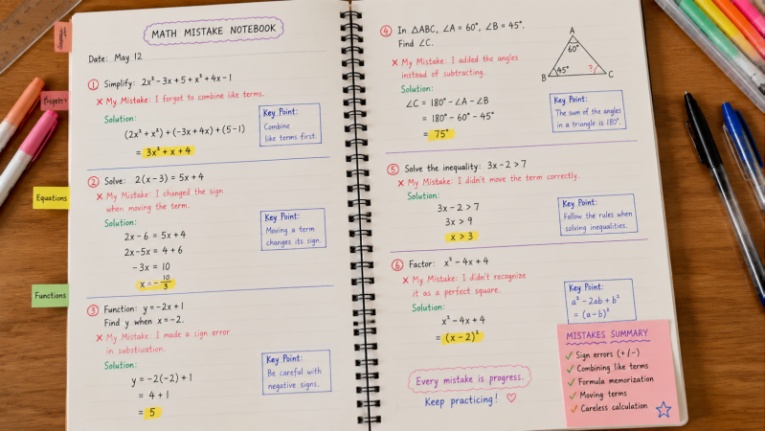
Mistakes are a necessary part of improving math skills. Instead of simply checking the correct answer, students should analyze why they made the mistake.
Common types of mistakes include:
-
Concept mistakes: Not understanding the underlying idea or rule.
-
Calculation mistakes: Making errors during arithmetic or algebraic steps.
-
Reading mistakes: Misunderstanding what the problem is asking.
Keeping track of mistakes creates a personal learning record. Over time, students can identify patterns in their weaknesses and focus their practice more effectively.
Develop Mathematical Thinking
Advanced math ability comes from developing mathematical thinking, not just learning more formulas.
Strong math thinkers can:
-
recognize patterns
-
make logical connections
-
explain their reasoning
-
approach unfamiliar problems creatively
Activities such as puzzles, logic problems, programming, and challenging math questions can help develop these skills.
For students interested in higher-level mathematics, subjects like discrete math, calculus, and mathematical proofs require a deeper ability to reason rather than simply calculate.
Can You Be Good at Math Without Studying?
You cannot become good at math without learning and practice. While some students may learn faster than others, strong math skills are built through consistent effort and a solid understanding of basic concepts .
However, studying math does not mean spending endless hours memorizing formulas or doing repetitive exercises. The key is to study smarter by using effective resources and learning methods. Students can use tools such as textbooks, tutoring resources, mistake journals, and even AI-powered learning tools to better understand concepts, review solutions, and improve practice efficiency.
At the same time, no tool can replace a strong foundation. Trying to skip the basics or looking for a shortcut to instantly become good at math usually leads to temporary results rather than real improvement. The most effective approach is to build your skills step by step, while using available resources to make the learning process clearer and more efficient.
Improve Your Math Skills Faster With AI
AI cannot replace learning or make someone good at math instantly. However, when used correctly, AI tools can make the learning process more efficient by helping students understand difficult concepts, receive explanations, and practice more effectively.
Different AI tools are designed for different learning needs. Some are better for explaining concepts, some focus on solving and checking math problems, while others provide a more structured math learning experience.
Also Read: 2026 Best AI for Math Compared: Which One Should You Use?
Use General AI Assistants for Concept Explanations

General AI assistants such as ChatGPT can be useful when students need help understanding difficult math concepts or exploring different ways to approach a problem .
For example, students can ask ChatGPT to explain a mathematical idea in simpler language, provide additional examples, or break down a complicated concept into smaller steps. This can be especially helpful when learning topics such as algebra, geometry, calculus, or statistics.
However, general AI assistants are designed for a wide range of tasks, not only mathematics. Their responses may need additional verification, and students should focus on understanding the reasoning instead of simply copying the final answer.
When used correctly, general AI tools can act like a personal study partner that helps students ask questions, review concepts, and build confidence in math learning.
Use AI Math Solvers for Step-by-Step Problem Practice
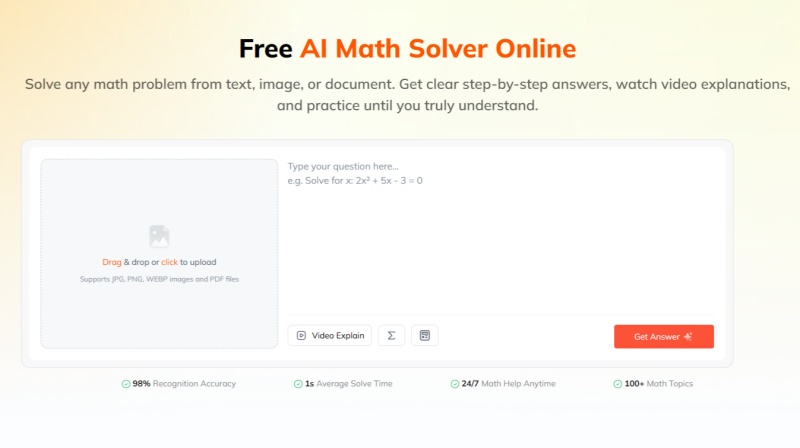
While general AI assistants are useful for explaining concepts, students who regularly practice math problems may need a more specialized tool designed specifically for mathematical learning.
Tenorshare AI Math is an AI-powered math learning tool designed to support the complete problem-solving process. Students can upload math questions through text, images, or documents and receive step-by-step solutions with clear explanations.
Its key features include:
-
Multiple Input Methods: Solve problems from images, text, and PDF files for more convenient homework support.
-
Step-by-Step Answers: Understand the logic behind each solution instead of only getting the final answer.
-
Video Explanations: Learn difficult concepts through AI-generated visual lessons.
-
Practice Tests: Generate similar exercises to review knowledge and reinforce learning.
By combining problem solving, explanations, and targeted practice in one workflow, Tenorshare AI Math helps students spend less time searching for answers and more time building actual math skills. However, students should still actively review solutions and practice independently to turn AI assistance into long-term improvement.
Conclusion
Becoming good at math is not about having a special talent. It is a skill that improves through strong foundations, effective practice, problem-solving strategies, and continuous learning.
Students who want to improve should focus on understanding concepts, analyzing mistakes, and developing mathematical thinking instead of only memorizing formulas.
AI tools can also support this process by providing explanations, feedback, and additional practice. When combined with active learning, they can help students build stronger math skills and learn more effectively.

Tenorshare AI Math
- Solve math from text, images & PDFs at 98% accuracy
- Deliver step-by-step answers with detailed logic breakdown
- Access video explanations for deeper math concept understanding
- Generate matching practice tests to solidify knowledge

FAQ
-
How Long Does It Take to Become Good at Math?
The time needed to become good at math depends on your current level, learning goals, and how consistently you practice. Basic improvements may take weeks or months, while developing advanced mathematical skills usually requires years of continuous learning.
-
How to Be Good at Basic Math?
To become good at basic math, focus on mastering arithmetic, fractions, decimals, percentages, and basic equations. Practice regularly, understand the reasoning behind calculations, and apply math concepts to real-life situations.
-
How to Be Good at Math Word Problems?
To improve at math word problems, focus on understanding the question before calculating. Identify important information, determine what needs to be found, choose the right strategy, and translate the problem into mathematical expressions.
-
How Good at Math Do You Need to Be to Become an Engineer?
Engineering requires strong math skills, especially in algebra, calculus, statistics, and physics-related mathematics. Engineers do not need to be perfect at every area of math, but they need strong problem-solving abilities and the ability to apply mathematical concepts.
-
How Good at Math Do You Need to Be to Become an Accountant?
Accountants mainly need practical math skills, including arithmetic, percentages, financial calculations, and data analysis. Advanced mathematics is usually less important than accuracy, logical thinking, and understanding financial concepts.
-
How to Be Good at Discrete Math?
To become better at discrete math, focus on logical reasoning, proofs, algorithms, combinatorics, and mathematical structures. Unlike basic calculation-based math, discrete math requires stronger abstract thinking and problem-solving skills.
You Might Also Like
- What Happened to Microsoft Math Solver? Why It Was Discontinued and What to Use Instead
- How to Solve Math Word Problems Step by Step: Strategies, Tips & Tool
- Is Gemini Good at Math? Gemini Math Solver Review 2026
- Is Claude Good for Math? A Student Guide to Claude's Math Ability
- Is ChatGPT a Good Math Solver? 2026 Complete Review and Comparison
- Best AI Math Solvers 2026: Honest Comparison for All Math Problems

Tenorshare AI Math: Solve any math problems with AI
Turn math questions into clear solutions, tutorial videos & targeted practice setsTenorshare AI Math: Instant Solutions
Steps, videos & practice for every problem
Tenorshare AI Math: Solve any math problems with AI