
Why Do AI Detectors Flag My Writing | Reasons & Solutions
If you've ever had an AI detector flag your writing, you may have wondered, why do AI detectors flag my writing even when you didn't use AI at all? Rest assured, you're not alone if this has happened to you.
This guide explains why AI detectors flag human writing, what's happening behind the scenes, and what you can do about it with Tenorshare AI Bypass .
I Didn't Use AI but It Says I Did -- You're Not Alone
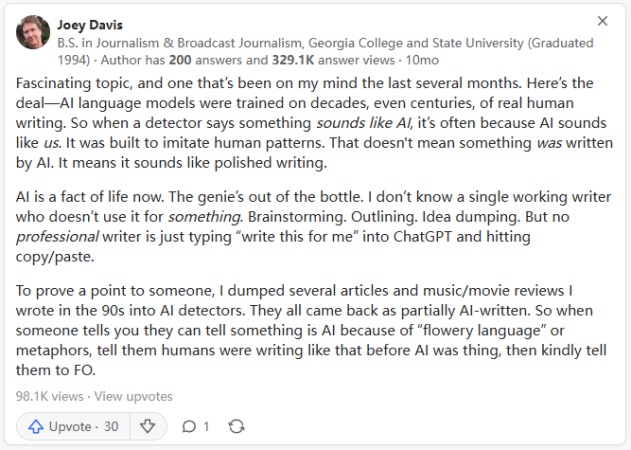
False positives are more common than many realize. Independent tests and user reports indicate that a notable proportion of human-written essays can be mistakenly flagged by AI detectors, depending on the detection tool, text genre, and writing style.
As journalist Joey Davis demonstrated, even his 1990s human-written articles and reviews, which were created long before AI tools existed, were labeled as "partially AI-written" by detectors, proving this issue is widespread. Awareness of these patterns can prevent unnecessary anxiety and help you take corrective steps when needed.
Why Does My Writing Get Flagged As AI: User Side
As real-world cases show, even human writing can be incorrectly labeled as AI, and this often stems from choices and patterns in your own work.
Perfect Writing Can Trigger Flags
Ironically, error-free, polished writing can mimic AI output. Detectors are trained to recognize patterns typical of AI -- consistent grammar, balanced sentence lengths, and predictable transitions. A perfectly structured essay may unintentionally meet these criteria, especially if written in a formal, neutral style.
Predictable Phrasing Raises Scores
Repetitive sentence structures or common transitions ("Firstly... Secondly... In conclusion...") can increase the likelihood of being flagged. AI detectors rely on statistical patterns, so writing that follows conventional frameworks too closely may score higher on "AI likelihood" even if it's fully human.
Editing Tools Can Affect Results
Grammar checkers, style editors, and paraphrasing tools can reduce natural variation in text. By standardizing word choices and sentence structure, these tools can inadvertently make writing appear algorithmically generated. Awareness of this effect is crucial for writers who rely heavily on such tools.
Why Does AI Detect My Work As AI: Detectors Side
Beyond your own writing choices, the design and limitations of AI detection tools themselves are major drivers of false positives, creating inherent risks of misclassification even for entirely human work.
Tool-Specific Updates Change Detection
AI detection algorithms are constantly updated. A text that passes one week might be flagged the next. Each tool has its own approach, meaning results can vary between platforms, even for identical content.
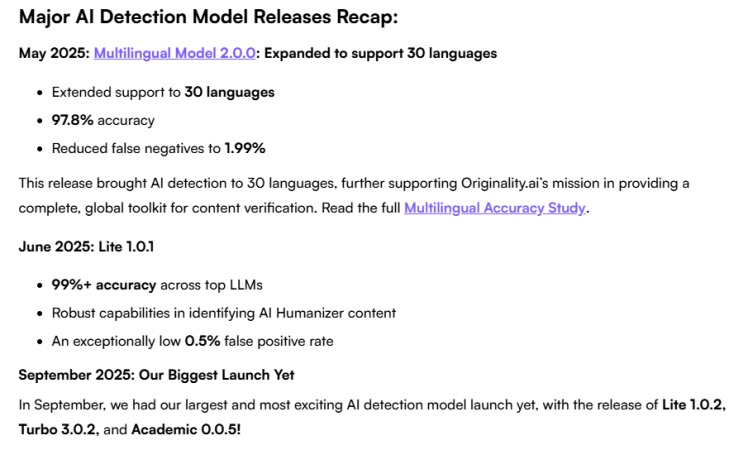
Take Originality.a i as an example: in 2025, it launched multiple major model updates, including expanding multilingual support to 30 languages in May and releasing specialized academic and high-speed detection models in September. Each iteration adjusted accuracy thresholds and detection logic, directly shifting how human-written texts might be scored or misclassified.
Training Data Bias
Detectors are trained on datasets of AI-generated and human-written text. If your writing style resembles the AI examples in the training data, it can be misclassified, reflecting a bias in the underlying dataset rather than an actual AI usage.

For example, a study of three major AI detection tools found high false positive rates (sometimes up to 50%) for genuine human writing, especially with mixed text or specific styles. Accuracy and misclassification rates also vary greatly across tools. Differences in training data, linguistic pattern recognition and decision thresholds directly cause misclassification of human writing and inconsistent results. This shows that a detector's training data and design algorithms heavily influence its judgments, and not all tools can reliably distinguish human from AI text.
Threshold Sensitivity
Beyond training data bias, another key factor contributing to inconsistent detection results is threshold sensitivity.
Detection tools assign scores based on various linguistic features and set a specific threshold to define "AI-written" content. Texts near this cutoff can be inconsistently flagged, as small variations in wording or sentence patterns may push them above or below the threshold.
Why Is My Essay Flagged As AI
While the above factors affect AI detection across all text types, academic writing, specifically essays, faces unique risks of false positives due to its inherent characteristics.
Academic Writing Is Risky
Academic essays and research papers are bound by norms requiring structured formats, formal language, and precise logic -- traits AI models are trained to replicate. AI detectors often link these standard academic features to algorithmic authorship, making human-written essays prone to false positives.
Formal Tone Increases Detection
Academic writing requires a formal tone -- no contractions, complex vocabulary, and neutral objectivity. This removes human conversational nuances, and its polished consistency closely matches AI's mechanical output, leading to false positives.
Lack of Personal Voice Triggers Flags
Academic writing prioritizes objectivity, so it minimizes personal anecdotes and unique phrasing. AI detectors recognize individuality as a human marker, so this absence confuses them into classifying academic prose as AI-generated.
What to Do When AI Detector Says My Writing Is AI
One solution is to use an AI Humanizer . It refines sentence structure, tone, and wording to restore natural variation, reduce AI traces while preserving the original meaning, and make your writing sound genuinely human. Be sure to select tools that support diverse writing tones for different text types.
You can also compare results across multiple AI detectors. Relying on only one tool can be misleading. Cross-checking helps spot false positives and gives a more reliable assessment of how your work is judged.
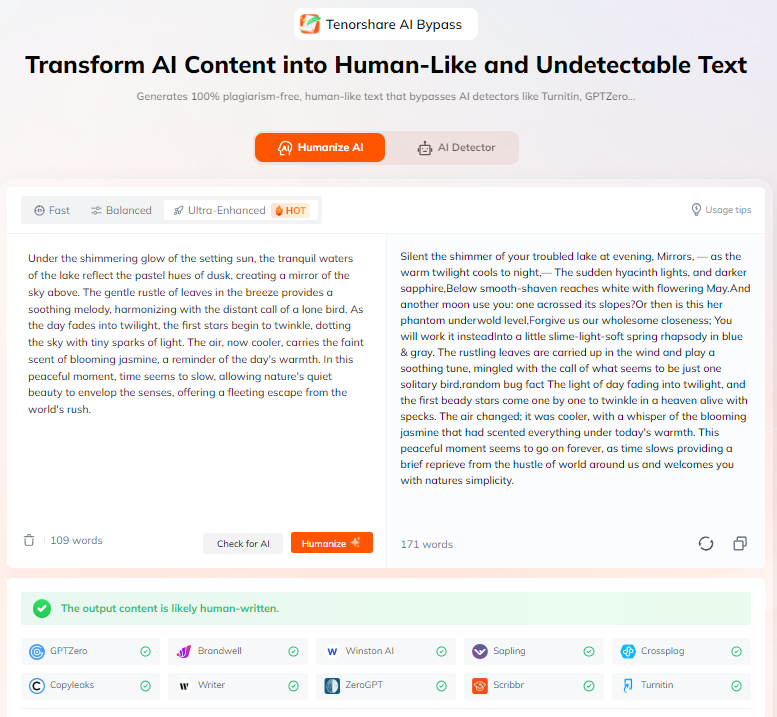
Tenorshare AI Bypass meets both needs:
-
Reliable AI Humanization: It optimizes sentences and tones to lower AI features while keeping the original meaning.
-
Integrated AI Detection: It compares results with major detectors in one click to avoid false positives.
-
Time-Saving Workflow: It integrates humanization and detection to simplify your operation.
-
Multiple Writing Styles: It provides 7 styles to fit essays, reports, emails and other texts.
Conclusion
If you've wondered why do AI detectors flag my writing , the key point is that these tools rely on pattern recognition, not true understanding. Many factors can lead to your text being misjudged.
But there's no need to worry. By understanding the causes and using a tool like Tenorshare AI Bypass to humanize your text and compare results across detectors, you can effectively avoid AI detection.

Tenorshare AI Bypass
- Create 100% undetectable human-like content
- Bypass all AI detector tools like GPTZero, ZeroGPT, Copyleaks, etc.
- Original content, free of plagiarism and grammatical errors
- One-click AI bypass with a clean and easy-to-use interface

FAQs
Why Is ZeroGPT Flagging Me
If ZeroGPT is flagging your writing, it's usually because its detection relies on statistical patterns rather than true understanding. Some independent tests suggest that around 14%-26% of genuine human texts can be incorrectly labeled as AI. The issue becomes more noticeable with shorter passages or heavily edited text, where limited data makes the analysis less stable.
Does Using Grammar or Editing Tools Affect AI Detection?
Yes. Overuse of grammar and style tools can standardize your writing, increasing the likelihood of being flagged as AI-generated.
Are Longer Essays More Likely to Be Flagged?
Longer texts provide more data for detectors to analyze, which can increase false positives. Consistency in style and tone throughout a lengthy essay can resemble AI-generated output.
You Might Also Like
- Why AI Humanizers Don't Work: 8 Hidden Reasons & 2 Fixes
- How Do Teachers Check for AI ? A Guide to Detection Methods and Tools
- Can AI Detectors Be Wrong? Causes, False Positives & How to Reduce Risk
- What AI Detector Do Colleges Use for Students in 2026?
- How to Use Turnitin AI Detector: 2026 Student Guide
- My Essay Is Detected As AI: Hidden Reasons & Complete Fix Guide 2026

Tenorshare AI Bypass: 100% Bypass AI Detection
Turn AI text into undetectable, human-like content.AI Humanizer, 100% Undetectable
Humanize AI text instantly.
Tenorshare AI Bypass: 100% Bypass AI Detection