
Why Does GPTZero Say I Used AI When I Didn't? Reasons and Fixes
Why does GPTZero say I used AI when I didn't ?
Have you ever wondered about this question right after turning in your paper? You are far from alone. Many people face this issue, having their essays marked AI-written or getting questioned by instructors despite writing every word personally. This unfair misjudgment easily brings unnecessary stress.
In fact, GPTZero cannot confirm if a paper is definitely generated by AI. Why is that? Read along.
This guide explains how GPTZero works, why it may falsely flag your writing, and what you can do right away.
How Does GPTZero Work?
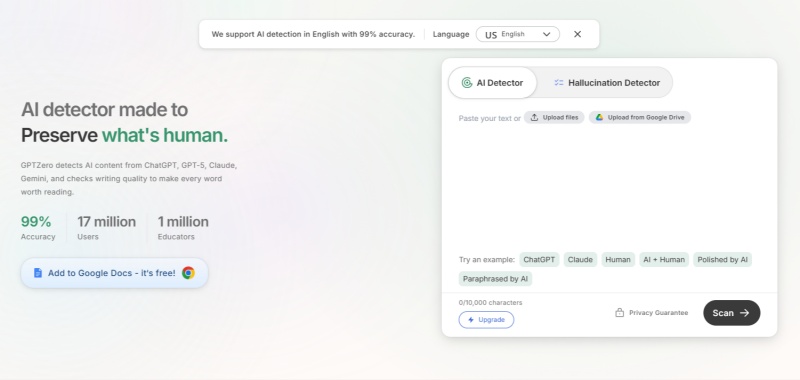
GPTZero does not know whether you personally wrote your essay. It analyzes your text and estimates whether the writing looks more human-written or AI-generated.
In other words, GPTZero is not checking your real writing process. It is checking writing patterns .
According to GPTZero's own explanation , its statistical layer uses perplexity and burstiness as part of AI detection. Perplexity measures how predictable the words are, while burstiness looks at variation in sentence length and rhythm.
Here is a simple way to understand it:
| GPTZero Signal | What It Means | Why It Matters |
|---|---|---|
| Perplexity | How predictable your word choices are | Very predictable wording may look AI-like |
| Burstiness | How much your sentence length and rhythm vary | Very even sentence patterns may look machine-like |
| Tone | Whether the writing sounds natural or overly polished | Overly smooth writing may trigger suspicion |
| Structure | Whether paragraphs follow a formula | Formulaic writing can resemble AI output |
So when GPTZero says your writing is AI, it usually means your writing matches certain patterns commonly associated with AI-generated text. It does not automatically mean you cheated.
That is why AI detector results should be treated as a warning signal, not as final proof. Even Turnitin has publicly discussed false positives in AI writing detection, showing that misclassification is a real issue in this field.
Why Does GPTZero Say My Writing Is AI: 5 Reasons
If GPTZero says your writing is AI, the problem may not be your honesty. The problem may be how your writing looks statistically.
Here are the five most common reasons .
Your Writing Sounds Too Polished
Writing that is very clean, formal, and grammatically perfect can sometimes look suspicious to AI detectors.
This often happens with:
-
academic essays
-
research papers
-
scholarship applications
-
business reports
-
SEO articles
-
technical explanations
A polished tone is not wrong. In fact, students are often taught to write clearly and formally. The problem is that AI-generated writing also tends to be smooth, balanced, and error-free.
| Human but Risky | More Natural |
|---|---|
| It is important to note that technology plays a crucial role in modern education. | Technology matters in education, but its impact depends on how teachers and students actually use it. |
The second sentence feels more specific and thoughtful. It sounds less like a generic statement.
Your Sentences Have the Same Rhythm
GPTZero may flag writing when every sentence feels similar.
For example, if most sentences are medium-length, perfectly structured, and evenly paced, the writing may have low burstiness. Human writing usually has more variation. Some sentences are short. Some are longer. Some include personal emphasis or a slightly different rhythm.
Compare these two versions:
| Low Variation | Better Variation |
|---|---|
| Social media affects communication. It changes how people interact. It influences relationships. It also shapes public opinion. | Social media changes how people communicate. Sometimes it helps people stay connected. But it can also make arguments more public, faster, and harder to control. |
The second version has more natural rhythm and clearer meaning.
Your Word Choices Are Too Predictable
GPTZero may say your writing is AI if your essay uses too many common or expected phrases.
These phrases are not automatically bad, but they can make your writing sound generic:
-
"In today's society"
-
"It is important to note"
-
"This highlights the importance of"
-
"Plays a crucial role"
-
"Has a significant impact"
-
"In conclusion"
If your paper uses many phrases like these, GPTZero may think your writing is too predictable. A better approach is to replace generic claims with specific meaning.
Grammar Tools Made Your Writing Look Too Perfect
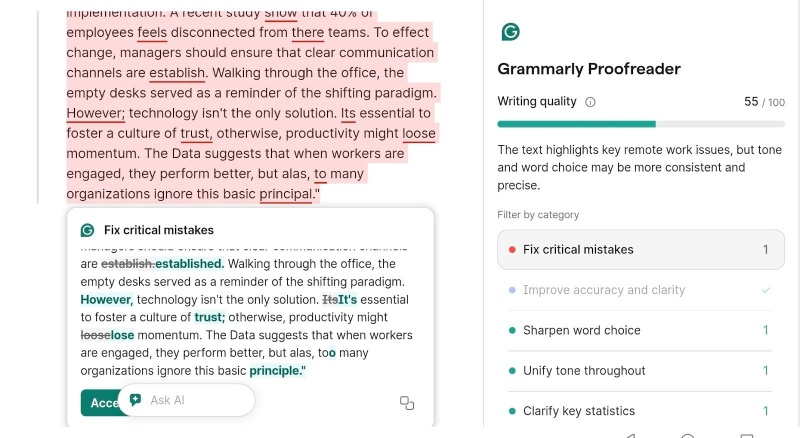
Many students use tools like Grammarly, Google Docs suggestions, Microsoft Editor, or auto-correct. These tools can be helpful, but they may also make your writing sound too polished.
They often:
-
remove informal phrasing
-
replace your original wording
-
make sentence structures more uniform
-
smooth out small imperfections
-
make your tone more formal
The final version may be grammatically better, but it can lose your personal voice.
GPTZero's own student guidance says avoiding AI detection should not be about tricking detectors. It should be about making sure your writing is obviously your own.
Your Writing Style Is Academic, Technical, or SEO-Like
Some writing styles naturally look more AI-like because they follow strict patterns.
For example:
| Writing Type | Why It May Be Flagged |
|---|---|
| Academic essays | Formal tone, predictable structure, standard transitions |
| Technical writing | Clear, direct, neutral explanations |
| SEO content | Repeated keywords, short paragraphs, structured headings |
| Business writing | Polished language and generic professional phrases |
| Non-native English writing | Simpler structure may be misread as AI-like |
This is especially important for non-native English writers. Stanford HAI discussed research showing that GPT detectors can be biased against non-native English writing, meaning some human-written essays may be misclassified as AI-generated more often.
The key point is simple: GPTZero may flag your writing because it looks statistically AI-like, not because it has proof that you used AI.
What to Do When GPTZero Says My W riting Is AI: 5 Solutions
If GPTZero says everything is AI, your goal is not to panic or blindly rewrite the whole paper . Your goal is to make your writing more natural, more personal, and easier to defend.
Here are five practical solutions.
Use Tenorshare AI Bypass Before Submitting Your Writing
The fastest way to reduce the risk of false AI flags is to check and humanize your writing before you submit it.
GPTZero may flag writing that is too polished, too predictable, or too formulaic. That means even original writing can look suspicious if it sounds overly mechanical. An AI humanizer like Tenorshare AI Bypass can help make stiff or AI-like writing sound more natural while keeping your original meaning.
Tenorshare AI Bypass is useful when you want to:
-
make formal writing sound more natural
-
reduce overly robotic sentence patterns
-
improve sentence variety
-
avoid generic AI-style wording
-
prepare essays, papers, blog posts, or SEO content before submission
Here is a simple workflow to use it.
-
Finish your essay or article in your own words.
-
Paste or upload your AI-generated text into the tool.

-
Choose your desired mode for rewriting like Fast, Balanced, and Ultra-Enhanced Mode. Then, Run it through Tenorshare AI Bypass.
-
Review the humanized version and make sure the meaning is still yours.
-
Save both the original draft and final version as proof of your writing process.

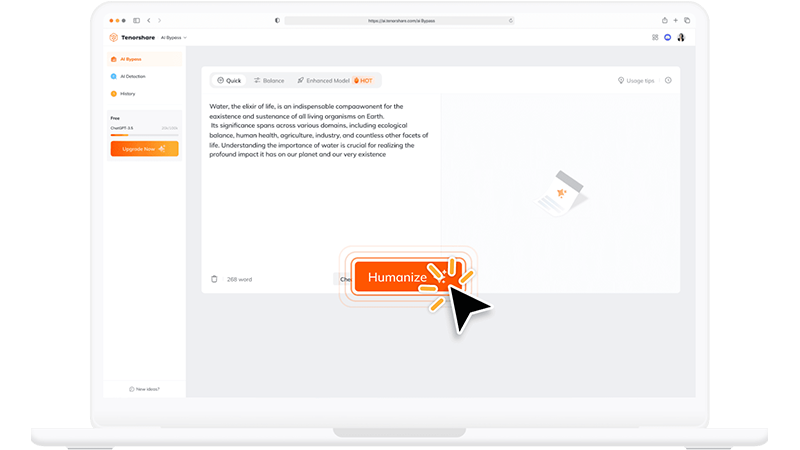

This is the most direct fix because it addresses the main reason GPTZero makes mistakes: the text pattern itself.
Save Your Drafts and Version History
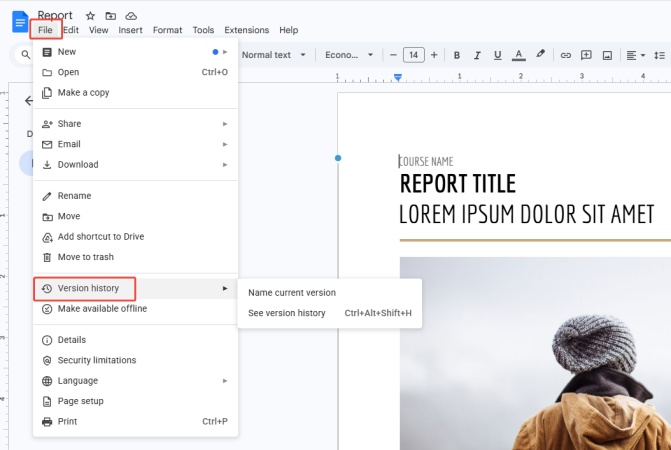
If someone questions your writing, evidence matters more than arguing with the detector score.
Keep proof that shows how your work developed over time.
Use this checklist:
-
Google Docs version history
-
Microsoft Word file history
-
handwritten notes
-
outline drafts
-
source links
-
research notes
-
earlier submissions
-
screenshots of writing progress
-
teacher comments or feedback
If your professor says you used AI, version history can show that your paper was built gradually instead of pasted all at once.
Review the Flagged Sections
Do not rewrite the entire essay immediately. Start with the parts GPTZero highlights.
Ask yourself:
| Question | What to Look For |
|---|---|
| Does this paragraph sound generic? | Too many broad claims |
| Are the sentences too similar? | Low sentence variation |
| Did I use common AI-like phrases? | Predictable transitions |
| Did Grammarly rewrite this section? | Over-polished tone |
| Is there enough original thinking? | Lack of personal analysis |
If a flagged section sounds vague, add more specific detail. If it sounds too formal, make the wording more direct. If every sentence has the same rhythm, vary the structure.
Add Personal Voice and Specific Examples
AI detection tools tend to mark plain and generic writing as AI content. The most effective fix is to inject genuine personal voice and unique personal thoughts into your text.
You can enrich your content with real-life observations, class discussion insights, detailed specific cases, original analogies, your unique viewpoints and logical reasoning to make your writing more authentic and human-like.
Talk to Your Professor or Reviewer Calmly
If your professor says GPTZero flagged your paper, do not respond emotionally. Explain the situation clearly and offer evidence.
You can follow this structure:
-
Acknowledge the concern.
-
State that you wrote the work yourself.
-
Offer your drafts, notes, and version history.
-
Ask for a review beyond the AI detector score.

You can say:
I understand why the GPTZero result is concerning, but I wrote this paper myself. I can provide my notes, outline, sources, and document version history to show how the essay developed. Could we review my writing process together?
Conclusion
So, why does GPTZero say I used AI when I didn't ? Usually, it is because your writing matches patterns that AI detectors often associate with AI-generated text.
But GPTZero does not prove academic misconduct. It only makes a prediction based on text patterns such as perplexity, burstiness, tone, and structure. That means false positives can happen, even when you wrote every word yourself.
The fastest way to reduce the risk is to check your writing before submission with an AI humanizer like Tenorshare AI Bypass . Then, keep your drafts, save your version history, review flagged sections, and make your writing more specific and personal.
Your writing should not only be original. It should also look and sound clearly human.

Tenorshare AI Bypass
- Create 100% undetectable human-like content
- Bypass all AI detector tools like GPTZero, ZeroGPT, Copyleaks, etc.
- Original content, free of plagiarism and grammatical errors
- One-click AI bypass with a clean and easy-to-use interface

FAQs
Can AI Detectors Like GPTZero Be Wrong?
Yes. GPTZero can be wrong because it predicts based on writing patterns, not proof of authorship. Human writing can be falsely flagged as AI.
Does GPTZero Prove I Used AI?
No. GPTZero does not prove you used AI. It only suggests that your writing looks similar to AI-generated text.
How Can I Avoid Being Falsely Flagged by GPTZero?
Use Tenorshare AI Bypass before submission, vary your sentence structure, add specific examples, and keep proof of your writing process.
Why Does GPTZero Say My Essay Was Written by AI?
Your essay may sound too polished, generic, predictable, or formal. These patterns can make human writing look AI-generated.
What Should I Tell My Professor If I Didn't Use AI?
Tell your professor you wrote the paper yourself and offer evidence such as drafts, notes, sources, and Google Docs version history. Ask them to review your writing process, not only the GPTZero score.
You Might Also Like
- Why Do AI Detectors Flag My Writing | Reasons & Solutions
- Why AI Humanizers Don't Work: 8 Hidden Reasons & 2 Fixes
- My Essay Is Detected As AI: Hidden Reasons & Complete Fix Guide 2026
- Can AI Detectors Be Wrong? Causes, False Positives & How to Reduce Risk
- Can Grok Content Be Detected: Full Test & Results
- How Do Teachers Check for AI ? A Guide to Detection Methods and Tools

Tenorshare AI Bypass: 100% Bypass AI Detection
Turn AI text into undetectable, human-like content.AI Humanizer, 100% Undetectable
Humanize AI text instantly.
Tenorshare AI Bypass: 100% Bypass AI Detection