
Best AI Models for Math (2026): 4 Leading Tools Compared & Ranked
Math AI is no longer limited to producing a final answer. Today's models can explain a calculus method, help structure a proof, interpret a word problem, review long technical notes, or turn a mathematical idea into code. Still, they do not perform equally well in every situation.
The best AI model for math depends on what you need it to do. A student checking an algebra exercise may value fast, step-by-step help. A researcher may need a model that can work with long papers and detailed notation. A developer may prioritize open-source access and deployment flexibility.
This guide compares four leading models by those practical needs and explains when a dedicated AI math solver may be the simpler choice.
Catalogs:
Quick Answer: Which AI Model Is Best for Math?
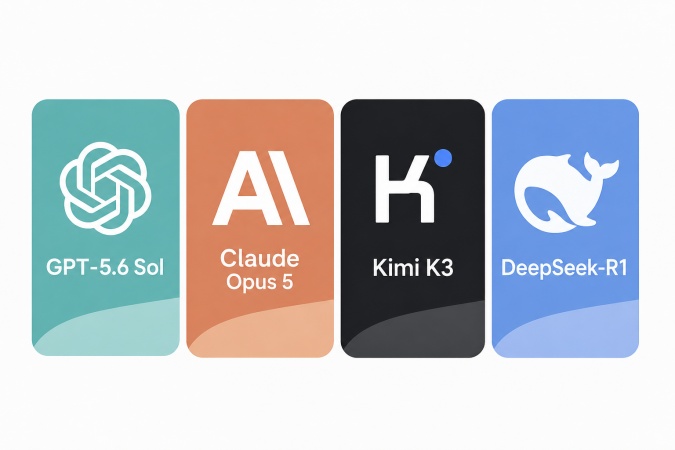
Choosing the best AI model for math problems is less about finding a universal winner than identifying the type of help you need. The table below provides a quick starting point by matching common math needs with the model or tool type that is most relevant to them. It is not a definitive ranking: model performance can vary by problem difficulty, model version, settings, and the way a question is written.
| Math Need | Suggested Starting Point | Primary Reason |
|---|---|---|
| Complex, multi-step reasoning | GPT-5.6 Sol | Designed for demanding reasoning workflows |
| Clear learning-oriented explanations | Claude Opus 5 | Useful for structured, readable walkthroughs |
| Long papers, notes, and research context | Kimi K3 | Can support long-context document workflows |
| Open-source or customizable deployment | DeepSeek-R1 | Relevant for flexible technical setups |
If you need a more detailed comparison, continue reading to see where each model may be most useful, what its limitations are, and when a dedicated AI math solver may be the simpler option.
Best AI Models for Math Compared
The four models below are general-purpose reasoning systems rather than dedicated calculators. They can help analyze and explain mathematical questions, but important answers should still be checked with independent calculations, a symbolic math tool, course materials, or expert review.
| Model | Main Strength | Useful For | Keep in Mind |
|---|---|---|---|
| GPT-5.6 Sol | Multi-step reasoning | Complex problems, competition-style questions, math and code | Verify arithmetic and final conclusions |
| Claude Opus 5 | Clear explanations | Learning, reviewing methods, structured walkthroughs | Fluent wording does not guarantee correctness |
| Kimi K3 | Long-context work | Papers, notes, lengthy derivations, research workflows | Context length does not replace validation |
| DeepSeek-R1 | Open-source flexibility | Testing, integration, private or custom workflows | Local deployment may require technical resources |
GPT-5.6 Sol --- Best AI Model for Math Reasoning and Complex Problems
GPT-5.6 Sol is a practical choice when a math problem requires more than applying a familiar formula. OpenAI positions the model for demanding reasoning, coding, and scientific work, which can make it useful for problems involving several linked steps, hidden constraints, alternative approaches, or a combination of mathematical reasoning and programming.
Best suited to:
-
Multi-step algebra, calculus, and probability problems
-
Competition-style or logic-heavy math questions
-
Turning a mathematical method into code
-
Comparing two possible solution strategies
To get more useful output, ask the model to identify the assumptions it is making, state the relevant theorem or formula, and check the answer using another method. This approach makes it easier to spot skipped steps or incorrect transformations.
For routine calculations, however, a general reasoning model may be more than you need. A calculator, symbolic engine, or dedicated solver can be faster when the task is simply to evaluate an expression or solve a standard equation.
Claude Opus 5 --- Best AI for Step-by-Step Math Explanations

Claude Opus 5 is a useful option for learners who want to understand a method rather than receive only an answer. Anthropic describes the model as being designed for problem-solving, knowledge work, and scientific tasks; in a math-learning setting, its structured responses can be useful for organizing a solution into clear stages, explaining why a method applies, and restating an idea in simpler language.
Best suited to:
-
Reviewing a worked solution after attempting a problem independently
-
Explaining algebra, calculus, and statistics concepts
-
Comparing a student's approach with another valid method
-
Creating practice questions with explanations
This can make Claude Opus 5 helpful for tutoring-style interactions. For example, instead of asking for the full answer immediately, a learner can ask for a hint, request feedback on one step, or ask why a particular substitution or theorem is appropriate.
The limitation is the same as with other language models: a polished explanation can still contain an error. It is worth checking each critical step, especially when working with proofs, signs, boundary conditions, or multi-part calculations.
Kimi K3 --- Best AI Model for Math Research and Long Context
Kimi K3 may be useful when math work is connected to a large amount of reference material. Kimi states that the model has a 1-million-token context window and is designed for long-horizon reasoning and knowledge-work workflows. This can help a model track definitions, notation, assumptions, and related passages across lengthy notes or documents.
Best suited to:
-
Summarizing mathematical papers or lecture notes
-
Organizing definitions and notation from a long document
-
Comparing several methods described in reference material
-
Preparing research questions or a structured reading plan
-
Working across mathematics, physics, and technical documentation
This type of workflow can save time when the challenge is finding and organizing relevant material rather than completing a single short calculation. It can also help users turn dense notes into a clearer outline before studying or writing.
However, a large context window does not prove that the model has interpreted every statement correctly. For research use, verify citations, definitions, claims, and derivations against the original source. AI can help with synthesis and exploration, but it should not replace formal peer review or mathematical validation.
DeepSeek-R1 --- Best Open-Source AI Model for Math

DeepSeek-R1 is relevant for users searching for an open-source AI model for math. Its published model card lists an MIT license and provides documentation for local and hosted use. Its accompanying technical report presents results across mathematics, code, and reasoning tasks, making it a relevant option for developers and technical teams that need greater control over access, integration, and deployment.
Best suited to:
-
Experimenting with math-focused prompts and workflows
-
Building custom applications that need reasoning features
-
Testing a model through a local or compatible hosted environment
-
Exploring privacy-conscious or self-managed deployment options
The appeal of an open-source model is flexibility, not necessarily simplicity. Running a model locally may require sufficient memory, processing power, model-serving software, and time to configure the environment. Hosted versions can reduce that setup burden, but pricing, performance, and data-handling practices vary by provider.
For users who only need occasional homework help, a browser-based math solver may be easier. For developers who need customization or integration, DeepSeek-R1 may be a more appropriate starting point.
To Solve Math Instantly, Try an AI Math Solver
General AI assistants are valuable when a question needs interpretation, explanation, or extended reasoning. Yet for everyday use---such as checking an incorrect answer, reviewing a worksheet, or solving a photographed equation---the user may prefer a direct input-to-solution workflow.
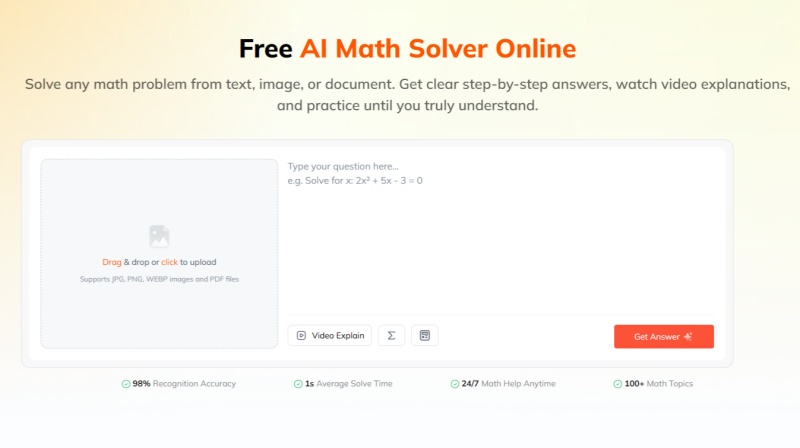
Tenorshare AI Math is powered by advanced AI models to interpret and solve mathematical questions across common homework formats. Instead of requiring users to refine a long prompt for each exercise, it is designed to turn typed questions, images, or documents into structured, step-by-step learning support.
Its key features include:
-
Multiple Input Options: Users can submit typed questions, images, or PDF files, which can be useful for worksheets, screenshots, and photographed homework.
-
Step-by-Step Solution Explanations: The tool presents the solving process and the reasoning behind each step rather than only returning a final answer.
-
AI-Generated Video Explanations: Visual explanations can help learners review more difficult concepts and follow a solution at their own pace.
-
Practice Question Generation: After solving a problem, users can generate similar exercises to reinforce the underlying method.
That workflow can be convenient for routine homework review, practice problems, and quick checks of standard calculations.
A dedicated AI math solver does not replace a general reasoning model. Instead, it can be a more direct option when the goal is to solve a routine problem, understand a missed step, or practice a method immediately after reviewing an answer.
Final Verdict: Which AI Model Is Better at Math?
The best AI model for math is the one that matches your specific mathematical task.
GPT-5.6 Sol is a sensible starting point for complex reasoning and problems with several dependent steps, while Claude Opus 5 may be more suitable when the quality and clarity of the explanation matter most. Kimi K3 can support research-oriented workflows that involve lengthy documents and extensive context, and DeepSeek-R1 offers an option for users who value open-source flexibility or custom deployment.
For faster day-to-day equation checks, homework review, and image-based questions, a dedicated tool such as Tenorshare AI Math may provide a more direct experience than a general AI assistant.

Tenorshare AI Math
- Solve math from text, images & PDFs at 98% accuracy
- Deliver step-by-step answers with detailed logic breakdown
- Access video explanations for deeper math concept understanding
- Generate matching practice tests to solidify knowledge

FAQs
-
Which AI Can I Use for Mathematics?
You can use a general AI model, a dedicated AI math solver, or a computational mathematics tool. General models are helpful for explanations and open-ended reasoning, while dedicated solvers can be more convenient for routine equations and structured step-by-step answers.
-
Which LLM Is the Best for Math?
There is no single best LLM for every math task. GPT-5.6 Sol is suited to complex reasoning, Claude Opus 5 to clear explanations, Kimi K3 to long-context workflows, and DeepSeek-R1 to open-source experimentation and deployment.
-
Which AI Is Best for Math?
The best AI for math depends on the problem type, the level of explanation you need, whether privacy or local deployment matters, and whether you want to work from typed text or an uploaded image. Testing the same problem in more than one tool can also help you compare results.
-
Which AI Is Better for Math: ChatGPT or Gemini?
The answer can change by model version, reasoning mode, and the type of question. Compare both tools using the same math problem, then evaluate the final answer, the logic of the intermediate steps, the explanation quality, and how well each tool follows your instructions. Important answers should be checked independently.
-
Which Is the Best AI Model for Math Proofs?
A strong reasoning model can help explore proof ideas, identify missing cases, and organize a draft. However, an AI-generated proof should not be considered valid without checking every definition, assumption, and logical step. Formal verification tools or expert review may be necessary for rigorous work.
-
Which Is the Best AI Model for Math Solving?
For difficult or unfamiliar questions, a general reasoning model can help explain possible methods and work through the logic. For standard equations, homework checks, and quick step-by-step answers, a dedicated AI math solver may be the more efficient option.
You Might Also Like
- 10 Best Mathway Alternatives in 2026: Free Math Solvers With Step-by-Step Solutions
- Which Is the Best AI for Calculus? Top Picks for Students in 2026
- 6 Best Photomath Alternatives in 2026: Math Apps and Online Tools Compared
- 8 Best AI Math Tutors in 2026 That Actually Help You Learn
- 2026 Best AI for Statistics: 6 Tools for Homework and Data Analysis
- AI Math Solver That Can Read Graphs: 5 Best Tools Reviewed

Tenorshare AI Math: Solve any math problems with AI
Turn math questions into clear solutions, tutorial videos & targeted practice setsTenorshare AI Math: Instant Solutions
Steps, videos & practice for every problem
Tenorshare AI Math: Solve any math problems with AI