
2026 ACT vs SAT Math: 8 Key Differences and How to Choose
Choosing between the ACT and SAT can be challenging, especially if math is either one of your strongest subjects or an area where you want more support.
Although SAT Math and ACT Math cover many of the same high school concepts, they test those skills in different ways. The differences in pacing, question style, calculator use, and scoring can make one exam a better fit than the other.
This guide breaks down ACT vs SAT Math in the areas that can have the biggest impact on your score. You'll see how the two sections compare, determine which test may better suit your strengths, and learn how to prepare after making your choice.
Catalogs:
Is ACT Math Easier Than SAT Math?
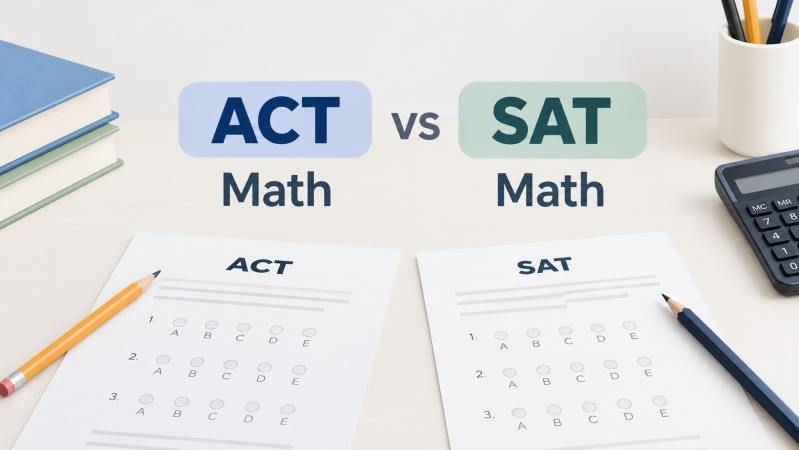
Many students assume that ACT Math will be easier because its questions can appear more direct and familiar. However, that assumption often changes after they take a timed practice test or compare the two sections more closely. The ACT's faster pace and wider topic range can be challenging, while SAT Math may require more reading, modeling, and multi-step reasoning.
ACT Math is not automatically easier than SAT Math. SAT Math may feel more manageable if you prefer extra time per question, are comfortable interpreting math in real-world contexts, and can use a graphing calculator strategically. ACT Math may be a better fit if you solve routine problems quickly, remember formulas well, and can move confidently between a broad range of topics.
Rather than asking if is ACT easier than SAT overall, focus on which format better matches your skills. The comparison below breaks down the key differences in timing, content, tools, and scoring so you can make that decision with more confidence.
SAT vs ACT Math: Complete Comparison
The table below reflects the current test formats published by the College Board and ACT. Because ACT delivery options can vary by registration and testing site, confirm the format available for your specific test date before registering.
| Difference | SAT Math | ACT Math |
|---|---|---|
| Delivery | Digital only | Paper or online, depending on the test administration |
| Structure | Two adaptive modules | One nonadaptive section |
| Questions | 44 total (22 per module) | 45 total (41 operational questions and 4 field-test questions) |
| Time | 70 minutes | 50 minutes |
| Average Time per Question | About 95 seconds | About 67 seconds |
| Response Types | Multiple-choice and student-produced response | Multiple-choice only, with four answer choices |
| Calculator | Available throughout; includes embedded Desmos and an approved personal-calculator option | An approved personal calculator is permitted but optional |
| Math Score | 200–800 | 1–36 |
SAT Math vs ACT Math: Questions, Time Limits, and Pacing

The SAT has 44 Math questions in 70 minutes, divided into two 35-minute modules. That works out to about 95 seconds per question.
ACT Math has 45 questions in 50 minutes, or about 67 seconds per question. In practical terms, ACT test takers have about 29 fewer seconds per question than SAT test takers.
The format also changes how that time feels:
-
SAT Math: The first module contains a range of difficulty levels. Performance on it determines whether the second module is more or less difficult.
-
ACT Math: The section is not adaptive. All test takers complete one Math section under the same time limit.
For students deciding between SAT Math vs. ACT Math, this is often the most noticeable difference. The SAT allows more time to interpret a question and check work; the ACT places more emphasis on efficient recall and pacing.
SAT Math vs ACT Math: Math Topics and Difficulty Level
Both tests assess high school math, but they organize and emphasize it differently.
SAT Math covers four official content areas:
| SAT Content Area | Approximate Number of Questions |
|---|---|
| Algebra | 13–15 |
| Advanced Math | 13–15 |
| Problem-Solving and Data Analysis | 5–7 |
| Geometry and Trigonometry | 5–7 |
About 30% of SAT Math questions are set in a real-world, science, or social studies context. This means students may need to interpret a short scenario before deciding which math method to use.
ACT Math reports two main skill categories:
-
Preparing for Higher Math (80%): Number and Quantity, Algebra, Functions, Geometry, and Statistics and Probability
-
Integrating Essential Skills (20%): Foundational mathematical reasoning and problem solving
-
Modeling: Integrated throughout the test rather than reported as a separate percentage
ACT describes its Math test as measuring skills students typically acquire through the beginning of Grade 12. The section rewards broad familiarity with school-math topics and the ability to recognize an efficient solution method quickly.
Put simply, SAT Math more often asks students to apply a smaller set of core skills in context, while ACT Math requires faster movement across a wider mix of mathematical knowledge.
SAT Math vs ACT Math: Calculator Rules, Formula Support, and Test Format
Both exams allow calculator use throughout the Math section, but the testing tools are different.
On the Digital SAT:
-
Desmos is built into the Bluebook testing app.
-
Students may also bring an approved calculator.
-
A reference sheet is available on Math questions.
-
Some questions require a student-produced response rather than a selected answer.
On the ACT:
-
A permitted personal calculator may be used on the Math test, but it is optional.
-
ACT does not provide an embedded graphing calculator such as Desmos.
-
All Math questions are multiple-choice, with four answer options.
These differences can affect strategy. Students who use graphing technology effectively may prefer SAT Math, while students who are comfortable solving quickly with their own calculator may find ACT Math more familiar.
How Math Affects Your Overall SAT or ACT Score

Math has a larger share of the total score on the SAT.
SAT: Math is scored from 200 to 800 and makes up half of the 400--1600 total score.
ACT: Math is scored from 1 to 36. The current Composite score is the average of English, Math, and Reading, so Math is one of three equally weighted components. Science is optional and reported separately.
This does not mean that students who are strong in math should automatically choose the SAT. However, a high Math score has a more direct effect on the SAT total score , while ACT Math is balanced with performance in English and Reading . Consider that difference alongside your practice-test results when deciding which test better matches your strengths.
Should You Take the SAT or ACT for Math?

Consider the SAT if you:
-
Prefer more time per question
-
Are comfortable with digital testing
-
Like algebra, functions, and data-based questions
-
Benefit from an integrated Desmos calculator
-
Tend to be accurate but not especially fast
Consider the ACT if you:
-
Solve routine math questions quickly
-
Are comfortable memorizing formulas
-
Have a broad foundation in geometry and trigonometry
-
Prefer a predictable, nonadaptive section
-
Can maintain accuracy under a tighter time limit
The most reliable way to choose is to take one official, timed practice test for each exam . Compare not only your scores, but also your pacing, error patterns, and confidence. A student who misses easy ACT questions because of time pressure may be a better SAT candidate. A student who dislikes longer SAT-style word problems may prefer ACT Math.
What to Do After You Choose Your Test
Choosing the SAT or ACT is only the first step. Your preparation should reflect the format that you selected rather than following a generic math-study routine. The most effective plan starts with official practice, identifies the reasons behind missed questions, and then targets the skills that matter most for that exam.
SAT Math: Prioritize Adaptive Practice and Error Analysis
SAT Math preparation should focus on both content mastery and performance across the two adaptive modules. Start with an official full-length Digital SAT practice test to establish a baseline. Then sort missed questions into clear categories, such as algebra, advanced math, data analysis, geometry and trigonometry, question interpretation, or calculator use.
Focus on these priorities:
-
Strengthen high-frequency skills, including linear equations, functions, quadratics, ratios, percentages, and data analysis.
-
Practice interpreting questions set in real-world or academic contexts.
-
Learn when Desmos is helpful and when direct algebra is faster.
-
Review why an answer was wrong, not only what the correct answer is.
-
Track whether errors result from a knowledge gap, a reading mistake, a calculation error, or inefficient pacing.
For SAT Math, strong performance in the first module matters because it influences the difficulty of the second module. Students should aim for consistent accuracy on accessible questions before concentrating heavily on the most difficult problems.
ACT Math: Prioritize Pacing and Broad Topic Review
ACT Math preparation should combine broad content review with timed practice. Because the section moves quickly, students need to recognize common question types and choose an efficient approach without spending too long on any one problem.
Focus on these priorities:
-
Review the full range of tested skills, especially algebra, functions, geometry, statistics, probability, and trigonometry.
-
Memorize and apply commonly tested formulas before test day.
-
Complete short timed sets to build speed without sacrificing accuracy.
-
Identify questions that should be solved immediately and questions that should be revisited later.
-
Analyze skipped questions, careless errors, and topics that take too long to solve.
Students who want to improve their ACT Math score should not rely only on more practice questions. They should identify whether their main barrier is missing content knowledge, weak formula recall, calculation errors, or time management.
Improve Your Math Test Score With Tenorshare AI Math
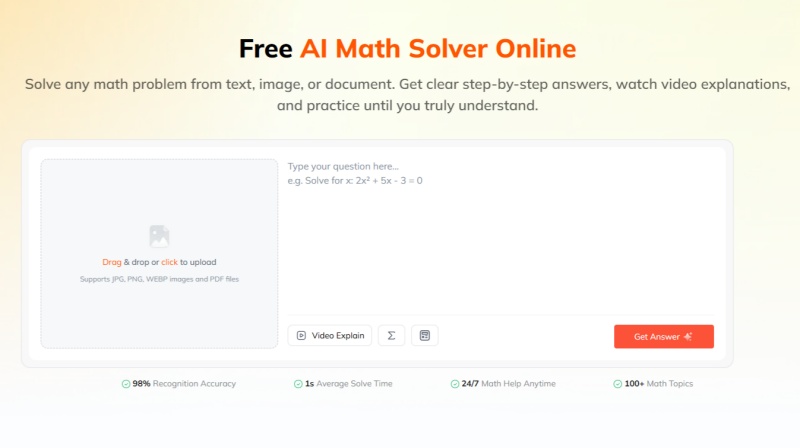
Practice questions are essential for improving your SAT or ACT Math score. However, reviewing mistakes can become inefficient when checking answers takes too long or when it is difficult to find a clear explanation for a problem you could not solve. If that sounds familiar, an AI math solver such as Tenorshare AI Math can help make your review process faster and more focused.
For SAT and ACT Math preparation, use it after completing a problem independently. Upload a question, compare your approach with the explanation, and identify whether the issue came from a missing concept, an incorrect setup, or a calculation error.
Key features include:
-
Multiple Input Options: Enter a question as text or upload an image or PDF file.
-
Step-by-Step Solution Explanations: See the reasoning behind each step instead of receiving only a final answer.
-
AI-Generated Video Explanations: Use visual explanations to revisit difficult concepts or follow a solution process at a more manageable pace.
-
Practice Question Generation: Generate similar questions after reviewing a missed problem to check whether you can apply the same concept independently.
-
Built-In Math Calculator: Handle basic calculations and mathematical expressions without switching between multiple tools during a study session.
AI math tools work best as a supplement to official SAT or ACT practice. Use them to understand errors and reinforce weak skills, then return to official timed questions to confirm that you can solve similar problems independently.
Final Verdict: Is ACT or SAT Easier for Math?
Neither test is universally easier. The better choice depends on how you handle time pressure, question style, and different areas of high school math.
Choose SAT Math if you prefer more time per question, digital tools such as Desmos, and algebra- or data-focused problem solving. Choose ACT Math if you work quickly, have a broad math foundation, and feel confident managing a faster pace.
The best ACT vs SAT Math decision should be based on your own timed practice results. Take official practice tests, compare both your score and error patterns, then focus on the exam that better fits your strengths. For more efficient mistake review between practice sessions, Tenorshare AI Math can help you work through difficult problems and reinforce weak topics.

Tenorshare AI Math
- Solve math from text, images & PDFs at 98% accuracy
- Deliver step-by-step answers with detailed logic breakdown
- Access video explanations for deeper math concept understanding
- Generate matching practice tests to solidify knowledge

FAQs
-
Is the ACT Easier Than the SAT Overall?
Neither test is easier for every student. The SAT is fully digital and adaptive, with more time per question. The ACT is more linear and faster-paced, with optional Science and Writing sections. Your reading speed, math background, and comfort with digital testing can all affect which exam feels easier.
-
What Is a Good ACT Math Score?
A good ACT Math score depends on your goals and college list. A score near or above the middle 50% range for your target colleges is usually a useful benchmark. For highly selective programs, you may need a substantially higher section score. Check each college's published admitted-student profile and compare it with current ACT percentile information.
-
What Math Is on the ACT?
ACT Math covers mathematical reasoning from pre-algebra through trigonometry. Common areas include algebra, coordinate geometry, plane geometry, probability, statistics, functions, and trigonometry. Some questions may also involve logarithms, matrices, or complex numbers.
-
What Math Is on the SAT?
SAT Math covers Algebra, Advanced Math, Problem-Solving and Data Analysis, and Geometry and Trigonometry. Expect questions involving linear equations, systems, functions, quadratics, percentages, ratios, statistics, probability, and basic geometry.
-
How Many Math Questions Are on the SAT?
The SAT Math section has 44 SAT math problems total. It is divided into two modules, each with 22 questions and 35 minutes of testing time.
-
What Level of Math Is on the SAT?
The SAT primarily tests math taught through Algebra II, including algebra, functions, data analysis, and basic geometry and trigonometry. You do not need a full precalculus course to prepare effectively, but a strong foundation in Algebra I and Algebra II is important.
You Might Also Like
- Descriptive vs Inferential Statistics: Differences, Examples & Uses
- How to Use Desmos for SAT 2026: Master the Digital SAT Calculator
- 15 Hardest Digital SAT Math Questions With Answers & Strategies
- Is AP Statistics Hard? A Complete Guide to AP Stats Difficulty [2026]
- 50+ Statistics Project Ideas for High School & College
- Is Statistics Harder Than Calculus? Which Should You Take? [2026]

Tenorshare AI Math: Solve any math problems with AI
Turn math questions into clear solutions, tutorial videos & targeted practice setsTenorshare AI Math: Instant Solutions
Steps, videos & practice for every problem
Tenorshare AI Math: Solve any math problems with AI