
Is AP Statistics Hard? A Complete Guide to AP Stats Difficulty [2026]
When choosing an AP math course, many students ask: is AP Statistics hard ? The answer depends on your math background, learning style, and comfort level with analyzing data.
Unlike many traditional math classes that focus mainly on formulas and calculations, AP Statistics emphasizes interpreting data, understanding statistical concepts, and explaining conclusions. Students often find the course challenging not because of advanced calculations, but because it requires a different way of thinking.
This guide explains how hard AP Statistics is, what topics the course covers, how it compares with other math classes, and how to prepare effectively.
Catalogs:
What Is AP Statistics?

AP Statistics is a college-level introductory statistics course offered by the College Board. The course teaches students how to collect, analyze, and interpret data using statistical methods.
For students wondering what is AP Statistics, it is not simply a class about calculating averages or creating graphs. Instead, it focuses on using data to answer questions, evaluate evidence, and make conclusions based on statistical reasoning.
Compared with many other math courses, AP Statistics places more emphasis on understanding the meaning behind calculations. Students need to explain why a method is appropriate and what the results mean in a real-world context.
What Topics Does AP Statistics Cover?
So, what does AP Statistics cover ? The course is usually divided into several major areas:
-
Exploring Data: Learning how to describe patterns, distributions, and relationships in data.
-
Sampling and Experimentation: Understanding how surveys and experiments are designed and how data is collected.
-
Probability and Random Variables: Studying uncertainty and using probability models to make predictions.
-
Statistical Inference: Learning how to use sample data to make conclusions about larger populations.
Students also learn concepts such as confidence intervals, hypothesis testing, correlation, and regression analysis.
Although some calculations are involved, success in AP Statistics often depends more on understanding when and how to apply statistical methods.
What Do You Do in AP Statistics?
Many students ask what do you do in AP Statistics because the course is different from typical algebra or calculus classes.
In AP Statistics, students may:
-
Analyze real-world datasets
-
Create and interpret graphs
-
Design surveys and experiments
-
Calculate probabilities
-
Evaluate statistical claims
-
Explain conclusions using statistical evidence
For example, instead of only solving an equation, students may need to decide whether a study provides enough evidence to support a claim and explain their reasoning.
This focus on interpretation is one reason some students find AP Statistics unfamiliar at first.
How Hard Is AP Statistics?

The question how hard is AP Statistics does not have one universal answer. The difficulty depends on a student's previous math experience, study habits, and ability to understand statistical reasoning.
AP Statistics is generally considered a challenging AP course, but it does not require the same type of mathematical thinking as courses like calculus. Students who are comfortable reading graphs, analyzing information, and explaining ideas may find the course manageable even if they do not consider themselves advanced math students.
On the other hand, students who prefer solving problems with clear formulas and fixed procedures may need more time to adjust.
Is AP Statistics Easy or Difficult for Most Students?
The answer to is AP Statistics easy depends on what type of learner you are.
Some students find AP Statistics easier than other advanced math courses because:
-
It uses fewer complex calculations than calculus.
-
Many concepts connect to real-life situations.
-
Understanding ideas is often more important than memorizing formulas.
However, the course can still be difficult because students must:
-
Interpret unfamiliar situations
-
Choose the correct statistical method
-
Write clear explanations
-
Understand probability and inference
In other words, AP Statistics may feel easier for students who enjoy reasoning and analysis, while it may feel harder for students who prefer step-by-step calculation problems.
What Math Skills Do You Need for AP Statistics?
Students do not usually need advanced calculus skills to succeed in AP Statistics. A strong foundation in algebra is generally more important.
Helpful skills include:
-
Understanding equations and variables
-
Working with percentages and ratios
-
Reading graphs and tables
-
Using logical reasoning
-
Explaining solutions clearly
Basic calculator skills are also useful because statistical calculations often involve technology.
Students who have completed Algebra 2 or an equivalent course often have the mathematical background needed for AP Statistics.
Why Is AP Statistics So Hard?
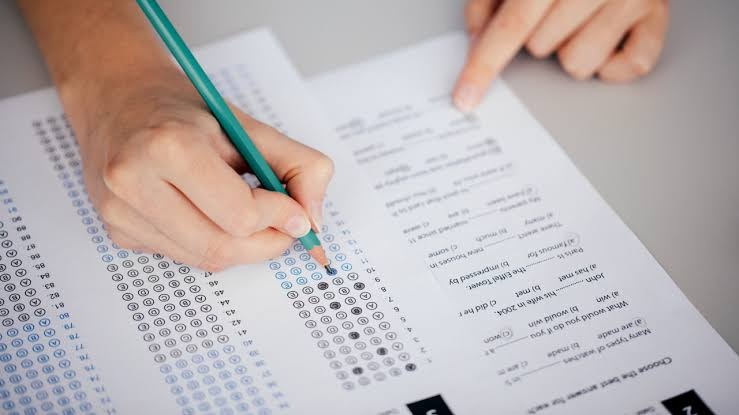
If you are wondering why is AP Statistics so hard, the answer is usually not advanced mathematics. The main challenge is learning how to think statistically and apply concepts to different situations.
AP Statistics often requires students to move beyond simply finding the correct numerical answer . You may need to identify an appropriate method, explain why it works, and interpret the result in the context of the problem.
Another challenge is that similar-looking problems may require different approaches . For example, choosing between a confidence interval and a hypothesis test requires you to understand the purpose of each method rather than simply follow a memorized formula.
Probability, sampling distributions, confidence intervals, and hypothesis testing can also take time to understand because they introduce ideas that may be unfamiliar to students.
Is AP Statistics Harder Than Other Math Classes?
Comparing AP Statistics with other math classes can be useful when deciding which course fits your background and interests. However, difficulty varies from student to student because different courses require different types of mathematical thinking.
AP Statistics tends to emphasize data analysis, probability, statistical inference, and written interpretation. Calculus focuses more heavily on functions, limits, derivatives, integrals, and mathematical procedures.
Is AP Statistics Harder Than AP Calculus?
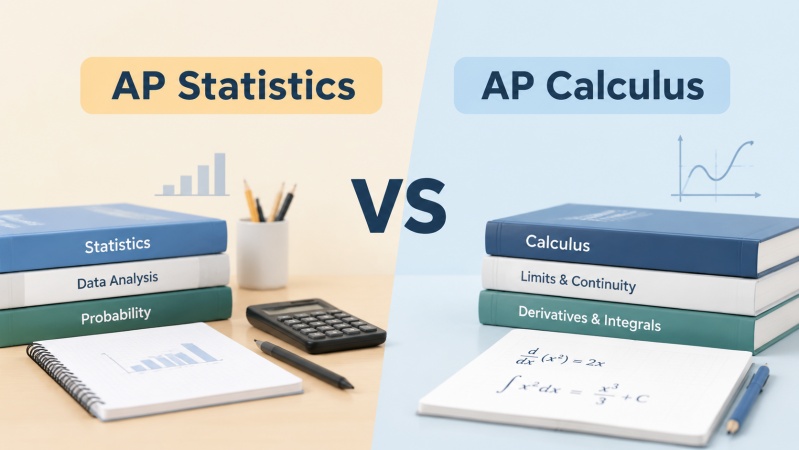
Students often ask, is AP Statistics harder than calculus? There is no universal answer because the two courses challenge students in different ways.
AP Calculus generally involves more advanced algebraic manipulation and concepts such as limits, derivatives, and integrals. AP Statistics generally involves less advanced computation but requires more interpretation of data and statistical reasoning.
A student who prefers symbolic calculations may find calculus more familiar, while someone who enjoys analyzing data and explaining conclusions may find statistics more approachable.
Therefore, comparing the courses based only on which one is "harder" can be misleading. The type of mathematics you are more comfortable with can have a significant effect on your experience.
Is AP Statistics Harder Than AP Precalculus?
AP Precalculus focuses on functions and mathematical relationships, including polynomial, rational, exponential, logarithmic, and trigonometric functions. AP Statistics instead focuses on data, probability, sampling, and statistical inference.
For students moving from AP Precalculus to AP Statistics, the main challenge may be the change in problem-solving style. Instead of primarily manipulating equations and functions, you will often need to interpret data and communicate statistical conclusions.
The two courses also serve different purposes, so your experience with one does not necessarily predict how difficult you will find the other.
Best Resources for Learning and Preparing for AP Statistics
Finding the right resources can make AP Statistics easier to understand and practice. Because the course focuses heavily on statistical reasoning, students usually benefit from a combination of concept explanations, exam-style questions, and tools that help explain difficult problems.
Instead of relying on a single resource, many students use different materials for learning concepts, practicing questions, and reviewing mistakes.
AP Statistics Textbooks and Review Books
A good AP Statistics textbook or review book can help students organize important concepts, formulas, and problem-solving strategies.
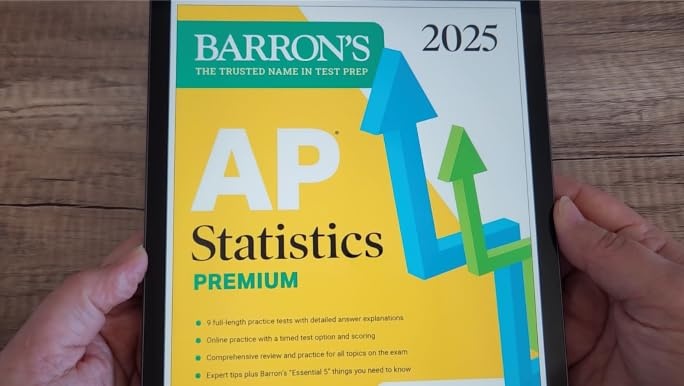
Some commonly used AP Statistics preparation books include:
-
Barron's AP Statistics Premium: Known for detailed explanations and extensive practice material. It can be useful for students who want a thorough review of statistical concepts, although the amount of content may feel overwhelming for some learners.
-
The Princeton Review AP Statistics Premium Prep: Offers a more streamlined approach with review chapters, exam strategies, and practice tests. It may be suitable for students who want a balance between concept review and exam preparation.
-
5 Steps to a 5: AP Statistics : Provides a structured study plan and review schedule, which can help students who prefer a step-by-step preparation process.
-
UWorld AP Statistics Study Guide : Combines content review with practice questions and explanations designed around AP-style problems.
When choosing a review book, students should consider their goal. Those who need to rebuild their understanding of statistics may prefer more detailed explanations, while students who already know the basics may benefit more from practice-focused resources.
AP Statistics Practice Exams and Question Banks
Practice is one of the most important parts of preparing for AP Statistics because the exam tests whether students can apply statistical concepts in different situations.
AP Statistics practice exams help students become familiar with:
-
Multiple-choice question formats
-
Free-response question expectations
-
Time management during the exam
-
Common statistical reasoning patterns
Students can use official College Board practice materials as well as third-party resources such as UWorld, Barron's, and Princeton Review. Many of these resources include AP Statistics practice questions with explanations to help students understand why an answer is correct or incorrect.
When reviewing practice questions, focus on the reasoning process instead of only checking the final answer. For example:
-
Why is this statistical method appropriate?
-
What does this result mean in the context of the problem?
-
Did the conclusion correctly explain the evidence?
This approach is especially important for AP Statistics because written explanations often determine whether an answer receives full credit.
AI Math Solvers for Step-by-Step AP Statistics Problem Solving
AI math solvers can be useful for students who need additional support when reviewing AP Statistics problems. Unlike traditional calculators that mainly provide numerical results, AI-powered math solvers can help explain the steps behind a solution and show how a problem is approached.
For AP Statistics students, this can be helpful when reviewing topics such as probability calculations, data analysis, and statistical problems that involve multiple steps.
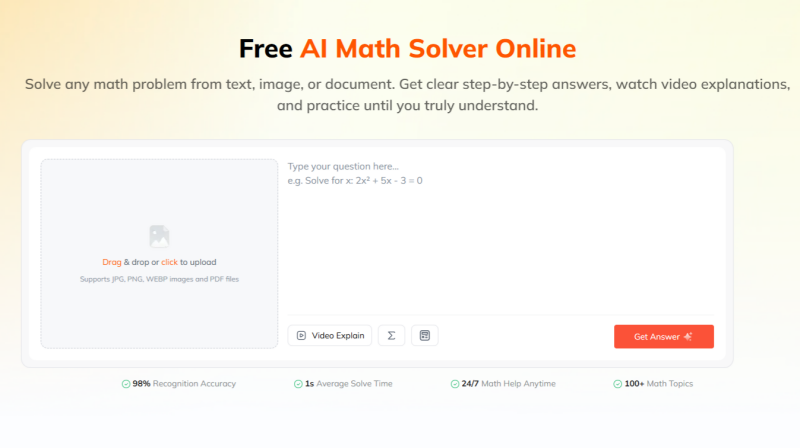
Tools like Tenorshare AI Math are designed to help students understand the solving process through features such as:
-
Step-by-step solutions: Breaks down each step of a problem-solving process, helping students understand the reasoning behind the solution and identify where mistakes may have occurred.
-
Text, image, and PDF input: Supports typed questions as well as problems from worksheets, screenshots, and PDF documents, making it easier to review problems from different learning materials.
-
AI-generated video explanations: Provides visual walkthroughs for problems that may be difficult to understand through written explanations alone.
-
Similar practice questions: Generates related problems so students can practice applying the same concepts and improve their understanding through repetition.
-
Built-in math calculator: Helps handle routine calculations that appear during multi-step math problems.
When using AI math solvers for AP Statistics, students should focus on understanding why each step is performed instead of only checking the final answer. These tools work best as learning assistants that support concept review, problem analysis, and independent practice.
Final Thoughts: Is AP Statistics Hard?
So, is AP Statistics hard ?
The answer depends on your background, learning style, and preparation. AP Statistics can be challenging because it requires more than completing calculations. Students need to understand statistical concepts, choose appropriate methods, interpret data, and explain their reasoning clearly.
Using the right resources can also make learning AP Statistics easier. Textbooks, practice questions, official exam materials, and learning tools can help students strengthen their understanding. For students who need extra support with difficult problems, Tenorshare AI Math can provide step-by-step solutions, explanations, and practice support to help review AP Statistics concepts more effectively.
Overall, AP Statistics is not a course that depends only on advanced math skills. With consistent practice and a focus on understanding the reasoning behind each problem, many students can successfully build the skills needed for the course and exam.

Tenorshare AI Math
- Solve math from text, images & PDFs at 98% accuracy
- Deliver step-by-step answers with detailed logic breakdown
- Access video explanations for deeper math concept understanding
- Generate matching practice tests to solidify knowledge

FAQs
-
Is AP Statistics Hard If You Are Not Good at Math?
Not necessarily. AP Statistics requires mathematical skills, but it also places substantial emphasis on interpretation, reasoning, and communication. Students who are not particularly strong at advanced calculations may still do well if they have a solid algebra foundation and are willing to practice statistical concepts.
-
Is AP Statistics Easy for Students Who Are Good at Math?
Being good at math can provide a useful foundation, but it does not automatically make AP Statistics easy. Students also need to understand statistical terminology, interpret data, and explain conclusions in context.
-
Why Do Students Struggle With AP Statistics?
Students may struggle because the course requires a different approach to problem solving. Common challenges include probability, statistical inference, choosing the appropriate method, and writing explanations that correctly interpret the results.
-
How Long Does It Take to Learn AP Statistics?
There is no fixed amount of time required to learn AP Statistics. Most students take the course over an academic year, while independent learners may need more or less time depending on their previous math background and study schedule. Consistent practice is generally more useful than trying to learn the entire course in a short period.
-
Can You Take AP Statistics Without Taking Calculus?
Yes. AP Statistics does not generally require students to take AP Calculus first. The mathematical foundation is more closely related to algebra, while the course focuses on probability, data analysis, and statistical inference.
You Might Also Like
- How to Isolate a Variable: Definition, Step-by-Step Tutorial & Common Mistakes
- Geometric Terms List: 30+ Geometry Terms You Should Know
- Is Geometry Hard? What Makes Geometry Difficult & How to Simplify It
- Geometry Proofs: How to Think Through and Solve Any Proof
- How to Improve Math Skills: 5 Practical Ways to Get Better at Math 2026

Tenorshare AI Math: Solve any math problems with AI
Turn math questions into clear solutions, tutorial videos & targeted practice setsTenorshare AI Math: Instant Solutions
Steps, videos & practice for every problem
Tenorshare AI Math: Solve any math problems with AI