
Is Statistics Harder Than Calculus? Which Should You Take? [2026]
Choosing between statistics and calculus can be confusing because both subjects can be important for college and career preparation, yet they develop very different skills. Statistics focuses on using data to make informed conclusions, while calculus focuses on understanding change, functions, and mathematical relationships.
So, is statistics harder than calculus ? The answer depends on the course level, your current math preparation, and your academic goals. This guide compares statistics and calculus through key topics, prerequisite skills, real math problems, and course requirements to help you decide which subject better fits your future plans.
Catalogs:
The Short Answer: Is Statistics Harder Than Calculus?

There is no universal answer to whether statistics is harder than calculus. The two subjects are challenging in different ways, and the answer can change depending on the level of the course.
Introductory statistics commonly focuses on data collection, probability, statistical inference, regression, and interpreting results. Many introductory statistics courses are designed for students with an algebra background and do not require previous calculus experience.
Calculus focuses on limits, derivatives, integrals, differential equations, and applications of change. AP Calculus AB, for example, is equivalent to a first-semester college calculus course and recommends a stronger background in algebra, geometry, trigonometry, analytic geometry, and elementary functions.
The main difference is not simply how much math each course contains. Statistics asks students to use data and evidence to support a conclusion, while calculus asks students to analyze functions and mathematical relationships.
How Statistics and Calculus Differ in Practice
In statistics, students often work with a real-world question and a set of data. They may need to identify the population and sample, choose an appropriate method, calculate a result, and explain what the result means in context.
For example, if 60 out of 100 surveyed students support a proposed policy, the task may be to determine whether the sample provides enough evidence to conclude that more than half of all students support it. The answer requires both a calculation and a clear conclusion based on the data.
In calculus, students often begin with a function, graph, or mathematical model. They use tools such as derivatives and integrals to describe how a quantity changes, locate maximum or minimum values, or calculate accumulated change.
For example, given f(x) = x3 - 4x2 + 5x, a student may find the derivative, solve f'(x) = 0, and use the result to identify critical points and intervals where the function increases or decreases.
This is why statistics and calculus should not be treated as interchangeable math courses. The better choice depends on the skills you want to develop and the requirements of your intended major.
Statistics vs Calculus Difficulty: A Comparison of Key Topics
Statistics and calculus develop different mathematical skills and prepare students for different types of academic work.
| Area | Statistics | Calculus |
|---|---|---|
| Main focus | Data, probability, uncertainty, and evidence | Change, accumulation, functions, and mathematical models |
| Common topics | Sampling, distributions, regression, confidence intervals, and hypothesis testing | Limits, derivatives, integrals, optimization, and differential equations |
| Typical task | Select a method, analyze data, and explain a conclusion | Apply mathematical rules to analyze a function or model |
| Mathematical foundation | Algebra, graphs, and quantitative reasoning for many introductory courses | Algebra, functions, geometry, and often trigonometry |
| Assessment style | Applying methods and communicating conclusions in context | Showing mathematical reasoning through multi-step solutions |
| Common academic uses | Data analysis, research, business, social sciences, and health | STEM, economics, engineering, physics, and mathematical modeling |
AP Statistics emphasizes collecting and analyzing data, using probability and simulation, and drawing conclusions from statistical reasoning. It is often a useful choice for students whose future coursework involves research, data, or evidence-based decisions.
AP Calculus AB emphasizes limits, differentiation, integration, and applications of calculus. It is often more relevant for students planning to continue in mathematics, engineering, physical sciences, economics, or other fields that require a calculus sequence.
Rather than asking which subject is universally harder, compare the actual course description, prerequisites, and role of the course in your academic plan. This gives you a more practical way to decide whether statistics or calculus is the better next step.
Statistics vs Calculus: Comparing Real Math Problems
Looking at typical problems makes the difference clearer.
Consider a simple statistics problem:
A survey finds that 60 out of 100 randomly selected students support a proposed change. A question might ask whether the sample provides enough evidence to conclude that more than half of the student population supports the change.
To solve it, you need to identify the population and sample, choose an appropriate inference method, calculate the relevant statistic, and interpret the result in context.
Now consider a calculus problem:
Given f(x) = x^3 - 4x^2 + 5x, find the critical points and determine where the function is increasing or decreasing.
Here, the process is more direct. You first find the derivative,
f'(x) = 3x^2 - 8x + 5,
then solve f'(x) = 0 and use the results to analyze the function.
Neither problem is automatically harder. They test different skills. The statistics problem places greater emphasis on interpreting a situation and selecting an appropriate method, while the calculus problem requires procedural fluency and an understanding of how derivatives describe a function.
This is one reason searches such as "calculus vs statistics which is harder" do not have a single mathematical answer. Difficulty depends partly on which type of reasoning feels more natural to you.
Should You Take Statistics or Calculus?
The better choice depends on your school requirements, intended major, current math preparation, and the type of mathematics you want to study.
You should also check the actual prerequisites for your school rather than assuming that statistics and calculus have the same course sequence.
AP Statistics vs AP Calculus
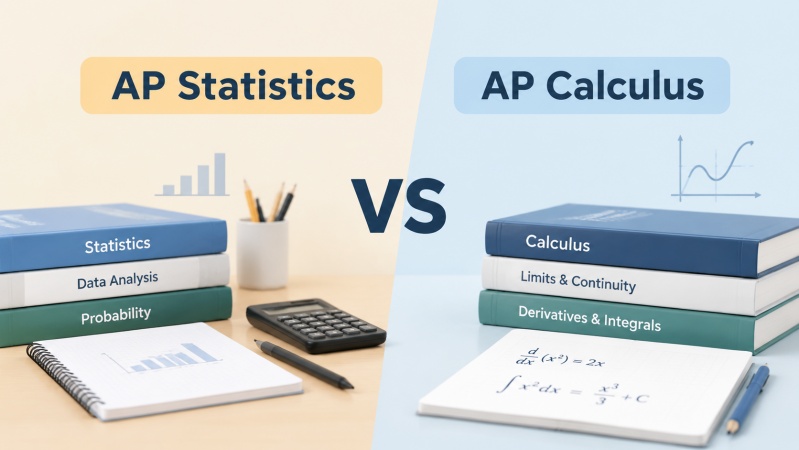
AP Statistics and AP Calculus AB are not simply two versions of the same level of mathematics.
AP Statistics is an introductory, non-calculus-based statistics course. Its content includes exploring and collecting data, probability and simulation, statistical inference, and regression.
AP Calculus AB is an introductory college-level calculus course covering differential and integral calculus. Its recommended preparation includes algebra, geometry, trigonometry, analytic geometry, and elementary functions.
The AP Statistics exam also places substantial emphasis on applying statistical methods and communicating conclusions. The current exam includes both multiple-choice and free-response questions, with statistical practices assessed throughout the course.
Therefore, choosing between AP Statistics and AP Calculus should not be based only on which course sounds easier.
Also Read: Is AP Statistics Hard? A Complete Guide to AP Stats Difficulty [2026]
College Statistics vs College Calculus
At the college level, course names can cover very different material.
An introductory statistics course for non-STEM students may require little or no calculus. A probability or mathematical statistics course for STEM students can be much more mathematically demanding and may use calculus extensively.
The same applies to calculus. Calculus I, Calculus II, business calculus, and advanced calculus courses can have substantially different content and prerequisites.
This is why comparing "college statistics" with "college calculus" without checking the course descriptions can produce a misleading conclusion.
Choosing Based on Your Major and Math Background

Your academic plans may be more important than a general difficulty comparison.
If your major requires calculus, taking calculus may help you meet prerequisites for later courses. This is common in areas that use mathematical modeling or require a calculus sequence.
Statistics may be particularly relevant for fields involving data analysis, social science, business, health research, or other areas where interpreting data and uncertainty is important.
Your existing strengths also matter. Students who are comfortable with algebraic manipulation and structured calculations may prefer some calculus problems, while students who enjoy working with data and explaining patterns may find statistics more natural.
The most useful question is therefore not simply "calculus vs statistics which is harder?" but "which course matches my academic requirements and current strengths?"
How to Make Statistics and Calculus Easier to Learn
The two subjects require different approaches, but the basic learning process is similar: understand the concept, work through examples, practice independently, and review mistakes.
Build Your Math Foundations and Practice Regularly
For calculus, review algebra, functions, equations, and trigonometry before moving into more advanced topics. Weak algebra skills can make differentiation and integration problems harder than they need to be.
For statistics, focus on understanding terminology and relationships between concepts rather than memorizing formulas in isolation. Practice identifying what a problem is asking before choosing a statistical method.
For both subjects, work through different types of problems instead of repeating the same format. After solving a problem, check not only whether the final answer is correct but also whether the reasoning supports it.
Understand Difficult Problems With An AI Math Solver
Some statistics and calculus problems are difficult not because the calculation is complicated, but because it is unclear which step to take next or why a particular method works. An AI Math Solver can be another useful option when you need to check your work, understand a difficult step, or review a problem after solving it yourself.
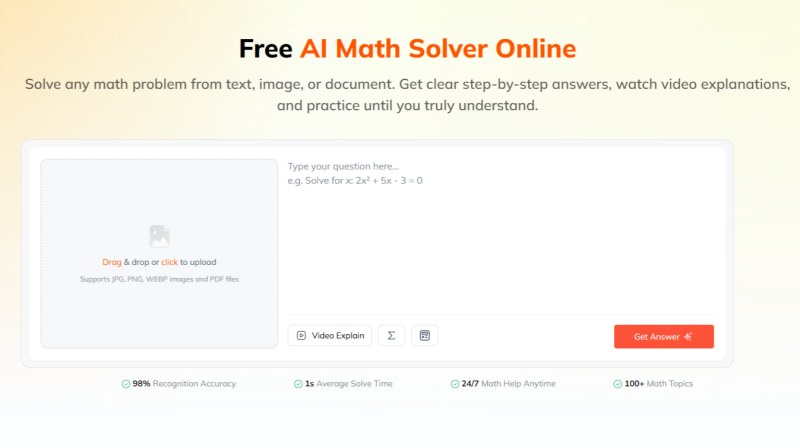
Tenorshare AI Math supports both statistics and calculus problems with features designed for step-by-step learning:
-
Step-by-step solutions: Breaks complex problems into smaller steps, making it easier to follow the reasoning and locate mistakes.
-
Text, image, and PDF input: Lets you enter an equation or upload problems from worksheets, screenshots, or PDF files.
-
AI-generated video explanations: Provides visual explanations when written solution steps are difficult to follow.
-
Similar practice questions: Creates related problems so you can apply the same concepts and methods to new questions.
-
Built-in math calculator: Handles routine calculations that come up while working through longer math problems.
Used this way, an AI Math Solver is not just an answer tool. It can help you review the reasoning behind a solution and practice the same type of problem independently.
Final Thoughts: Is Statistics Harder Than Calculus ?
So, is statistics harder than calculus ? There is no single answer that applies to every student or every course. The two subjects emphasize different skills, so their difficulty can depend on your mathematical background, learning style, and course level.
Introductory statistics often involves interpreting data, choosing appropriate methods, and communicating conclusions, while calculus focuses more on functions, limits, derivatives, integrals, and their applications. If you are working through difficult problems in either subject, tools such as Tenorshare AI Math can also help you check your steps, understand the reasoning, and practice similar problems.
Rather than deciding which subject is universally harder, compare the actual course content, prerequisites, assessment style, and your academic goals. This gives you a more practical basis for deciding what to study and how to prepare.

Tenorshare AI Math
- Solve math from text, images & PDFs at 98% accuracy
- Deliver step-by-step answers with detailed logic breakdown
- Access video explanations for deeper math concept understanding
- Generate matching practice tests to solidify knowledge

FAQs
-
Is Business Calculus Harder Than Statistics?
There is no general rule that business calculus is harder than statistics. Business calculus usually applies derivatives, integrals, and optimization to business or economic problems, while introductory statistics focuses on data, probability, inference, and interpretation. The actual difficulty depends on the course syllabus and your strengths.
-
Is Probability and Statistics Harder Than Calculus?
It depends on the level of the probability and statistics course. Introductory non-calculus-based statistics can have relatively limited calculus requirements, while probability and statistics courses for STEM or mathematics students may use calculus extensively. Therefore, "is probability and statistics harder than calculus" cannot be answered without specifying the courses being compared.
-
Is Statistics the Hardest Math?
Statistics is not inherently the hardest branch of mathematics. Mathematics includes many areas with very different levels of abstraction and prerequisites, including algebra, geometry, calculus, probability, statistics, linear algebra, and real analysis. Difficulty also varies substantially between introductory and advanced courses.
-
Is It Better to Take Calculus or Statistics First?
Neither course always needs to come first. The best order depends on your school, major, and future course requirements. AP Statistics is an introductory non-calculus-based course, while AP Calculus AB requires stronger preparation in algebra, geometry, trigonometry, and related topics. If your future courses require calculus, taking it earlier may be useful; if your program mainly requires statistics, statistics may be more immediately relevant. Check your school's prerequisites before deciding.
-
Is Statistics a Higher Math Than Calculus?
Statistics is not simply a higher or lower level of mathematics than calculus. They are different mathematical disciplines with overlapping areas and different applications. Some advanced statistics courses use calculus, probability theory, linear algebra, and other higher-level mathematics, but that does not make statistics a higher level than calculus as a whole.
You Might Also Like
- Why Is Statistics So Hard to Understand? 5 Real Reasons
- Is AP Statistics Hard? A Complete Guide to AP Stats Difficulty [2026]
- How to Isolate a Variable: Definition, Step-by-Step Tutorial & Common Mistakes
- Geometric Terms List: 30+ Geometry Terms You Should Know
- Is Geometry Hard? What Makes Geometry Difficult & How to Simplify It
- Why Is AI Bad at Math? Understand AI Math Mistakes & Pick a Trustworthy AI Math Tool

Tenorshare AI Math: Solve any math problems with AI
Turn math questions into clear solutions, tutorial videos & targeted practice setsTenorshare AI Math: Instant Solutions
Steps, videos & practice for every problem
Tenorshare AI Math: Solve any math problems with AI