
Geometric Terms List: 30+ Geometry Terms You Should Know
Geometry has its own vocabulary for describing points, lines, angles, shapes, and their properties. Understanding common geometric terms makes it easier to read diagrams, describe figures, and follow geometry solutions.
This list of geometric terms covers basic geometry vocabulary, common angles, geometric shapes, and important circle terms. Each definition is kept concise so you can use this guide as a quick reference.
Also Read: Is Geometry Hard? What Makes Geometry Difficult & How to Simplify It
What Are Geometric Terms
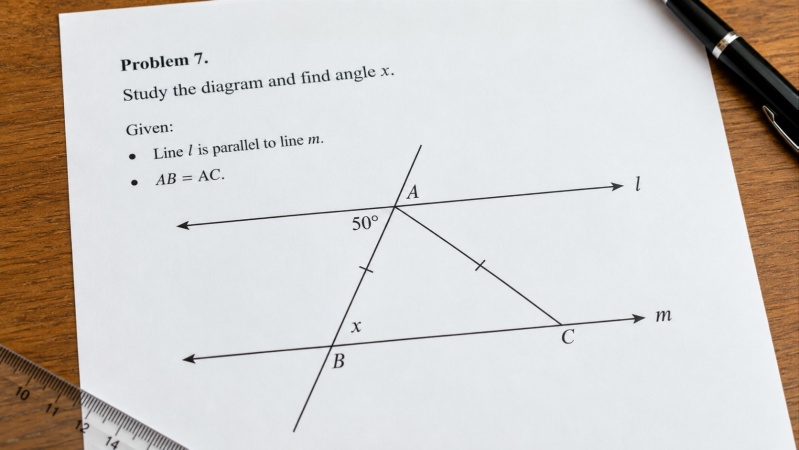
Geometric terms are words used to describe geometric objects, figures, measurements, and relationships. Some basic geometric terms, such as point, line, and plane, are treated as foundational concepts in geometry, while others describe specific shapes or relationships between figures.
Learning the definitions of geometric terms is important because the same vocabulary appears throughout geometry problems, diagrams, formulas, and proofs.
Why Geometry Terms Matter
Knowing geometric terms helps you identify what a diagram represents and understand what a geometry problem is asking. For example, knowing the difference between a line, line segment, and ray helps you interpret a figure correctly.
Geometry vocabulary also provides a precise way to describe relationships. Terms such as parallel, perpendicular, congruent, and vertex communicate specific mathematical properties rather than general descriptions.
Basic Geometric Terms
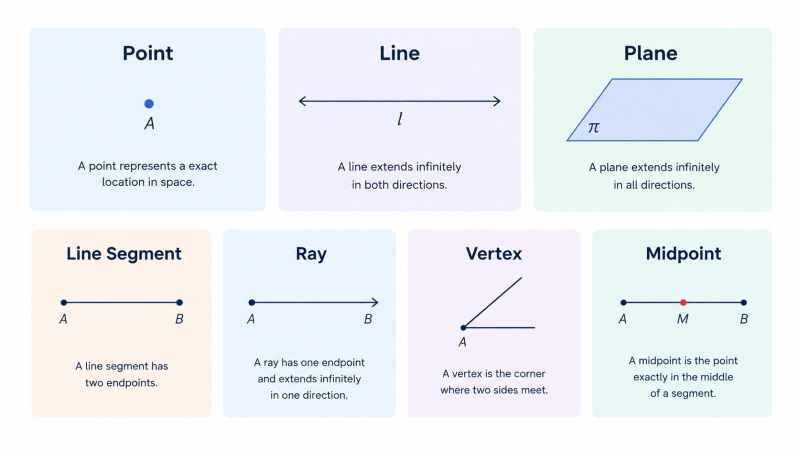
The following basic geometric terms are some of the building blocks of geometry.
Point, Line, and Plane
Point: A point represents a specific location. It has no length, width, or thickness and is usually shown as a dot labeled with a capital letter.
Line: A line is a straight path that extends infinitely in both directions. It can be identified by two points on the line or by a lowercase letter.
Plane: A plane is a flat, two-dimensional surface that extends infinitely in every direction. In diagrams, it is often represented by a four-sided figure.
Point, line, and plane are commonly introduced as the fundamental building blocks of geometry.
Line Segment and Ray
Line segment: A line segment is part of a line with two endpoints. Unlike a line, it has a definite length.
Ray: A ray has one endpoint and extends infinitely in one direction. The endpoint is named first when identifying a ray.
These terms are often confused because they are all related to lines. The key difference is how far they extend: a line continues in both directions, a ray continues in one direction, and a line segment has two endpoints.
Vertex and Midpoint
Vertex: A vertex is a point where two or more sides, edges, or line segments meet. The plural form is vertices.
Midpoint: The midpoint is the point that divides a line segment into two segments of equal length.
A vertex is commonly found at the corners of polygons, while a midpoint identifies the center of a line segment.
Common Types of Angles
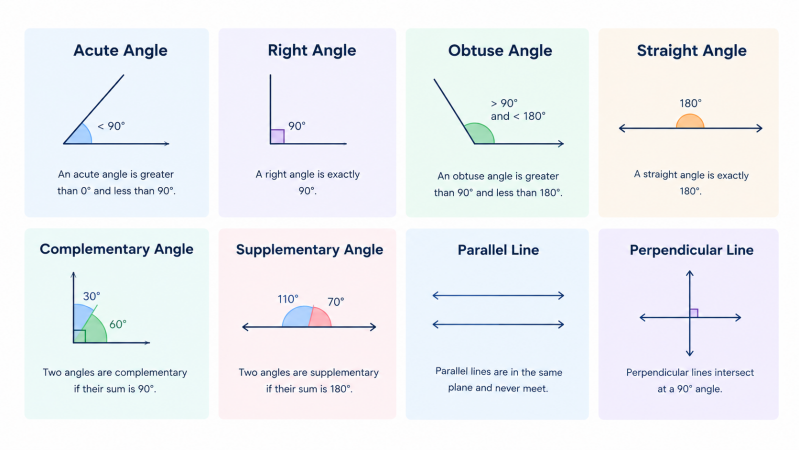
An angle is formed by two rays that share a common endpoint, called the vertex. Angles are usually measured in degrees and can be classified by their measures.
Acute, Right, Obtuse, and Straight Angles
Acute angle: An angle measuring more than 0° and less than 90°.
Right angle: An angle measuring exactly 90°.
Obtuse angle: An angle measuring more than 90° but less than 180°.
Straight angle: An angle measuring exactly 180°.
These are among the most common geometric terms used when identifying angles in diagrams and solving geometry problems.
Complementary and Supplementary Angles
Complementary angles: Two angles whose measures add up to 90°.
Supplementary angles: Two angles whose measures add up to 180°.
For example, angles measuring 30° and 60° are complementary, while angles measuring 110° and 70° are supplementary.
Parallel and Perpendicular Lines
Parallel lines: Lines in the same plane that do not intersect and remain the same distance apart.
Perpendicular lines: Lines that intersect to form a right angle, or 90°.
Parallel and perpendicular are important geometric terms because they describe relationships between lines rather than individual figures.
Geometric Shapes and Their Terms
Geometric shape terms describe the properties and classifications of two-dimensional and three-dimensional figures. Common geometry terms for shapes include the names of polygons, quadrilaterals, triangles, and solids.
Triangles and Quadrilaterals
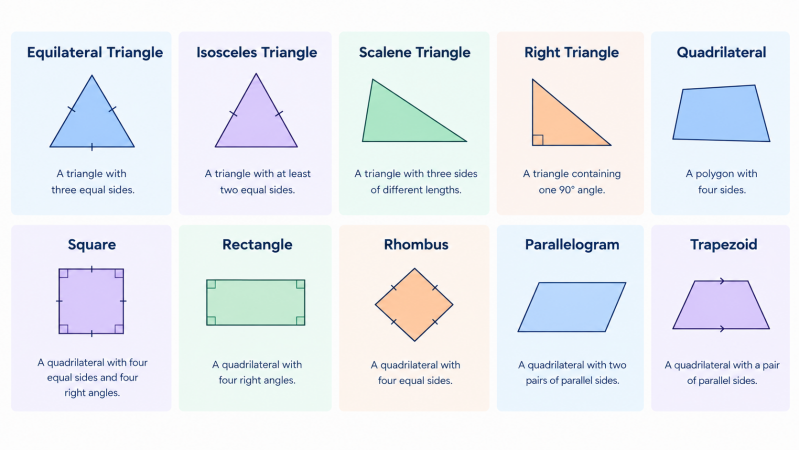
Triangle: A polygon with three sides and three angles.
Common triangle terms include:
-
Equilateral triangle: A triangle with three equal sides.
-
Isosceles triangle: A triangle with at least two equal sides.
-
Scalene triangle: A triangle with three sides of different lengths.
-
Right triangle: A triangle containing one 90° angle.
-
Quadrilateral: A polygon with four sides.
Common quadrilateral terms include:
-
Square: A quadrilateral with four equal sides and four right angles.
-
Rectangle: A quadrilateral with four right angles.
-
Rhombus: A quadrilateral with four equal sides.
-
Parallelogram: A quadrilateral with two pairs of parallel sides.
-
Trapezoid: A quadrilateral with a pair of parallel sides.
These shape definitions are useful when a problem asks you to identify a figure based on its sides, angles, or other properties.
Polygons and Circles
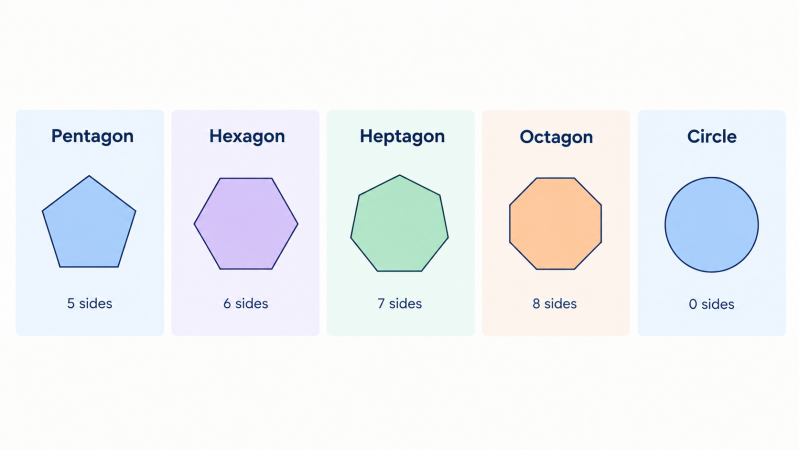
Polygon: A closed two-dimensional figure made from straight line segments.
Polygons can be named according to the number of sides. For example:
-
Pentagon: 5 sides
-
Hexagon: 6 sides
-
Heptagon: 7 sides
-
Octagon: 8 sides
Polygons can also be classified as regular or irregular. A regular polygon has equal sides and equal interior angles.
Circle: A two-dimensional figure in which every point on the circumference is the same distance from the center.
Common 3D Shapes
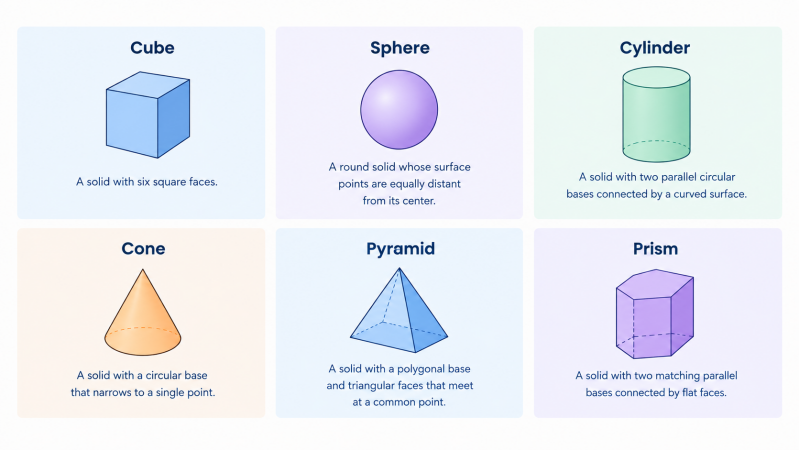
Three-dimensional geometric shapes have length, width, and height. They are also described using terms such as faces, edges, and vertices.
Common 3D geometric terms include:
-
Cube: A solid with six square faces.
-
Sphere: A round solid whose surface points are equally distant from its center.
-
Cylinder: A solid with two parallel circular bases connected by a curved surface.
-
Cone: A solid with a circular base that narrows to a single point.
-
Pyramid: A solid with a polygonal base and triangular faces that meet at a common point.
-
Prism: A solid with two matching parallel bases connected by flat faces.
These terms are commonly used when describing the structure and properties of three-dimensional figures.
Important Circle Terms
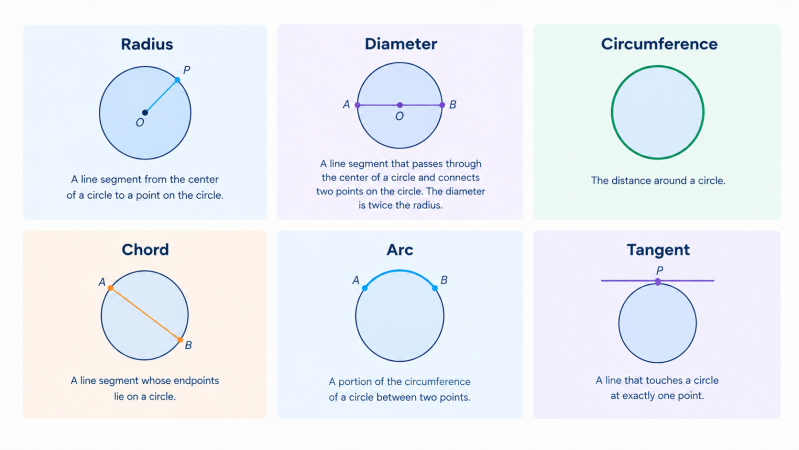
Circles have their own set of geometric terms. Learning this vocabulary makes it easier to understand circle diagrams and solve problems involving measurements and relationships. Circle vocabulary is commonly treated as a separate part of geometry terminology.
Radius, Diameter, and Circumference
Radius: A line segment from the center of a circle to a point on the circle.
Diameter: A line segment that passes through the center of a circle and connects two points on the circle. The diameter is twice the radius.
Circumference: The distance around a circle.
The relationship between radius and diameter can be written as:
d = 2r
where d represents diameter and r represents radius.
Chord, Arc, and Tangent
Chord: A line segment whose endpoints lie on a circle.
Arc: A portion of the circumference of a circle between two points.
Tangent: A line that touches a circle at exactly one point.
These circle terms are useful when identifying parts of a circle or interpreting geometric diagrams.
How to Learn and Use Geometric Terms
Memorizing a geometric terms list is useful, but recognizing the terms in diagrams can make them easier to remember and apply.
Identify the Figure and Its Properties
Start by identifying the basic figure. Ask whether it is a line, angle, polygon, circle, or three-dimensional shape.
Then look at its defining properties. For example, a four-sided figure with four equal sides and four right angles is a square, while a four-sided figure with only opposite sides parallel is a parallelogram.
When a question asks which term best describes a geometric figure, focus on the properties shown in the diagram rather than its appearance alone.
Use Diagrams to Understand Geometry Vocabulary
Visual examples can make geometric terms easier to distinguish. Marking endpoints, vertices, equal sides, right angles, or parallel lines can help connect a definition with the corresponding figure.
For more complex geometry problems, an AI math solver can also help explain how geometric vocabulary is used in a specific diagram. Tools that accept text or image inputs can be useful when a problem includes a geometry figure and requires step-by-step reasoning.
Need Help Applying Geometry Terms? Try Tenorshare AI Math
Knowing the definition of a geometric term does not always mean you know how to apply it in a real geometry problem. A question may combine unfamiliar vocabulary with diagrams, multiple conditions, and several steps of reasoning. Instead of looking up each term separately, it can be more helpful to see how those terms are used together to solve the problem .

This is where Tenorshare AI Math can be useful. It is an AI-powered math solver and learning tool that helps explain math problems step by step, allowing you to see how geometric terms and properties are applied in context. It also supports text, image, and PDF inputs, so geometry questions from diagrams or worksheets can be worked through directly.
Key features include:
-
Step-by-Step Explanations: Break down the reasoning behind a geometry solution.
-
Image and PDF Support: Work with geometry problems from diagrams, worksheets, or PDF files.
-
AI Video Explanations: Provide visual walkthroughs for difficult concepts and solution steps.
-
Similar Practice Questions: Generate related problems to reinforce what you have learned.
-
Built-in Math Calculator: Handle calculations that appear while solving geometry problems.
-
Follow-Up Q&A: Ask additional questions when a geometric term, step, or explanation is unclear.
Conclusion
Understanding geometric terms makes it easier to read diagrams, identify geometric figures, and follow the reasoning used in geometry problems and proofs. Terms such as point, line, angle, vertex, radius, diameter, chord, and tangent describe the objects and relationships that appear throughout geometry.
Learning these terms is only the first step. When a problem combines several concepts or requires multiple steps, a geometry math solver like Tenorshare AI Math can help explain how the relevant terms are applied and show the reasoning behind the solution. This can make it easier to connect geometry vocabulary with practical problem-solving.

Tenorshare AI Math
- Solve math from text, images & PDFs at 98% accuracy
- Deliver step-by-step answers with detailed logic breakdown
- Access video explanations for deeper math concept understanding
- Generate matching practice tests to solidify knowledge

FAQs About Geometric Terms
-
What words are typically associated with geometry?
Common geometry vocabulary includes point, line, line segment, ray, angle, vertex, midpoint, parallel, perpendicular, radius, diameter, circumference, chord, arc, polygon, triangle, quadrilateral, and circle. These terms are commonly used to describe geometric figures, their properties, measurements, and relationships.
-
What are the basic geometric terms?
Common basic geometric terms include point, line, plane, line segment, ray, angle, and vertex. These concepts are used to describe more complex geometric figures.
-
What are the most common geometry terms?
Some of the most common geometry terms include point, line, plane, angle, vertex, parallel, perpendicular, triangle, quadrilateral, polygon, circle, radius, diameter, and circumference.
-
How can I memorize geometric terms?
Group terms by category, such as basic figures, angles, shapes, and circle vocabulary. Using diagrams and identifying each term in example problems can also make the definitions easier to remember.
You Might Also Like
- 150+ Geometry Pick-Up Lines That Add Up to Love
- Best AI for Geometry in 2026: We Tested the Top 7 AI Math Tools
- Is Geometry Hard? What Makes Geometry Difficult & How to Simplify It
- Geometry Proofs: How to Think Through and Solve Any Proof
- How to Improve Math Skills: 5 Practical Ways to Get Better at Math 2026
- How to Solve Linear Equations in 5 Easy Steps [2026 Guide]

Tenorshare AI Math: Solve any math problems with AI
Turn math questions into clear solutions, tutorial videos & targeted practice setsTenorshare AI Math: Instant Solutions
Steps, videos & practice for every problem
Tenorshare AI Math: Solve any math problems with AI