
Is Geometry Hard? What Makes Geometry Difficult & How to Simplify It
Staring at a geometry diagram and having no idea where to start? You're not alone. Geometry can feel very different from the math you have learned before. Instead of simply plugging numbers into an equation, you may need to interpret a diagram, recognize geometric relationships, choose the right theorem, and explain your reasoning.
So, is geometry hard ?
It can be, but struggling with geometry does not mean you are bad at math. In this guide, we'll break down why geometry can be difficult, compare its difficulty with Algebra 1 and Algebra 2, and share 4 practical tips and a geometry math solver that can walk you through difficult geometry problems step by step when you need extra help.
Catalogs:
How Hard Is Geometry?

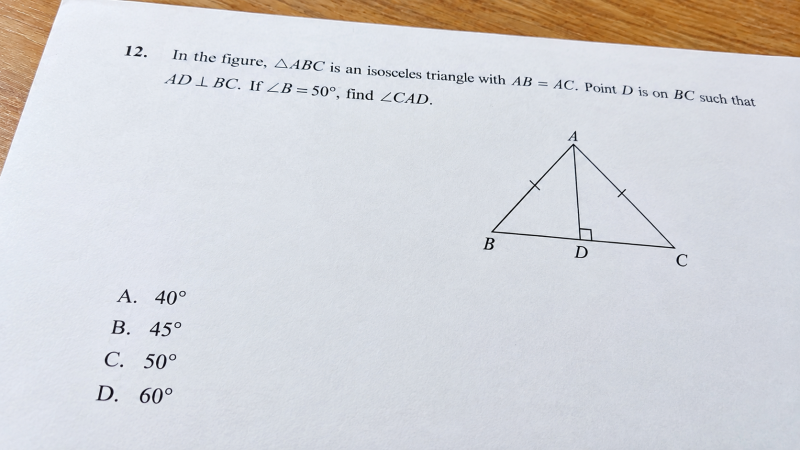
How hard is geometry depends largely on the topics being studied and a student's existing math skills. Basic concepts such as angles, area, perimeter, and simple shapes may be relatively straightforward, while proofs, similarity, congruence, and multi-step problems can require more reasoning.
For some students, geometry may feel easier than algebra because they find visual problems more intuitive. Others may find it harder because geometry often requires interpreting diagrams and connecting several concepts rather than following a single calculation procedure.
This is also why there is no universal answer to is geometry easy. Geometry can become more manageable with practice, but students may experience different levels of difficulty depending on their strengths and prior knowledge.
Why Is Geometry So Hard?
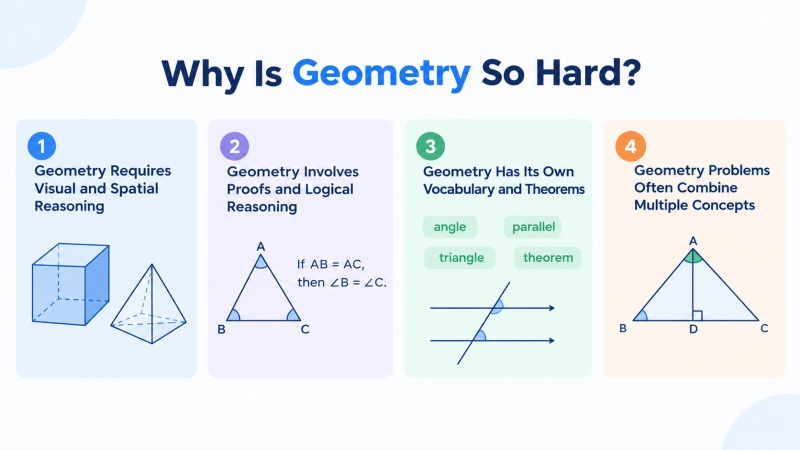
There are several reasons students may feel that geometry is hard.
Geometry Requires Visual and Spatial Reasoning
Many geometry problems provide information through diagrams rather than equations alone . Students need to identify shapes, angles, parallel lines, symmetry, and relationships between different parts of a figure.
This can be difficult for students who are more comfortable working with numbers and algebraic expressions than interpreting visual information.
Geometry Involves Proofs and Logical Reasoning
Proofs are another common reason why is geometry so hard for some students. Instead of simply finding an answer, a proof requires a logical sequence of statements that explains why a conclusion is true.
Students may need to use definitions, postulates, theorems, and previously established relationships to build an argument. This type of reasoning can feel unfamiliar at first.
Geometry Has Its Own Vocabulary and Theorems
Geometry introduces many terms and relationships, including congruent figures, similar figures, complementary and supplementary angles, and properties of different shapes.
Remembering these concepts is only part of the challenge. Students also need to recognize when a particular definition or theorem applies to a problem .
Geometry Problems Often Combine Multiple Concepts
A single problem may require several steps . For example, a student might need to identify a triangle relationship, apply a theorem, set up an equation, and then use algebra to find an unknown value.
As a result, is geometry difficult to learn can depend partly on how well students can connect different concepts rather than learn each rule separately.
Is Geometry Harder Than Algebra?
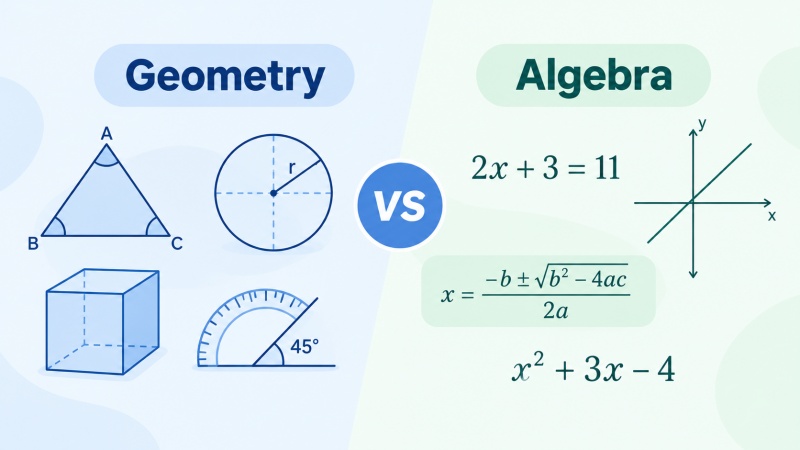
There is no universal answer to is geometry harder than algebra because the subjects emphasize different skills.
Algebra primarily works with variables, equations, functions, and symbolic relationships. Geometry focuses more heavily on figures, spatial relationships, properties, and logical reasoning. Some students find symbolic manipulation more difficult, while others struggle more with diagrams and geometric proofs.
The perceived difficulty can also change as the level of the course increases.
Is Algebra 1 Harder Than Geometry?
Whether is algebra 1 harder than geometry depends on the student. Algebra 1 introduces concepts such as variables, linear equations, inequalities, functions, and graphing. Geometry introduces spatial relationships, theorems, constructions, and proofs.
A student who is comfortable with equations may find Geometry more challenging, while someone who prefers visual problems may have the opposite experience.
Is Algebra 2 Harder Than Geometry?
Algebra 2 generally builds on concepts from Algebra 1 and introduces more advanced functions, equations, and mathematical relationships. Geometry follows a different progression, with greater emphasis on spatial reasoning and geometric logic.
Because the courses challenge different skills, comparing their difficulty depends on the topics, course level, and student's strengths.
How to Make Geometry Easier: 4 Tips That Actually Work
If geometry is hard right now, simply doing more exercises may not solve the problem. The more useful approach is to identify what is making a problem difficult and change how you work through it.
Use this quick guide to find a starting point:
| If you struggle with... | Try this first |
|---|---|
| Understanding diagrams | Draw, label, and mark the information you know |
| Remembering theorems | Learn what each theorem means and when to use it |
| Starting a difficult problem | Break it into known information, target, and steps |
| Applying what you've learned | Practice the same concept in different problem formats |
Understand Why a Rule Works, Not Just What It Says
Memorizing formulas and theorems can help you complete familiar exercises, but it becomes less useful when a problem is presented in an unfamiliar way.
For each important theorem or formula, ask yourself three questions:
-
What does this rule tell me?
-
What conditions need to be true before I can use it?
-
What kind of problem would require this rule?
For example, don't just memorize that the angles in a triangle add up to 180°. Practice identifying situations where that relationship can help you find an unknown angle.
A useful study method is to create a simple "rule + meaning + example" note for each major concept. This gives you something more useful to review than a list of formulas.
Turn Every Diagram Into Useful Information
A geometry diagram is not just a picture. It often contains most of the information needed to solve the problem.
Before calculating anything, spend a few seconds marking what you know:
-
Circle or mark given angles and side lengths.
-
Label unknown values with variables.
-
Mark parallel or perpendicular lines.
-
Look for equal sides, equal angles, or symmetry.
-
Identify the shapes inside the larger figure.
For example, if two lines are parallel and a transversal crosses them, marking the relevant angle relationships can immediately reveal which angles are equal or supplementary.
If the diagram is complicated, redraw it in a simpler form. You do not need to make it artistic. The goal is to make the mathematical relationships easier to see.
Use a Fixed Process for Multi-Step Problems
One reason geometry is hard is that students may know several formulas but not know which one to use first.
Instead of immediately searching for a formula, use the same four-step process:
| Step | What to ask |
|---|---|
| Given | What information does the problem provide? |
| Find | What exactly am I being asked to calculate or prove? |
| Connect | Which theorem, property, or equation connects the known and unknown information? |
| Solve | Can I work through the calculation or proof one step at a time? |
Suppose a problem asks you to find an unknown side in a triangle. First identify the known sides and angles. Then determine whether the problem involves a special triangle, similarity, the Pythagorean theorem, or another relationship. Only after identifying the connection should you start calculating.
This process prevents a common mistake: choosing a familiar formula simply because you remember it, even when it does not apply to the problem.
Practice Problems That Change, Not Just Problems That Repeat
Once you understand a concept, don't only solve ten nearly identical questions. Geometry tests whether you can recognize the same relationship when the diagram or wording changes.
Try a progression like this:
-
Learn: Review the concept and one worked example.
-
Follow: Work through a similar problem while checking each step.
-
Solve: Try a new problem without looking at the solution.
-
Explain: Describe why you chose the theorem, formula, or method.
When you get a problem wrong, don't stop at correcting the final answer. Find the first step where your reasoning changed from correct to incorrect. Was the diagram misread? Did you choose the wrong theorem? Did an algebra calculation go wrong?
Keeping a short error log can make practice much more effective. For each mistake, record:
What I did → What went wrong → What I should look for next time
This helps you recognize recurring mistakes instead of repeating them across different assignments.
Get Extra Geometry Help With Tenorshare AI Math
Geometry can feel overwhelming, largely because you need to connect diagrams, geometric theorems, and numerical calculations all together. If you do not know where to begin a problem, struggle to spot key geometric relationships, or lose track of logic through multi‑step questions, an AI math solver can give you the extra learning support you need.
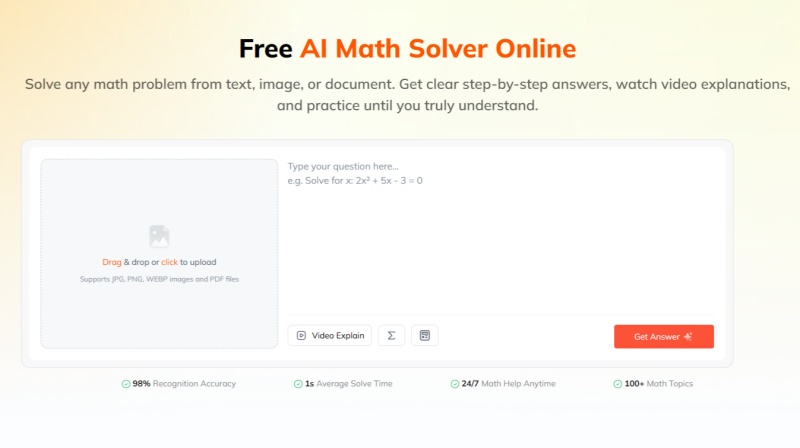
Tenorshare AI Math goes far beyond simple answer-checking by combining problem-solving, detailed explanations and targeted learning resources. It helps you unpack geometric relationships laid out in questions, follow the logical flow of each solution, and solidify core concepts with hands-on practice.
Key Features
-
Multiple Input Options: Supports text questions, images, and PDF files, making it easier to submit geometry problems with diagrams or worksheets.
-
Step-by-Step Solution Explanations: Breaks down each solution step and explains the reasoning behind the method used.
-
AI-Generated Video Explanations: Provides visual explanations that can make difficult geometry concepts easier to follow.
-
Practice Question Generation: Creates similar geometry problems to help reinforce a concept after solving an example.
-
Built-In Math Calculator: Helps handle basic calculations and mathematical expressions without switching to another calculator.
Rather than acting purely as an answer generator, Tenorshare AI Math functions as a practical study aid. It guides you through tough geometry exercises, teaches you why each step works, and builds your confidence when tackling comparable problems.
Final Verdict: Is Geometry Hard?
So, is geometry hard ? It can be challenging, especially when problems require you to interpret diagrams, choose the right theorem, and connect multiple steps of reasoning. However, difficulty varies from student to student, and struggling with geometry does not mean you are bad at math.
The key is to focus on understanding geometric relationships rather than memorizing formulas alone. Practice reading diagrams, identifying the right approach, and working through problems step by step. When you get stuck, tools such as Tenorshare AI Math can provide additional explanations and practice to help you understand the reasoning and build stronger problem-solving skills.

Tenorshare AI Math
- Solve math from text, images & PDFs at 98% accuracy
- Deliver step-by-step answers with detailed logic breakdown
- Access video explanations for deeper math concept understanding
- Generate matching practice tests to solidify knowledge

FAQs
-
Is Honors Geometry Hard?
Honors Geometry can feel more challenging than a standard Geometry course because it may move at a faster pace or include more advanced problems and reasoning. The actual difficulty depends on the course curriculum and the student's preparation.
-
Is Algebra or Geometry Harder?
There is no single answer to is algebra or geometry harder. Algebra emphasizes symbolic relationships and equations, while Geometry places more emphasis on visual reasoning, properties, and proofs. A student's strengths can affect which subject feels more difficult.
-
Is Trigonometry Harder Than Geometry?
Trigonometry introduces relationships involving angles and sides, along with functions such as sine, cosine, and tangent. Geometry covers a broader range of spatial concepts and can include proofs and constructions. Whether trigonometry feels harder than geometry depends on the specific topics being studied and the student's mathematical background.
-
What Grade Are You Supposed to Take Geometry In?
Geometry is commonly taken during high school, often after Algebra 1. The exact grade varies by school, district, and course sequence. Some students take Geometry in ninth grade, while others take it later.
-
Is Geometry the Hardest Math Class?
Is geometry the hardest math class? Not necessarily. Math courses become difficult for different reasons, and students have different strengths. Advanced courses such as Algebra 2, Precalculus, Calculus, or higher-level mathematics may introduce concepts that some students find more challenging than Geometry.
-
How Long Does It Take to Get Good at Geometry?
There is no fixed amount of time required to become good at Geometry. Progress depends on your current math foundation, how often you practice, and which topics you find difficult. Consistent practice with diagrams, proofs, and different problem types can gradually improve both problem-solving skills and confidence.
You Might Also Like
- How to Solve a Hard Math Problem: A Simple Guide for Students
- How to Take Math Notes: The Ultimate Guide to Handwritten and Digital Notes
- 15 Hardest Digital SAT Math Questions With Answers & Strategies
- How to Improve Math Skills: 5 Practical Ways to Get Better at Math 2026
- How to Solve Linear Equations in 5 Easy Steps [2026 Guide]
- How to Study for a Math Test: From 7 Days Before to the Night Before

Tenorshare AI Math: Solve any math problems with AI
Turn math questions into clear solutions, tutorial videos & targeted practice setsTenorshare AI Math: Instant Solutions
Steps, videos & practice for every problem
Tenorshare AI Math: Solve any math problems with AI