
How to Improve Math Skills: 5 Practical Ways to Get Better at Math 2026
If math has always felt harder than it should, the problem is rarely a lack of ability. More often, one or two earlier skills were never fully understood, and each new topic has made that gap more noticeable.
The good news is that math skills can be improved at any level. The most reliable approach is not to do as many questions as possible. It is to identify what is getting in the way, practice with a clear purpose, and give yourself enough time to understand each method.
This guide explains how to improve math skills with five practical habits that work for school students, college learners, and adults returning to math after a long break.
Also Read: How to Be Good at Math: A Complete Guide to Improve Your Math Skills
Catalogs:
Can You Really Improve Your Math Skills?
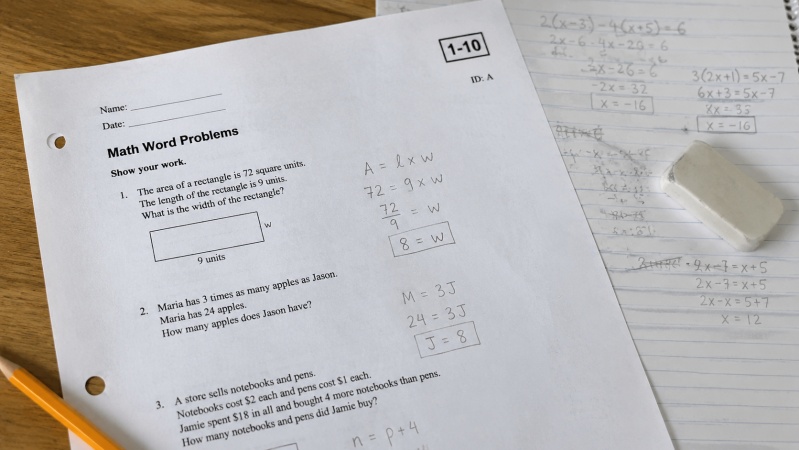
Absolutely. Math is a learned skill, not a fixed trait. People do have different experiences with the subject: some had stronger teaching, more practice, or fewer gaps in their early education. But none of that means your current level is permanent.
Math builds from earlier ideas. Addition and subtraction support multiplication and division; fractions and negative numbers support algebra; algebra supports more advanced subjects such as geometry, trigonometry, and calculus. When a later topic feels impossible, the real issue may be an earlier concept that needs attention.
Improvement also depends on changing the goal. Instead of aiming to "be good at math," focus on smaller, concrete outcomes: understand how to solve linear equations, calculate percentages confidently, or complete ten fraction problems accurately. Small wins create evidence that you are improving, which makes it easier to keep going.
How to Improve Your Math Skills: 5 Proven Strategies
Find the Exact Skill That Is Causing the Problem
Saying "I'm bad at math" does not tell you what to work on. A better first step is to identify the exact point where a question becomes difficult .
Use recent homework, quizzes, or practice sets to look for repeated patterns.
| If this happens... | The issue may be... | Start by... |
|---|---|---|
| You understand the lesson but lose marks | Calculation accuracy | Reviewing signs, arithmetic, and written steps |
| You remember a formula but cannot use it | Conceptual understanding | Learning when and why the formula applies |
| Routine questions are manageable, but word problems are not | Translating language into math | Identifying quantities and writing an equation |
| New topics feel confusing immediately | A missing prerequisite skill | Reviewing an earlier topic first |
Do not avoid basic skills simply because you are studying a more advanced topic. Reviewing fractions, negative numbers, or order of operations may feel like a step back, but it often removes the obstacle much faster than repeating difficult questions.
Understand the Method Before You Memorize It
Memorizing formulas and procedures is useful, but it should follow understanding---not replace it. A method is easier to remember when you know what each step is doing.
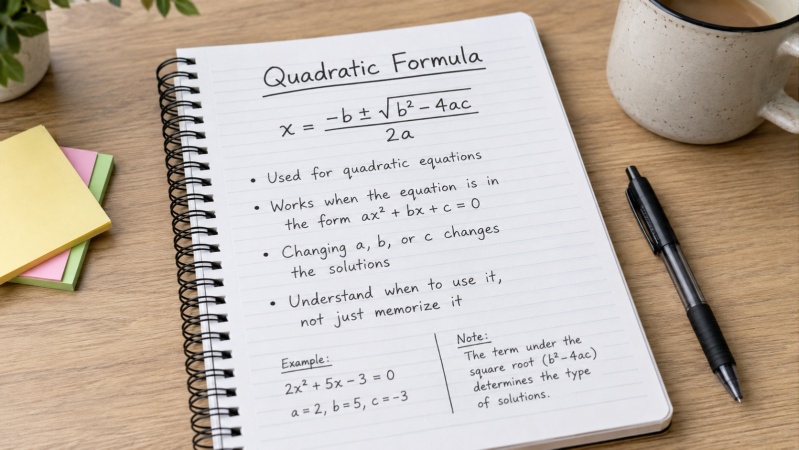
When you learn a new topic, ask yourself:
-
What do the numbers, symbols, or variables represent?
-
Why is this step allowed?
-
When should I use this method instead of another one?
-
Can I explain the process in plain language?
For example, solving an equation is not only about moving numbers from one side to another. It is about keeping both sides balanced while isolating the unknown value.
Use different ways to explore a new idea:
-
Draw a diagram or graph.
-
Make a table of values.
-
Use a number line.
-
Explain the idea aloud.
-
Link it to a familiar situation, such as discounts, recipes, distance, or test scores.
The more connections you can make, the easier it becomes to recall the concept when the question looks unfamiliar.
Practice Actively in Short, Consistent Sessions
Reading an answer can make a solution seem obvious. Active practice shows whether you can actually use the method on your own.
Try this four-step practice routine:
-
Study one worked example. Focus on why each step is taken.
-
Cover the solution. Recreate the method without looking.
-
Solve a similar problem independently. Write down every step.
-
Review only where you got stuck. Then retry the question or complete a new one.
Short, regular sessions are usually more effective than occasional long study sessions. A focused 20- to 30-minute session on most days is enough to build consistency.
A simple weekly rhythm can help:
| Practice type | Goal |
|---|---|
| Current-topic practice | Learn the skill you are studying now |
| Review practice | Revisit a topic from earlier in the week |
| Mixed practice | Decide which method fits different problem types |
As your confidence grows, avoid doing only identical questions. Mixed practice may feel harder, but it teaches you how to choose a strategy independently.
Use Mistakes as Feedback, Not as a Final Result
A wrong answer is useful only when you understand why it happened. Instead of marking a question wrong and moving on, identify the type of mistake.
| Type of mistake | Example | What to do next |
|---|---|---|
| Concept error | Choosing the wrong formula | Review the concept with a simpler example |
| Process error | Skipping or changing a step | Write each step on a separate line |
| Calculation error | Incorrect arithmetic or sign | Slow down and check intermediate work |
| Reading error | Misunderstanding what the question asks | Underline key information before solving |
Keep a brief error log for recurring issues. You do not need to copy every incorrect question.
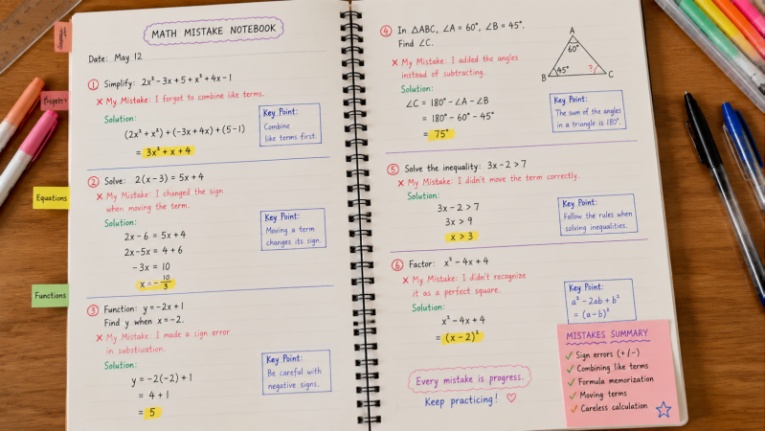
Record:
-
The topic
-
The error type
-
The correct rule or method
-
One reminder for next time
Then test yourself with a fresh, similar problem. Correcting an answer while looking at the solution is helpful, but solving a new question is what confirms that you have learned from the mistake.
Make Math Part of Everyday Thinking
Math feels less intimidating when it is not limited to homework or test preparation. Everyday activities provide low-pressure ways to strengthen number sense and see why math matters.
Try using math in situations such as:
-
Comparing unit prices while shopping
-
Estimating a restaurant tip
-
Doubling or halving a recipe
-
Calculating travel time
-
Checking a discount
-
Tracking a weekly budget
These activities build number sense---the ability to judge whether an answer is reasonable. For example, if a discount calculation gives you a price higher than the original amount, number sense helps you spot the problem before you rely on the answer.
Explaining your reasoning is another useful habit. Teach a method to a classmate, a family member, or simply talk through it aloud. If you can explain why each step works, you are more likely to understand it. If you cannot, you have identified exactly what to review.
Focus on accuracy and understanding before speed. Fast calculation is usually the result of repeated, correct practice---not something to force at the beginning.
How to Improve Maths Skills at Different Learning Stages
The best approach depends on what you are learning now. As math becomes more advanced, the focus shifts from building number sense to applying connected ideas independently.
| Learning stage | Main focus | A useful habit |
|---|---|---|
| Basic math | Accuracy and number sense | Connect skills to daily life |
| 8th grade | Moving between concepts and representations | Show every step and check answers |
| High school | Choosing the right method independently | Review and practice mixed questions |
| College | Filling gaps and explaining reasoning | Ask specific questions early |
How to Improve Basic Math Skills
Start with the skills that support both daily life and later math classes:
-
Place value
-
Addition and subtraction
-
Multiplication and division
-
Fractions and decimals
-
Percentages
-
Negative numbers
Work from concrete examples to written calculations. This makes the meaning behind the numbers easier to understand.
| Topic | Everyday practice idea |
|---|---|
| Fractions | Use measuring cups, food portions, or fraction bars |
| Decimals | Compare prices or read measurements |
| Percentages | Calculate discounts, tax, or test scores |
| Negative numbers | Track temperatures above and below zero |
Focus on one skill at a time, then return to it regularly. Basic math is not something you simply finish; it is the foundation you continue to use in every later topic.
How to Improve 8th Grade Math Skills
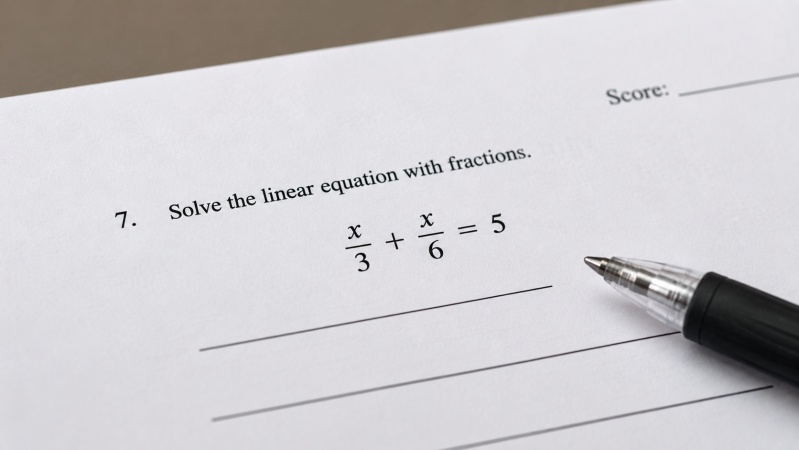
Eighth-grade math combines arithmetic with more abstract topics, including:
-
Linear equations
-
Exponents
-
Functions
-
Geometry
-
Data and graphs
At this stage, it is important to see how different representations describe the same idea. An equation, a table of values, and a graph can all show the same relationship.
When solving an equation, follow this quick check:
-
Write each step on a separate line.
-
Keep both sides of the equation balanced.
-
Substitute your final answer into the original equation.
-
Check whether both sides have the same value.
For word problems, avoid guessing the operation immediately. Instead:
-
Identify the known quantities.
-
Decide what the question is asking for.
-
Define the unknown value.
-
Write an equation or draw a simple model before calculating.
How to Improve Math Skills for High School
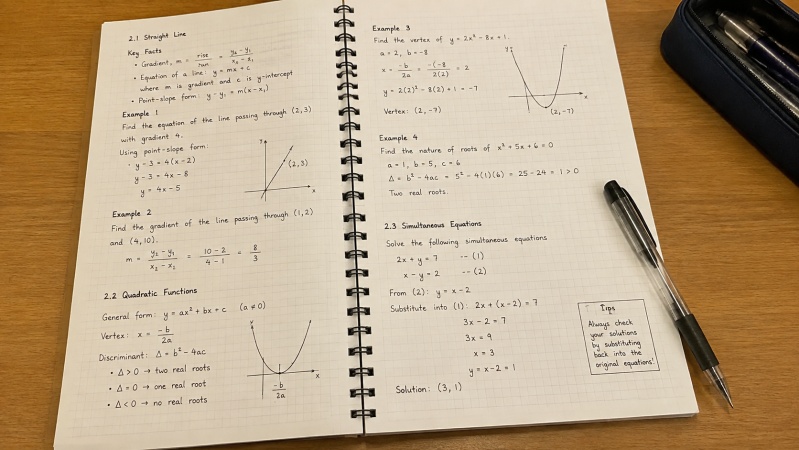
High school math requires stronger foundations and more independent thinking. Topics such as algebra, geometry, trigonometry, statistics , precalculus, and calculus often combine several skills in one problem.
A simple study routine can make this workload more manageable:
| When | What to do |
|---|---|
| After class | Review notes while the lesson is still fresh |
| During practice | Solve a few questions without looking at examples |
| Before a test | Complete mixed questions under realistic conditions |
| After checking answers | Review errors and note the rule or method you missed |
Keep formulas organized, but do not memorize them without context. Add a short note beside each one explaining when it should be used.
For example, instead of only writing a formula, include:
-
What the formula helps you find
-
Which information you need before using it
-
One short example of the type of question it fits
This helps you move from "I know this formula" to "I know when to use this formula."
How to Improve Math Skills in College
College math often moves quickly and assumes that earlier skills are secure. Courses such as calculus, statistics, linear algebra, and math-heavy science classes may become difficult when an earlier algebra, graphing, or trigonometry skill is missing.
When you notice a gap, act early:
-
Identify the exact step or prerequisite skill you do not understand.
-
Review a simpler explanation or example.
-
Try a related problem on your own.
-
Ask for help if the same issue continues.
Useful support options include:
-
Instructor office hours
-
Tutoring sessions
-
Study groups
-
Course discussion forums
-
Step-by-step learning tools
Bring a specific question whenever possible. Questions such as "Why can I make this step?" or "Where did this term come from?" are more useful than simply saying, "I do not understand."
College-level math also rewards clear reasoning. Show your steps, state any assumptions, and check whether your answer makes sense in context. This improves your understanding and makes it easier for instructors or tutors to identify where you need support.
To Improve Math Skills Faster, Try Tenorshare AI Math
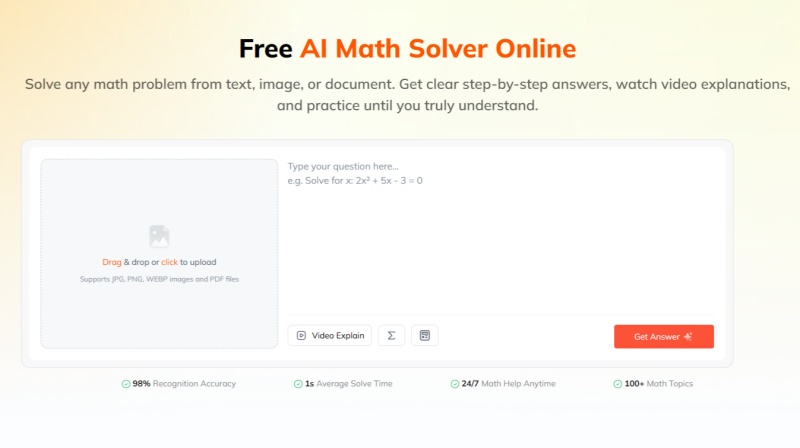
When students get stuck on a math problem, the difficulty is often not finding an answer---it is understanding where the method stopped making sense. Waiting for help can interrupt practice, while checking only the final answer does little to explain a mistake. An AI math solver can be useful when it helps students see the process, review the concept, and practice the same skill again.
Tenorshare AI Math is an AI-powered math learning tool designed for this process. Rather than focusing only on answers, it supports a workflow of solving, understanding, and practicing.
Its core features include:
-
Multiple input options: Enter a math question as text or upload it as an image or PDF.
-
Step-by-step solutions: Review the formulas, calculations, and reasoning used to reach the answer.
-
Visual video explanations: Use AI-generated visual explanations to explore difficult concepts in another format.
-
Similar practice questions: Generate related problems to apply the same method independently.
-
Follow-up learning support: Ask additional questions when a specific step or concept remains unclear.
To use an AI math solver effectively, try the problem yourself before checking the explanation. Then compare your approach with the step-by-step solution, identify the point where you went wrong, and complete a similar question without assistance. Used this way, Tenorshare AI Math can help turn a difficult homework question into a focused learning opportunity instead of a one-time answer.
Final Thoughts
Learning how to improve math skills is less about finding a shortcut and more about following a reliable process: identify the gap, understand the concept, practice actively, learn from mistakes, and revisit important skills over time.
Start with one topic that currently causes trouble. A few focused practice sessions can make the next lesson feel more manageable. When you need extra support, Tenorshare AI Math can help you review step-by-step solutions, clarify difficult methods, and practice similar problems independently.
As those small improvements add up, math becomes less about guessing and more about knowing what to do next.

Tenorshare AI Math
- Solve math from text, images & PDFs at 98% accuracy
- Deliver step-by-step answers with detailed logic breakdown
- Access video explanations for deeper math concept understanding
- Generate matching practice tests to solidify knowledge

FAQs
-
Can Mathematical Ability Be Improved?
Yes. Mathematical ability can improve through targeted practice, better foundational knowledge, and useful feedback. Some topics may take longer than others, but steady work on specific skills is more effective than labeling yourself as naturally good or bad at math.
-
What Is the Best Way to Improve Math Skills Fast?
The fastest sustainable method is to focus on one weak area at a time. Review the prerequisite skill, study one worked example, solve similar questions independently, and correct mistakes immediately. This is more effective than rushing through a large number of questions.
-
How to Improve Math Skills for Adults?
Adults can begin with practical goals, such as calculating percentages, managing a budget, understanding measurements, or reviewing fractions. Start at the level that feels comfortable, practice regularly, and use real-life examples. There is no penalty for returning to basic math skills; they support nearly every later topic.
-
How to Improve Math Calculation Skills?
Build calculation skills by improving number sense and accuracy first. Practice breaking calculations into manageable parts, estimating the likely answer, and writing intermediate steps. Once your methods are reliable, use short timed exercises to build speed without sacrificing accuracy.
-
How to Improve Math Computation Skills?
Math computation skills improve through consistent practice with operations such as addition, subtraction, multiplication, division, fractions, and decimals. Work carefully, review common errors, and practice several related question types. A calculator can be useful for checking work, but it should not replace understanding the method.
-
How to Improve Math Problem-Solving Skills?
Begin by reading the problem carefully and identifying what you know and what you need to find. Translate the information into a diagram, table, equation, or list of steps. After solving, check whether the answer is reasonable and whether it answers the original question. Over time, mixed practice will help you recognize which strategy fits each new problem.
You Might Also Like
- How to Get Better at Math Fast: 8 Strategies to Improve Your Skills
- How to Be Good at Math: A Complete Guide to Improve Your Math Skills
- AI Advances in Math: A Guide to the 2026 Latest Breakthroughs
- How to Study for a Math Test: From 7 Days Before to the Night Before
- How to Solve a Hard Math Problem: A Simple Guide for Students
- How to Take Math Notes: The Ultimate Guide to Handwritten and Digital Notes

Tenorshare AI Math: Solve any math problems with AI
Turn math questions into clear solutions, tutorial videos & targeted practice setsTenorshare AI Math: Instant Solutions
Steps, videos & practice for every problem
Tenorshare AI Math: Solve any math problems with AI