
Geometry Proofs: How to Think Through and Solve Any Proof
Geometry proofs show why a geometric statement must be true by connecting given information to a conclusion through logical steps. Unlike a calculation problem, a proof requires you to explain why each step follows from a definition, property, postulate, theorem, or previously established fact.
If you are learning geometry proofs, the hardest part is often not memorizing theorems. It is knowing how to decide what to do next.
This guide explains the main types of proofs, common theorems and properties, worked geometry proofs examples, and a step-by-step method for solving proofs.
Also Read: Best AI for Geometry in 2026: We Tested the Top 7 AI Math Tools
What Is a Proof in Geometry?
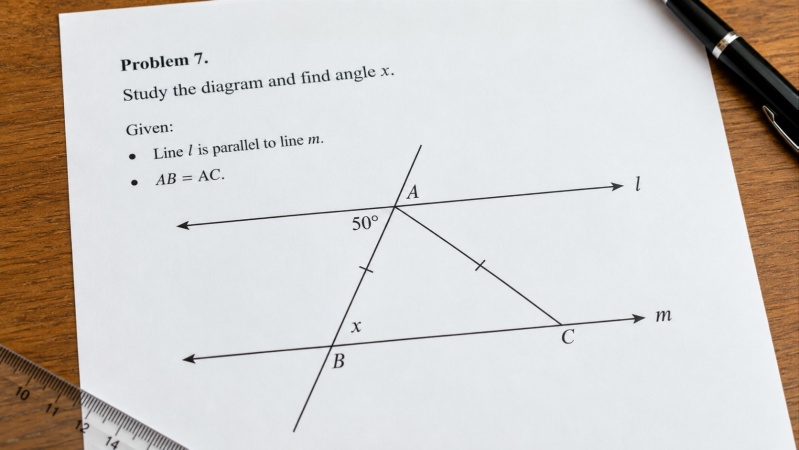
A proof in geometry is a logical argument used to establish that a geometric statement is true. It starts with information that is known or given and uses justified steps to reach the statement that must be proved.
A typical proof has three key parts:
-
Given: Information provided in the problem.
-
Prove: The statement you need to establish.
-
Reasoning: Definitions, properties, postulates, and theorems that connect the given information to the conclusion.
For example, if a problem states that point M is the midpoint of segment AB, you know that AM = MB by the definition of a midpoint. If the problem asks you to prove AM = MB, the proof can be completed in one logical step.
The important idea is that a diagram alone is not proof. A segment may look equal to another segment, or two angles may appear equal, but you cannot use their appearance as evidence unless the information is given or can be established mathematically. Geometry proofs rely on justified relationships rather than visual assumptions.
What Are the Main Types of Proofs Geometry?
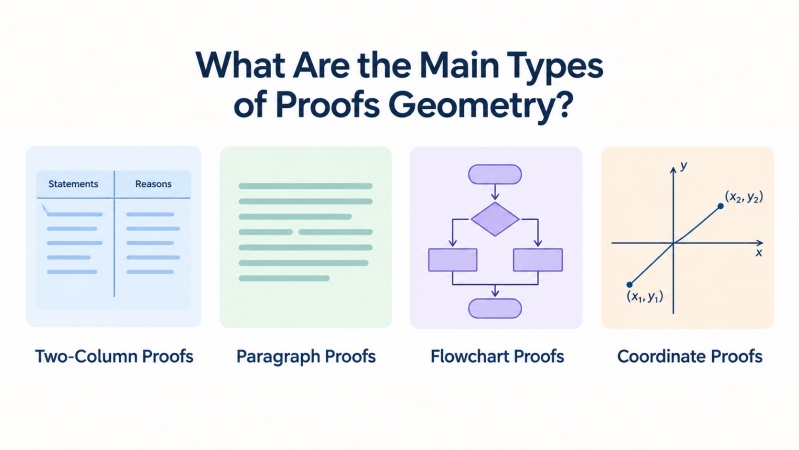
The same mathematical reasoning can be presented in different formats. The most common formats in school geometry are two-column, paragraph, and flowchart proofs. Coordinate proofs use a different approach by representing geometric objects on a coordinate plane and using algebra to verify the desired property.
Two-Column Proofs
A two-column proof places statements in one column and their corresponding reasons in another.
| Statements | Reasons |
|---|---|
| M is the midpoint of AB | Given |
| AM = MB | Definition of midpoint |
The format makes the logical structure easy to check because every statement has a corresponding justification. Two-column proofs are widely used in geometry classes for this reason.
When learning what is a two column proof in geometry, think of it as a structured record of your reasoning. The left side answers "What do I know?", while the right side answers "Why can I say that?"
Paragraph Proofs
A paragraph proof presents the same type of reasoning in complete sentences rather than separate columns.
For example:
Since M is the midpoint of AB, AM = MB by the definition of midpoint.
A longer proof can combine several statements and reasons into one connected explanation. Paragraph proofs can make the reasoning sound more natural, but individual steps can be harder to identify when a proof becomes complicated.
Flowchart Proofs
A flowchart proof represents the reasoning with boxes and arrows. Each box contains a statement, while the reason for that statement is usually shown below or beside it.
This format makes relationships between different steps more visual. It can be especially useful when several facts need to come together before reaching the final conclusion.
Coordinate Proofs
A coordinate proof places geometric figures on a coordinate plane and uses algebraic tools such as the distance formula, midpoint formula, or slope to establish a geometric relationship.
For example, to show that two segments are congruent, you can calculate their lengths using coordinates. To show that two lines are parallel, you can compare their slopes.
Coordinate proofs therefore connect geometric reasoning with algebra rather than relying only on traditional statements and reasons.
What Theorems and Properties Are Used in Proofs Geometry?
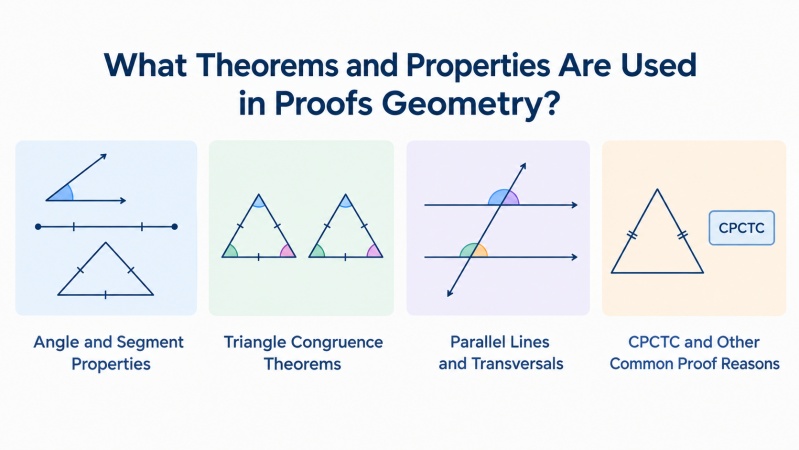
Geometry proofs use a collection of definitions, properties, postulates, and theorems as their reasoning tools. Knowing these tools is important, but it is equally important to recognize when each one applies.
Angle and Segment Properties
Common angle and segment relationships include:
-
Vertical Angles Theorem: Vertical angles are congruent.
-
Linear Pair: Angles forming a linear pair are supplementary.
-
Angle Addition: Adjacent angles can be combined to find a larger angle.
-
Segment Addition: Parts of a segment can be combined to form the whole segment.
-
Reflexive Property: A segment or angle is congruent to itself.
-
Definition of midpoint: A midpoint divides a segment into two congruent segments.
-
Definition of angle bisector: An angle bisector divides an angle into two congruent angles.
These properties often provide the intermediate steps needed to reach a larger result.
Triangle Congruence Theorems
Triangle congruence is central to many proofs in geometry . The main criteria are:
-
SSS: Three pairs of corresponding sides are congruent.
-
SAS: Two pairs of corresponding sides and the included angles are congruent.
-
ASA: Two pairs of corresponding angles and the included side are congruent.
-
AAS: Two pairs of corresponding angles and a non-included side are congruent.
-
HL: triangles, a hypotenuse and one leg are co In rightngruent.
The key is not simply remembering these abbreviations. You need to compare the information you have with the conditions required by each theorem.
Parallel Lines and Transversals
When a transversal crosses parallel lines, several angle relationships can be used in geometry proofs.
Common relationships include:
-
Corresponding angles are congruent.
-
Alternate interior angles are congruent.
-
Alternate exterior angles are congruent.
-
Same-side interior angles are supplementary.
These relationships can provide the angle congruences needed to prove triangles congruent or establish another geometric relationship.
CPCTC and Other Common Proof Reasons
CPCTC stands for Corresponding Parts of Congruent Triangles are Congruent. It is commonly used after two triangles have already been proven congruent.
For example:
-
Prove △ABC ≅ △DEF using SAS.
-
Identify the corresponding angles or sides.
-
:Use CPCTC to prove the specific pair requested by the problem.
CPCTC should not normally be the starting point of a proof because you first need to establish that the triangles are congruent. Other common reasons include definitions, properties of equality, postulates, and previously proven theorems.
Geometry Proofs Examples
Working through geometry proofs examples can help you recognize recurring patterns. The following examples use simplified problems to show how the reasoning works.
Example 1: A Basic Angle Proof
Given:∠1 and ∠2 are vertical angles.
Prove: ∠1 ≅ ∠2.
| Statements | Reasons |
|---|---|
| ∠1 and ∠2 are vertical angles | Given |
| ∠1 ≅ ∠2 | Vertical Angles Theorem |
The important pattern is:
Given relationship → applicable theorem → conclusion
Example 2: A Segment Proof
Given:M is the midpoint of AB.
Prove: AM = MB.
| Statements | Reasons |
|---|---|
| M is the midpoint of AB | Given |
| AM = MB | Definition of midpoint |
This is a simple example, but it illustrates an important idea: definitions can directly provide the reason for a proof step.
Example 3: A Triangle Congruence Proof
Given:AB ≅ DE, BC ≅ EF, and ∠B ≅ ∠E.
Prove: △ABC ≅ △DEF.
The two sides and the included angle correspond:
-
AB ≅ DE
-
BC ≅ EF
-
∠B ≅ ∠E
Therefore:
△ABC ≅ △DEF by SAS.
The key step is recognizing that the known angle is between the two known sides. That tells you to use SAS rather than simply choosing a triangle theorem based on the number of facts available.
Example 4: A Proof Using CPCTC
Suppose you have already proved:
△ABC ≅ △DEF
and the problem asks you to prove:
∠A ≅ ∠D
Because ∠A and ∠D are corresponding angles of the congruent triangles, you can write:
| Statement | Reason |
|---|---|
| △ABC ≅ △DEF | Previously proved |
| ∠A ≅ ∠D | CPCTC |
The important point is that CPCTC comes after triangle congruence has been established.
Example 5: A Proof Involving Parallel Lines
Given:Lines l and m are parallel, and a transversal crosses both lines.
Prove: A pair of alternate interior angles is congruent.
| Statements | Reasons |
|---|---|
| l ∥ m | Given |
| ∠1 and ∠2 are alternate interior angles | Definition of angle relationship |
| ∠1 ≅ ∠2 | Alternate Interior Angles Theorem |
This pattern appears frequently in geometry. First identify the line relationship, then identify the angle relationship created by the transversal, and finally apply the appropriate theorem.
How to Do Geometry Proofs Step by Step?
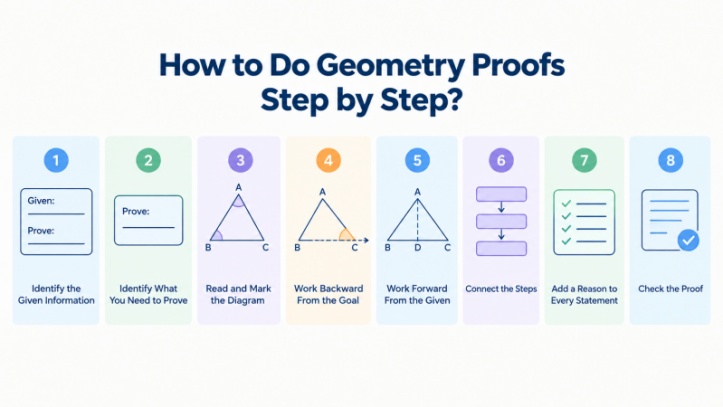
Learning how to do math proofs geometry becomes easier when you use a consistent process. Instead of trying to guess the next line immediately, work from both the information you have and the conclusion you need.
1. Identify the Given Information
Start by reading the problem carefully and listing exactly what is given.
Look for information about:
-
Congruent sides or angles
-
Parallel or perpendicular lines
-
Midpoints
-
Angle bisectors
-
Right angles
-
Special triangles or quadrilaterals
Do not add information simply because it appears obvious in the diagram.
2. Identify What You Need to Prove
Read the final part of the problem carefully.
Ask: What exactly do I need to establish?
If the goal is to prove two triangles congruent, your strategy will be different from a problem asking you to prove two angles congruent.
Writing the goal separately can make the proof easier to plan.
3. Read and Mark the Diagram
Translate the given information into marks on the diagram when possible.
For example:
-
Tick marks can represent congruent segments.
-
Matching arcs can represent congruent angles.
-
A small square can represent a right angle.
-
Arrow marks can indicate parallel lines.
The diagram is useful for organizing known information, but it should not be treated as evidence for facts that were not given or proven.
4. Work Backward From the Goal
Ask: What theorem, definition, or property could directly establish my goal?
For example, if the goal is to prove two angles congruent, possible routes might include:
-
Vertical Angles Theorem
-
Corresponding Angles
-
Alternate Interior Angles
-
Isosceles Triangle Theorem
-
CPCTC
If the goal requires CPCTC, ask what must be proven first. That may lead you to triangle congruence.
Working backward helps turn an unfamiliar proof into a sequence of smaller questions.
5. Work Forward From the Given
Now examine what the given information can establish.
For example:
Given midpoint → two congruent segments
or
Parallel lines → angle relationship
or
Two sides + included angle → possible SAS
The goal is to find a connection between what the problem gives you and what it asks you to prove.
6. Connect the Steps
Once you have possible starting and ending points, connect them into a logical chain.
A common triangle proof pattern looks like:
Given information → angle/segment relationships → triangle congruence → CPCTC → final conclusion
Not every proof follows this exact structure, but recognizing common patterns can make it easier to decide what to try next.
7. Add a Reason to Every Statement
Every statement in a formal proof should have a valid justification.
Possible reasons include:
-
Given
-
Definition
-
Postulate
-
Property
-
Theorem
-
Previously proven result
For example:
AB ≅ CD -- Given
∠1 ≅ ∠2 -- Vertical Angles Theorem
AM = MB -- Definition of midpoint
A statement without a valid reason leaves a gap in the proof.
8. Check the Proof
Before finishing, review each step of your proof and make sure the reasoning is complete.
Ask:
-
Does every statement have a valid reason?
-
Does each reason actually support the statement?
-
Did I assume anything from the appearance of the diagram?
-
Did I use the correct theorem or property?
-
Does the final statement match the required goal?
If you are unsure how the proof should progress, a geometry proof solver can help you review the problem with step-by-step explanations. Enter the problem or upload an image or PDF to see how the given information connects to the conclusion. Reviewing each step can help you understand the reasoning behind a proof rather than checking only the final answer.
A proof is complete when the logical chain reaches the statement you were asked to establish.
Common Geometry Proof Mistakes
Understanding common errors can make geometry proofs practice more productive because you can identify exactly where your reasoning breaks down.
Assuming Information From the Diagram
A diagram may make two segments look equal or two lines look parallel, but visual appearance is not enough.
Use a relationship only when it is:
-
Given
-
Defined
-
Established by a theorem or property
-
Derived from an earlier proven statement
Using the Wrong Theorem or Property
Having several theorems available does not mean they are interchangeable.
For example, SAS requires two corresponding sides and the included angle. If the angle is not between those two sides, SAS does not apply.
Before choosing a theorem, check its exact conditions.
Skipping Reasons
A statement by itself does not explain why it is true.
Instead of writing:
∠A ≅ ∠B
you need to identify the reason, such as:
∠A ≅ ∠B -- Vertical Angles Theorem
The reason column is an essential part of a two-column proof.
Using CPCTC Too Early
CPCTC applies to corresponding parts of congruent triangles .
Therefore, if the triangles have not yet been proven congruent, you need to establish their congruence first using an appropriate criterion such as SSS, SAS, ASA, AAS, or HL.
Proving Something Other Than the Given Goal
A proof can contain mathematically correct statements and still fail to answer the question.
Keep the target visible while working. Each step should either move you toward the target or establish information needed for a later step.
Conclusion
Geometry proofs become easier when you focus on the logical connection between the given information and the statement you need to prove. Instead of trying to guess the next step, identify the goal, work backward and forward, choose the theorem or property that connects each step, and give a valid reason for every statement.
Working through geometry proofs examples and practicing different proof formats can help you become more familiar with these patterns. When you get stuck or want to review how a problem should be solved, you can also use a geometry proof solver like Tenorshare AI Math to see step-by-step explanations and better understand the reasoning behind each solution.
With practice, the process of identifying what you know, what you need to prove, and which theorem connects the two becomes more systematic.

Tenorshare AI Math
- Solve math from text, images & PDFs at 98% accuracy
- Deliver step-by-step answers with detailed logic breakdown
- Access video explanations for deeper math concept understanding
- Generate matching practice tests to solidify knowledge

FAQs
-
What Are the 12 Theorems of Geometry?
There is no single universally accepted list of exactly 12 geometry theorems. Commonly used theorems include the Triangle Sum Theorem, Pythagorean Theorem, and triangle congruence theorems such as SSS, SAS, ASA, and AAS.
-
What Are the Three Main Types of Proofs?
The three common proof formats are two-column proofs, paragraph proofs, and flowchart proofs. They use the same logical reasoning but organize statements and reasons differently.
-
Are Proofs Still Taught in Geometry?
Yes. Geometry proofs remain part of many geometry courses because they teach students how to justify conclusions using definitions, properties, postulates, and theorems.
-
How Do You Solve Proofs in Geometry?
Start with the given information and identify what you need to prove. Mark the diagram, work backward from the goal and forward from the given, then connect the steps with appropriate theorems or properties.
-
How to Memorize Geometry Proofs?
Instead of memorizing entire proofs word for word, focus on understanding the definitions, theorems, and reasoning behind each step. Practicing similar problems can also help you recognize common proof patterns and remember when to use them.
-
Are Geometric Proofs Hard?
They can be challenging at first because you need to decide which facts and theorems connect the given information to the goal. With practice, recognizing common proof patterns can make the process more systematic.
You Might Also Like
- Is Geometry Hard? What Makes Geometry Difficult & How to Simplify It
- GeoGebra vs Desmos: What's the Difference & Which One to Use?
- Best AI for Geometry in 2026: We Tested the Top 7 AI Math Tools
- 150+ Geometry Pick-Up Lines That Add Up to Love
- How to Improve Math Skills: 5 Practical Ways to Get Better at Math 2026
- How to Solve Linear Equations in 5 Easy Steps [2026 Guide]

Tenorshare AI Math: Solve any math problems with AI
Turn math questions into clear solutions, tutorial videos & targeted practice setsTenorshare AI Math: Instant Solutions
Steps, videos & practice for every problem
Tenorshare AI Math: Solve any math problems with AI