
How to Solve Linear Equations in 5 Easy Steps [2026 Guide]
Linear equations are one of the basic topics in algebra. Once you understand how to keep both sides of an equation balanced and isolate the variable, most linear equations can be solved with the same general process.
In this guide, you will learn how to solve linear equations step by step , starting with simple one-variable equations and moving on to equations with fractions, two variables, and systems of three equations. Each section includes examples so you can see how the rules work in practice.
Catalogs:
What Is a Linear Equation?
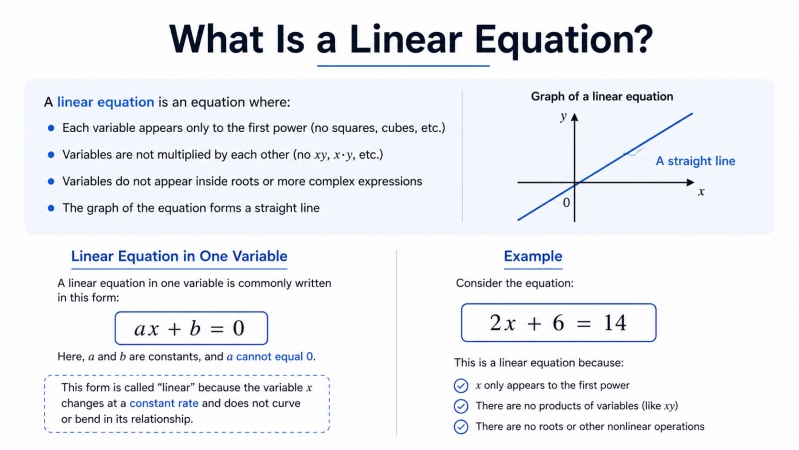
A linear equation is often introduced in a very simple way, but the full idea is a bit more precise than just "variables have power 1."
In general, a linear equation is an equation where:
-
Each variable appears only to the first power (no squares, cubes, etc.)
-
Variables are not multiplied by each other (no xy, x·y, etc.)
-
Variables do not appear inside roots or more complex expressions
-
The graph of the equation forms a straight line
So yes, the basic definition is simple, but these conditions are what make it truly "linear."
A linear equation in one variable is commonly written in this form: ax + b = 0
Here, a and b are constants, and a cannot equal 0.
This form is called "linear" because the variable x changes at a constant rate and does not curve or bend in its relationship.
For example: 2x + 6 = 14
This is a linear equation because x only appears to the first power, and there are no products or nonlinear operations applied to it.
If you solve it:
2x + 6 = 14
2x = 8
x = 4
The relationship remains linear throughout the process , which is why it is classified as a linear equation.
How to Tell If an Equation Is Linear
To quickly identify whether an equation is linear, check how the variables appear in the expression.
An equation is linear when:
-
Every variable has an exponent of 1
-
Variables are not multiplied by each other
-
Variables are not inside square roots or other nonlinear functions
-
Variables are not used as exponents
-
The graph of a two-variable equation is a straight line
For example:
-
3x + 5 = 20
This is linear because x appears only to the first power.
-
2x + 3y = 12
This is also linear because both variables are first-degree and not multiplied together.
In contrast:
-
x² + 5 = 14
Not linear, because x is squared.
-
xy = 10
Not linear, because x and y are multiplied together.
These rules help distinguish linear equations from nonlinear ones in a consistent and reliable way.
How to Solve Linear Equations Step by Step
The easiest way to understand how to solve a linear equation is to think of the equation as a balanced scale.
Whatever operation you perform on one side of the equation must also be performed on the other side.
A general method is to simplify the equation, move the variable terms to one side, move constants to the other side, isolate the variable, and then check the answer.
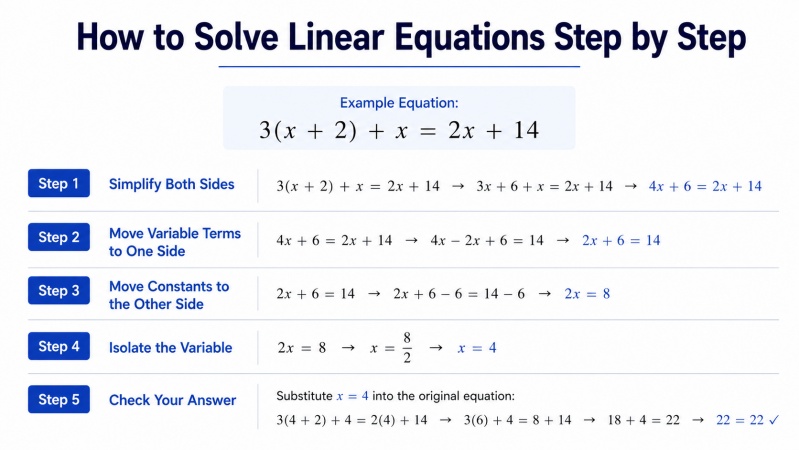
Consider this example: 3(x + 2) + x = 2x + 14
We can solve it in five steps.
Step 1: Simplify Both Sides
Start by simplifying both sides of the equation.
Remove parentheses using the distributive property and combine like terms when necessary.
-
Original equation: 3(x + 2) + x = 2x + 14
-
Distribute 3: 3x + 6 + x = 2x + 14
-
Combine like terms: 4x + 6 = 2x + 14
Now the equation is simplified and ready for solving.
Step 2: Move Variable Terms to One Side
Next, place the variable terms on the same side of the equation.
-
Start with: 4x + 6 = 2x + 14
-
Subtract 2x from both sides: 4x - 2x + 6 = 14
-
This becomes: 2x + 6 = 14
You can move the variable terms to either side. In many cases, choosing the side that keeps the variable coefficient positive makes the calculation simpler.
Step 3: Move Constants to the Other Side
Next, move the constant terms away from the variable.
-
Start with: 2x + 6 = 14
-
Subtract 6 from both sides: 2x = 8
The variable term is now alone on one side.
Step 4: Isolate the Variable
Now make the coefficient of the variable equal to 1.
-
Start with: 2x = 8
-
Divide both sides by 2: x = 4
-
Therefore, the solution is: x = 4
Depending on the equation, you may need to multiply instead of divide. The goal is always the same: isolate the variable.
Step 5: Check Your Answer
After solving the equation, substitute your answer back into the original equation.
-
The original equation was: 3(x + 2) + x = 2x + 14
-
Substitute x = 4: 3(4 + 2) + 4 = 2(4) + 14
-
Simplify: 3(6) + 4 = 8 + 14
-
Both sides are equal, so x = 4 is correct.
Checking the answer in the original equation helps you find arithmetic or algebra mistakes that may have occurred during the solving process.
To Quickly Check Answers, Try Tenorshare AI Math
Solving equations by hand is useful for understanding algebra, but checking every step can take time, especially when an equation contains several operations, fractions, or multiple variables. Because of this, many learners also use digital tools to verify their work and reduce mistakes.
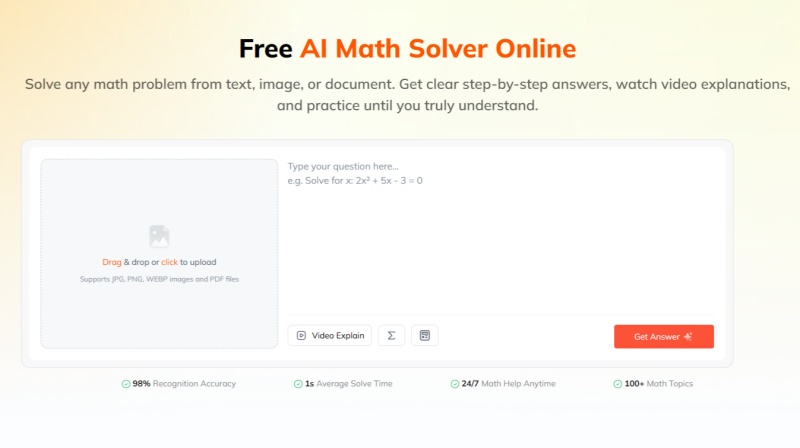
Tenorshare AI Math is an AI math solver that can provide step-by-step solutions instead of only showing the final answer. You can enter a math problem as text or upload a photo, image, or PDF.
It also offers several learning features:
-
Scan text, photos, and documents: You can upload or capture problems from different sources for quick solving.
-
Step-by-step answers: Shows each transformation used to reach the final result, helping you understand where mistakes may occur.
-
Video explanations: Provides visual walkthroughs of solving methods for easier understanding.
-
Similar practice questions: Generates additional exercises to reinforce what you've learned.
With step-by-step answers, you can trace errors instead of only checking the final result. You can also compare each step to identify where your own calculation starts to differ. This helps you clearly see what went wrong and understand the reason behind it.
The video explanation feature provides another way to review the solving method through visual learning, while the practice feature generates similar questions for additional reinforcement. Together, these tools help strengthen understanding through repetition and clear explanations.
How to Solve Linear Equations in One Variable
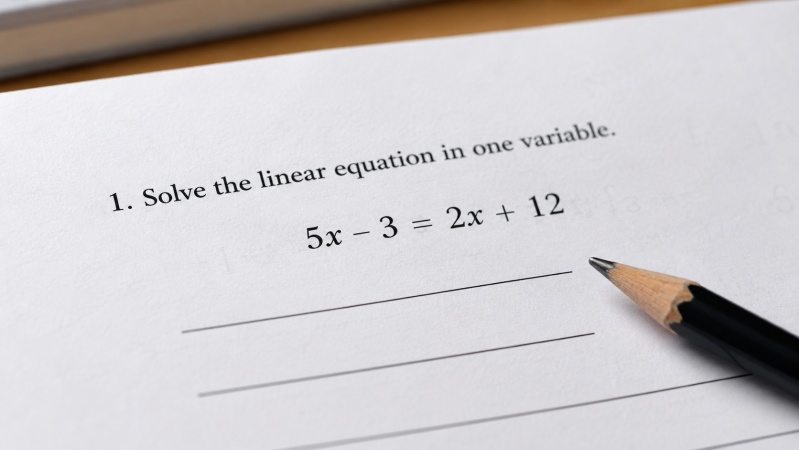
For a linear equation in one variable, the goal is simple: isolate the unknown on one side of the equation.
Start by simplifying both sides. Then collect all variable terms on one side and constants on the other. Use inverse operations---addition, subtraction, multiplication, or division---until the variable stands alone.
For equations with parentheses, distribute first. If the variable appears on both sides, move the variable terms together before isolating it.
The key is to first collect the x-terms on one side, then solve the remaining one-variable equation.
Watch for: sign changes, operations applied to only one side, and skipped simplification.
How to Solve Linear Equations With Fractions
When a linear equation contains fractions, clear the fractions before using the standard solving steps.
First, find the least common denominator (LCD) of all denominators. Multiply every term on both sides by the LCD. This removes the fractions and turns the problem into a simpler linear equation. Khan Academy uses the same approach when solving equations with fractional coefficients.
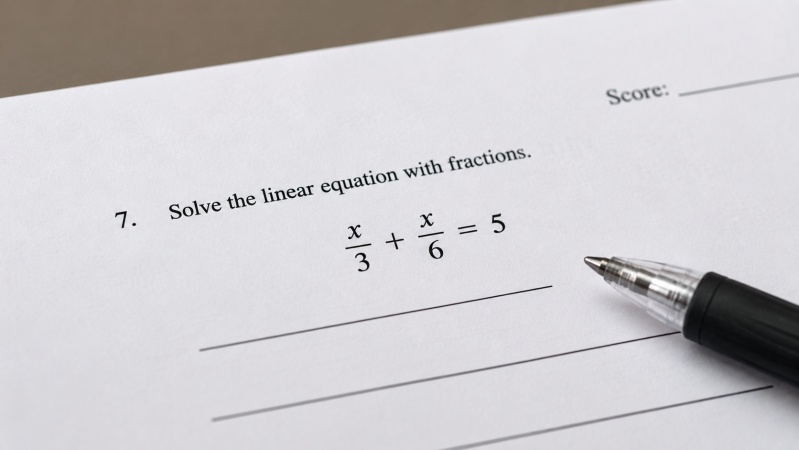
As shown in the image, the LCD is 6. Multiplying every term by 6 converts the equation into: 2x + x = 30
From there, solve it like any other linear equation.
Key rule: the LCD must multiply every term on both sides, not just the terms containing fractions.
How to Solve Linear Equations With Two Variables
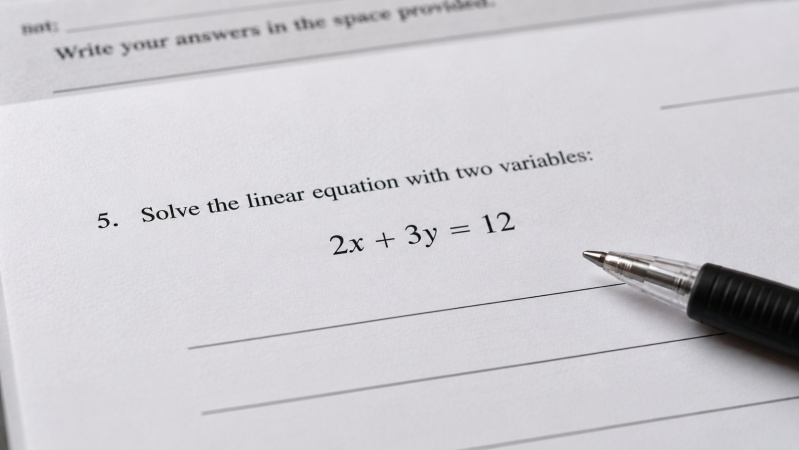
One linear equation with two variables usually does not have a single solution. Instead, it represents many pairs of values that satisfy the equation.
To find unique values for both variables, you normally need a system of two independent linear equations . The main methods are:
-
Substitution: solve one equation for one variable and substitute it into the other.
-
Elimination: add or subtract equations to remove one variable.
-
Graphing: find the point where the two lines intersect.
The main idea is reduction: turn a two-variable system into a one-variable equation, solve it, and then substitute the result back to find the remaining variable.
Watch for: treating one equation as enough to determine both variables and forgetting to substitute back after solving the first variable.
How to Solve a System of Three Linear Equations
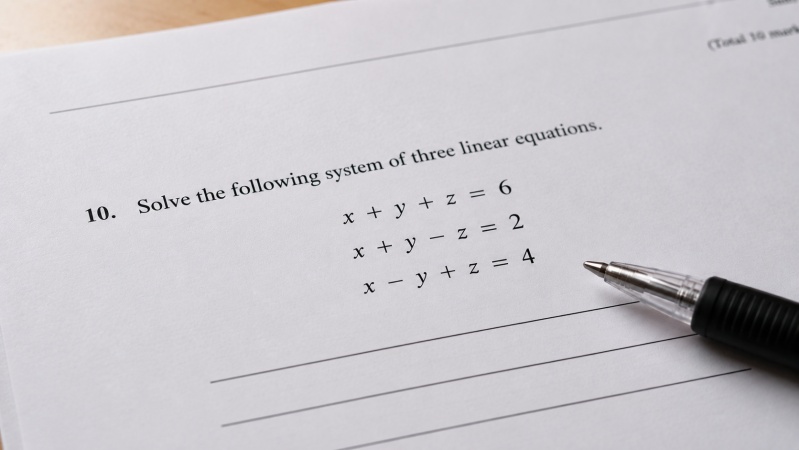
For a system with three variables, the same reduction principle applies, but in two stages.
First, use elimination to remove the same variable from two pairs of equations. This reduces the original three-variable system to a system with two variables. Then solve that smaller system and substitute the results back to find the third variable.
In short: 3 variables → 2 variables → 1 variable → back-substitute
OpenStax describes three-variable systems in the same way: eliminate variables step by step until the system is reduced enough to solve by back-substitution. The important part is not solving all three variables at once. It is choosing equations carefully so the same variable can be eliminated consistently.
Watch for: eliminating different variables in different equation pairs, misaligning terms, and carrying sign errors into later steps.
Conclusion
Learning how to solve linear equations comes down to one key rule: keep both sides balanced while isolating the variable. The same principle applies to fractions and multi-variable equations, with methods such as substitution or elimination used when needed.
For faster checking and extra guidance, Tenorshare AI Math can help you work through math problems with step-by-step explanations.

Tenorshare AI Math
- Solve math from text, images & PDFs at 98% accuracy
- Deliver step-by-step answers with detailed logic breakdown
- Access video explanations for deeper math concept understanding
- Generate matching practice tests to solidify knowledge

FAQs
-
What Is a System of Linear Equations?
A system of linear equations is a group of two or more linear equations that are solved together. The solution must satisfy all equations in the system at the same time, and a system may have one solution, no solution, or infinitely many solutions.
-
What Is the Easiest Way to Solve Linear Equations?
The easiest way is to simplify both sides, move variable terms to one side and constants to the other, then use inverse operations until the variable is isolated. Always apply the same operation to both sides to keep the equation balanced.
-
What Is the Formula for a Linear Equation?
A common form of a linear equation in one variable is ax + b = 0, while a two-variable linear equation is often written as Ax + By = C. In both cases, the variables appear only to the first power.
-
Can a Linear Equation Have No Solution?
Yes. A linear equation has no solution when simplifying both sides leads to a false statement, such as 3 = 7. This means no value of the variable can make the original equation true.
-
Can a Linear Equation Have Infinitely Many Solutions?
Yes. A linear equation has infinitely many solutions when simplification produces an identity that is always true, meaning every possible value of the variable satisfies the equation.
-
What Is the Difference Between a Linear Equation and a System of Linear Equations?
A linear equation is a single equation, while a system of linear equations contains two or more equations that must be satisfied at the same time. A two-variable system can have one solution, no solution, or infinitely many solutions.
You Might Also Like
- How to Solve a Hard Math Problem: A Simple Guide for Students
- How to Solve Math Word Problems Step by Step: Strategies, Tips & Tool
- What Happened to Microsoft Math Solver? Why It Was Discontinued and What to Use Instead
- How to Study for a Math Test: From 7 Days Before to the Night Before
- How to Get Better at Math Fast: 8 Strategies to Improve Your Skills
- How to Take Math Notes: The Ultimate Guide to Handwritten and Digital Notes

Tenorshare AI Math: Solve any math problems with AI
Turn math questions into clear solutions, tutorial videos & targeted practice setsTenorshare AI Math: Instant Solutions
Steps, videos & practice for every problem
Tenorshare AI Math: Solve any math problems with AI