
How to Do Math in Your Head: 5 Mental Math Techniques for Faster Calculations
Do you rely on a calculator for simple calculations or struggle to solve numbers quickly in your mind? Learning how to do math in your head can help you handle everyday arithmetic faster and with more confidence.
Mental math is not about doing complicated calculations instantly. It is about using smarter strategies, such as breaking numbers apart, rounding, and recognizing patterns, to make problems easier to solve.
In this guide, you will learn practical mental math techniques for addition, subtraction, multiplication, division, and percentages, along with methods that can help you calculate more efficiently without writing anything down.
Also Read: How to Get Better at Mental Math: Practical Strategies and Daily Practice
How Does Math in Your Head Work?

When people think about doing math mentally, they often imagine performing the same calculations they would write on paper, but without using a pencil. However, mental math usually works in a different way.
Written calculations often rely on fixed procedures, such as arranging numbers vertically and calculating each digit step by step. In contrast, math in head relies more on flexibility. Your brain looks for easier ways to represent the problem before solving it.
For example, if you need to calculate:
48 + 37
You could add directly, but a mental math approach may simplify the problem:
48 + 30 + 7 = 85
50 + 37 - 2 = 85
Both methods produce the same answer, but they reduce the amount of effort required.
This is the foundation of how to do mental math: instead of calculating every problem in the same way, you learn to choose strategies that make numbers easier to work with.
Mental calculation usually depends on several abilities:
-
Number sense: understanding how numbers relate to each other
-
Basic fact recall: quickly remembering common calculations
-
Pattern recognition: noticing shortcuts and relationships
-
Working memory: keeping important information in mind while solving
People who are good at mental arithmetic are not necessarily doing more calculations in their heads. They are often simplifying the problem before calculating.
The Core Mental Math Techniques You Need to Learn
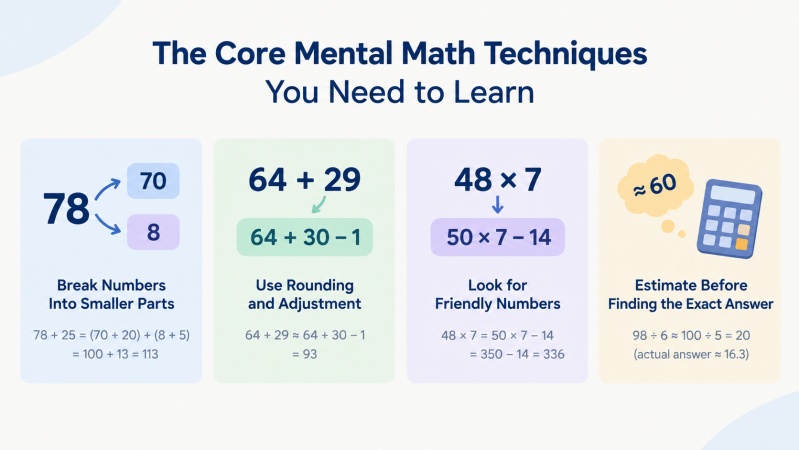
Before learning specific methods for addition, multiplication, or percentages, it is useful to understand the core ideas behind most mental calculation techniques.
Break Numbers Into Smaller Parts
One of the most common mental math strategies is breaking a large calculation into smaller, easier pieces.
For example:
76 + 45
Instead of treating it as one problem, separate the tens and ones:
-
70 + 40 = 110
-
6 + 5 = 11
-
110 + 11 = 121
This approach reduces the amount of information you need to process at once. It is especially useful when working with larger numbers or multi-step calculations.
Breaking numbers apart is also helpful for multiplication. For example:
14 × 6
can become:
-
10 × 6 = 60
-
4 × 6 = 24
-
60 + 24 = 84
Use Rounding and Adjustment
Round numbers are easier for the brain to handle because they create simpler calculations.
For example:
98 + 46
Instead of adding directly, you can round 98 up to 100:
-
100 + 46 = 146
-
subtract 2 because you added 2 extra
The answer is: 144
This method, sometimes called compensation, is one of the most useful techniques for learning how to do math faster in your head . It allows you to replace an awkward number with a simpler one and then correct the difference.
Look for Friendly Numbers
Some numbers naturally work well together because they create simple totals.
For example:
27 + 38 + 3
Rather than calculating from left to right, you can combine:
-
27 + 3 = 30
-
30 + 38 = 68
Finding these "friendly numbers" helps reduce mental workload. This strategy appears frequently in everyday calculations, especially when adding prices, estimating costs, or working with measurements.
Estimate Before Finding the Exact Answer
Estimation is an important part of mental math because it gives you a quick sense of whether your answer is reasonable.
For example:
398 × 5
Before calculating exactly, you might think:
400 × 5 = 2,000
The final answer should be close to 2,000.
Estimation does not replace exact calculation, but it helps you identify mistakes and makes mental arithmetic more reliable.
How to Do Math Fast in Your Head?

If you want to know how to do math fast in your head , the key is not trying to force your brain to calculate faster. Instead, you need to reduce unnecessary steps.
Different operations require different approaches. Addition often benefits from breaking numbers apart, multiplication depends on recognizing patterns, and percentages become easier when you connect them to familiar values.
The following techniques show how to apply mental math methods to common calculations.
How to Add Numbers in Your Head?
Addition is usually the easiest place to begin when learning how to do mental arithmetic because many strategies can be applied immediately.
Add Numbers From Left to Right
When calculating on paper, people often start with the ones column. In mental math, starting from the largest place value is often easier.
For example:
324 + 156
Instead of adding digit by digit:
-
300 + 100 = 400
-
20 + 50 = 70
-
4 + 6 = 10
Then combine:
400 + 70 + 10 = 480
This method keeps the calculation organized and reduces the chance of losing track of numbers.
Make Tens and Hundreds First
Numbers that create round totals are easier to remember.
For example:
46 + 28
You can adjust the problem:
-
46 + 4 = 50
-
28 - 4 = 24
-
50 + 24 = 74
By creating a round number first, the calculation becomes simpler.
How to Subtract Numbers in Your Head
Subtraction can sometimes feel harder than addition because people often try to process multiple digits at once. Mental subtraction becomes easier when you use rounding or think about the distance between numbers.
Round the Number and Adjust
For example:
82 - 39
Since 39 is close to 40:
-
82 - 40 = 42
-
Add back 1
The answer is: 43
This technique avoids handling an inconvenient number directly.
Count Up Instead of Counting Down
For some subtraction problems, finding the difference is easier by counting upward.
Example:
100 - 87
Think:
-
87 to 90 = 3
-
90 to 100 = 10
The total difference is: 13
This approach is especially useful for prices, changes, and everyday comparisons.
How to Multiply Numbers in Your Head?
Multiplication is where many people begin looking for shortcuts. The most effective mental multiplication methods are based on changing the problem into a simpler form.
Break Multiplication Into Smaller Parts
For example:
12 × 7
Instead of calculating directly:
-
10 × 7 = 70
-
2 × 7 = 14
Then:
70 + 14 = 84
This uses the same idea as the distributive property, which allows you to divide a difficult multiplication problem into smaller ones.
Use Numbers Close to 10 or 100
Numbers close to round numbers are often easier to calculate.
89 × 6
Instead of:
89 × 6
Think:
-
90 × 6 = 540
-
1 × 6 = 6
-
540 - 6 = 534
This type of adjustment is a common strategy in mental calculation techniques.
Use Doubling and Halving
Doubling and halving can simplify certain multiplication problems.
For example:
25 × 16
You can rewrite it as:
-
50 × 8
-
100 × 4
The answer is: 400
This method works because multiplying one number by 2 while dividing the other by 2 keeps the product unchanged.
How to Divide Numbers in Your Head?
Division can feel more challenging than other operations because it often requires you to think backward from multiplication. However, many division problems become easier when you recognize familiar number relationships and break the calculation into smaller steps.
When learning how to do mental arithmetic, it is helpful to think of division as finding a missing multiplication fact rather than simply splitting numbers apart.
Use Known Multiplication Facts
One of the simplest ways to divide mentally is to ask:
"What number multiplied by this divisor gives me the original number?"
For example:
72 ÷ 8
Instead of calculating directly, think:
8 × ? = 72
Since: 8 × 9 = 72
the answer is: 72 ÷ 8 = 9
Having common multiplication facts stored in memory can make many division problems much faster.
Break Large Divisions Into Smaller Steps
For larger numbers, dividing the problem into smaller parts can reduce mental effort.
For example:
240 ÷ 6
You can separate it into:
24 ÷ 6 = 4
Then bring back the zero:
240 ÷ 6 = 40
This strategy is especially useful when dividing numbers that contain zeros or when the numbers can be easily simplified.
Estimate Before Dividing
Estimation can help you quickly understand whether an answer is reasonable.
For example:
398 ÷ 4
You might first estimate:
400 ÷ 4 = 100
The exact answer should be close to 100.
Estimation is not always enough for an exact result, but it helps you avoid major mistakes and improves confidence when doing calculations mentally.
How to Calculate Percentages in Your Head?
Percentages are common in everyday situations, such as calculating discounts, tips, taxes, or price changes. Many people think percentages are difficult because they involve decimals and fractions, but they become much easier when you start with simple reference points.
A useful way to learn how to do math quickly in your head is to memorize a few common percentage relationships and build from them.
Find 10% First
The easiest percentage shortcut is finding 10% of a number.
To calculate 10%, simply move the decimal point one place to the left.
For example:
10% of 250 = 25
Once you know 10%, you can quickly calculate related percentages:
-
20% = 25 × 2 = 50
-
5% = half of 10% = 12.5
-
15% = 10% + 5% = 37.5
This method works well for shopping discounts and everyday calculations.
Convert Percentages Into Easier Parts
Instead of calculating a percentage directly, divide it into smaller, familiar parts.
For example:
15% of 200
You can solve it as:
-
10% of 200 = 20
-
5% of 200 = 10
Therefore:
15% of 200 = 30
Breaking percentages into smaller pieces is often faster than using a formula.
Use Fractions to Simplify Common Percentages
Some percentages have simple fraction equivalents:
-
50% = 1/2
-
25% = 1/4
-
20% = 1/5
-
10% = 1/10
For example:
25% of 80
Instead of calculating with percentages:
80 ÷ 4 = 20
Understanding these relationships makes percentage calculations more intuitive.
What Are the Most Common Mental Math Shortcuts?

Mental math shortcuts are useful because they reduce unnecessary steps. However, they work best when you understand why they work rather than simply memorizing them.
Some common shortcuts include:
Multiplying by 10, 100, and 1,000
Numbers become easier when multiplied by powers of 10.
Examples:
-
24 × 10 = 240
-
24 × 100 = 2,400
Understanding place value makes these calculations almost automatic.
Multiplying by 5
Multiplying by 5 can often be simplified by multiplying by 10 and dividing by 2.
Example:
36 × 5
Instead of:
36 × 5
Calculate:
-
36 × 10 = 360
-
360 ÷ 2 = 180
Multiplying by 9
A simple shortcut for multiplying by 9 is multiplying by 10 and subtracting the original number.
Example:
8 × 9
Think:
-
8 × 10 = 80
-
80 - 8 = 72
Using Number Complements
Numbers that combine into round values are easier to calculate.
Examples:
8 + 2 = 10
25 + 75 = 100
40 + 60 = 100
Recognizing these relationships helps you perform calculations more naturally and is one of the foundations of learning how to do mental math quickly.
Why Can't I Do Simple Math in My Head?
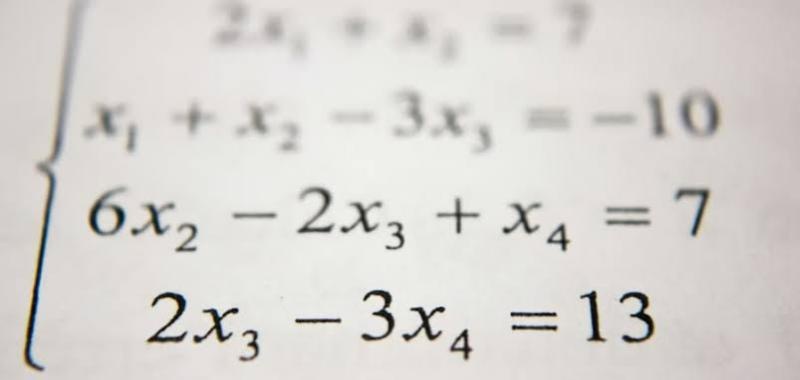
Many people wonder why they struggle with simple calculations while others seem to solve them instantly. Difficulty with mental math does not necessarily mean someone is "bad at math." In many cases, it is related to the strategies they use, their familiarity with numbers, and how much information they can hold in their mind at one time.
If you search for " Why can't I do simple math in my head? ", the answer is usually not one single reason. Mental calculation combines several skills, and weakness in any one area can make it feel more difficult.
Lack of Basic Math Fact Recall
Mental math becomes much easier when common calculations become automatic. For example, quickly remembering multiplication facts, simple additions, or common percentage relationships reduces the amount of effort your brain needs to spend on basic steps.
If you still need to calculate every small part of a problem, your working memory becomes occupied with simple operations instead of focusing on the overall solution.
Building familiarity with basic number facts can make more advanced mental calculations feel much easier over time.
Using Written Calculation Methods in Your Head
Many people struggle because they try to perform written math procedures mentally.
Traditional written methods are designed to be completed on paper, where numbers can be arranged clearly and intermediate steps can be recorded. When the same process is moved into your head, it may require remembering too many details at once.
Mental math uses a different approach. Instead of following every step, it focuses on simplifying the problem first.
For example:
98 + 47
A written approach may treat this as a standard addition problem, while a mental math approach may think:
100 + 47 - 2 = 145
The second method reduces the number of steps your brain needs to track.
Difficulty Visualizing Numbers
Some people search for " Why can't I visualize math in my head? " because they feel they cannot picture numbers or calculations mentally.
However, mental math does not require everyone to visualize numbers in the same way. Some people imagine quantities or number lines, while others rely more on verbal reasoning, patterns, or remembered relationships between numbers.
The important part is developing a calculation method that works for you. Mental math is a flexible skill, and different people may use different thinking processes to reach the same answer.
To Check Your Solutions, Try Tenorshare AI Math
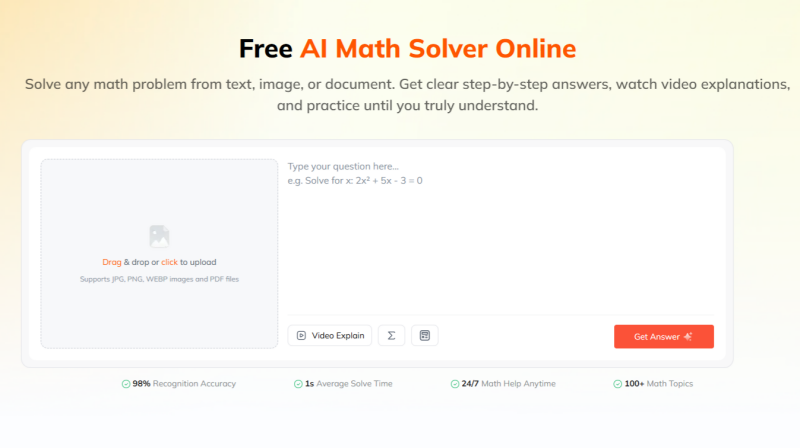
Practicing mental math requires more than just getting an answer. After solving a set of calculations in your head, checking whether your result is correct and understanding where a mistake happened are important parts of improving your skills. This can become time-consuming when problems come from worksheets, screenshots, or longer multi-step questions.
Tenorshare AI Math can support this review process by helping you check your work after you attempt a problem yourself. A simple workflow is:
Solve it yourself → Check your answer → Find mistakes → Review the steps → Practice with a similar problem
Its key features that can support mental math practice include:
-
Step-by-step solutions: Explains each calculation step, helping you compare your own approach with the correct solution and identify where a mistake occurred.
-
Text, image, and PDF input: Lets you check typed equations as well as problems from worksheets, screenshots, or PDF documents without manually entering every question.
-
AI-generated video explanations: Provides visual walkthroughs for problems that may be difficult to understand through written steps alone.
-
Similar practice questions: Generates related problems so you can practice the same calculation strategies and strengthen your understanding.
-
Built-in math calculator: Handles routine calculations that appear during longer problem-solving processes.
For mental math learning, the goal is not to replace your own calculations. Try solving problems in your head first, then use Tenorshare AI Math to verify your answer, understand mistakes, and practice the same concepts again. This approach keeps mental math practice focused on building calculation skills while using AI as a tool for feedback and improvement.
Final Thoughts
Learning how to do math in your head is mainly about developing better ways to work with numbers, not memorizing a large number of tricks. By learning techniques such as breaking numbers apart, rounding, estimating, and recognizing patterns, you can make everyday calculations faster and easier.
Mental math improves with practice, but accuracy should come before speed. Try different strategies, find the methods that work best for you, and use an AI math solver like Tenorshare AI Math to check solutions and understand mistakes when needed.

Tenorshare AI Math
- Solve math from text, images & PDFs at 98% accuracy
- Deliver step-by-step answers with detailed logic breakdown
- Access video explanations for deeper math concept understanding
- Generate matching practice tests to solidify knowledge

FAQs
-
What Is It Called When You Do Math in Your Head?
Doing calculations without writing them down is usually called mental math or mental arithmetic. These skills involve using number patterns, calculation strategies, and memory to solve problems internally.
-
How to Do Math Faster in Your Head?
To calculate faster, focus on simplifying problems instead of trying to process numbers more quickly. Strategies like rounding, breaking numbers into smaller parts, and using familiar number relationships can help reduce mental effort.
-
What Are the Easiest Mental Math Tricks to Learn First?
Beginners can start with simple techniques such as making numbers reach 10 or 100, rounding and adjusting, breaking calculations into smaller steps, and using basic percentage shortcuts. These methods are useful for many everyday calculations.
-
Can You Do Complex Math Problems in Your Head?
Mental math works best for arithmetic, estimation, and pattern-based calculations. Some advanced calculations can be done mentally with enough practice, but complex algebra, geometry, or multi-step problems are often easier to solve with written steps or learning tools.
-
What Is the Difference Between Mental Math and Mental Arithmetic?
Mental arithmetic mainly refers to performing numerical calculations such as addition, subtraction, multiplication, and division in your head. Mental math is a broader concept that also includes estimation, number sense, and flexible problem-solving strategies.
You Might Also Like
- Can ChatGPT Do Math? Here's What It Gets Right and Wrong
- Why Is AI Bad at Math? Understand AI Math Mistakes & Pick a Trustworthy AI Math Tool
- How to Improve Math Skills: 5 Practical Ways to Get Better at Math 2026
- AI Advances in Math: A Guide to the 2026 Latest Breakthroughs
- How to Study for a Math Test: From 7 Days Before to the Night Before
- How to Get Better at Math Fast: 8 Strategies to Improve Your Skills

Tenorshare AI Math: Solve any math problems with AI
Turn math questions into clear solutions, tutorial videos & targeted practice setsTenorshare AI Math: Instant Solutions
Steps, videos & practice for every problem
Tenorshare AI Math: Solve any math problems with AI