
How to Study for a Math Test: From 7 Days Before to the Night Before
Have a math test tomorrow but still feel unprepared? You are not alone. Many students start reviewing at the last minute and struggle to decide what to study first. Learning how to study for a math test effectively is not about spending endless hours reading notes --- it is about focusing on the right topics, practicing problem-solving, and fixing your weakest areas.
Whether you have 7 days, 2 days, or only one night before your exam , a clear study strategy can help you make better use of your remaining time. This guide covers proven math test preparation tips, last-minute study plans, and useful tools to help you review concepts, practice problems, and improve your score.
Catalogs:
How to Properly Study for a Math Test: 5 Best Tips
If you still have several days or even a week before your math test, this is the best time to build a structured study plan instead of relying on last-minute review. The following five tips focus on the key areas that make math test preparation more effective: understanding what to review, practicing the right problems, and identifying areas that need improvement.
Understand What Topics Will Be on the Test
Before starting your study session, first identify what will actually appear on the exam.
Check:
-
Your teacher's review sheet
-
Previous homework assignments
-
Class notes
-
Textbook chapters
-
Past quizzes or tests
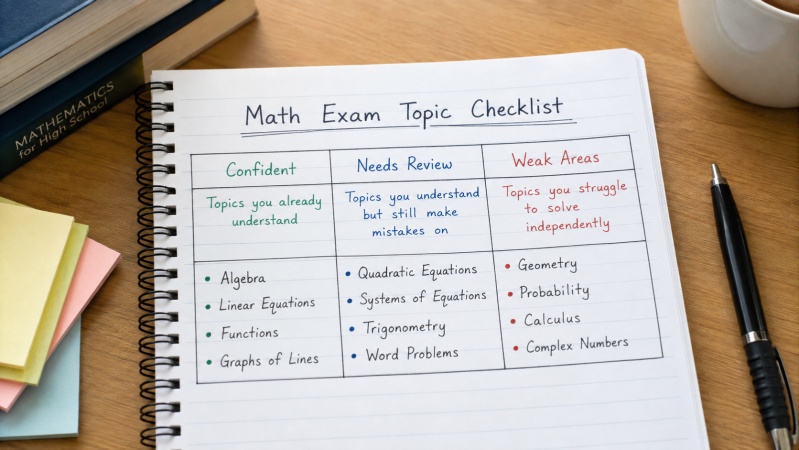
Knowing the test scope helps you avoid wasting time studying unrelated topics. Create a list of chapters or concepts that may appear on the exam, then divide them into three categories:
-
Confident: Topics you already understand
-
Needs Review: T opics you understand but still make mistakes on
-
Weak Areas: Topics you struggle to solve independently
Spend more time on weak areas instead of reviewing everything equally. A focused study plan usually produces better results than repeating familiar exercises.
Review Math Concepts Before Memorizing Formulas
Many students try to memorize formulas without understanding when and why to use them. This can cause problems when exam questions are presented in unfamiliar ways.
Before memorizing a formula, make sure you understand:
-
What the formula represents
-
When to use it
-
What each variable means
-
How the formula connects to the problem
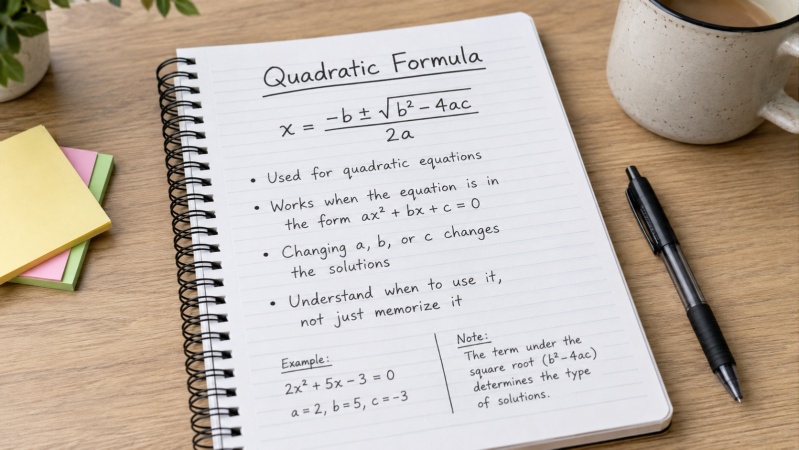
For example, instead of only memorizing the quadratic formula, understand what type of equations require it and how changing different values affects the result.
Creating your own formula sheet can also improve memory. Writing formulas from memory and explaining their purpose is usually more effective than simply copying them from notes.
Practice Different Types of Math Problems
Math improvement comes mainly from solving problems, not just reading explanations.
During your study sessions:
-
Start with basic problems to review the method.
-
Move to more challenging questions.
-
Practice problems that combine multiple concepts.
-
Solve questions without looking at examples.
Try to avoid checking the answer too quickly. Spending time attempting a problem helps you identify where your understanding is incomplete.
Practice problems also help you recognize common patterns, making it easier to choose the correct method during the actual test.
Track Your Mistakes and Fix Weak Areas
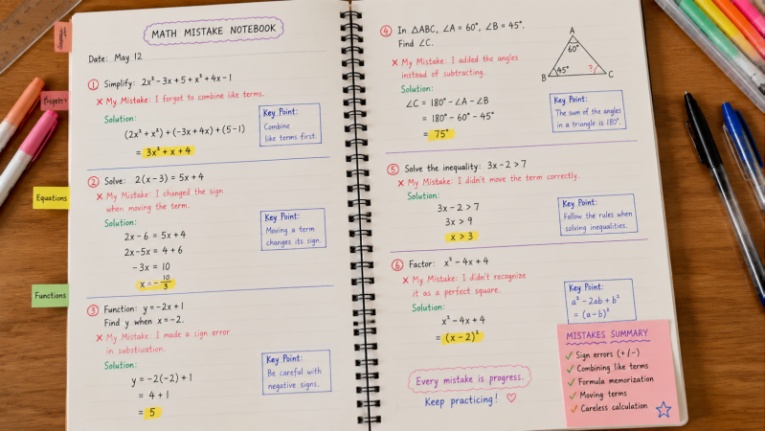
Reviewing mistakes is one of the most useful parts of math preparation.
Instead of only marking answers as right or wrong, record:
-
The problem type
-
Your incorrect step
-
Why the mistake happened
-
The correct approach
Common math mistakes include:
-
Using the wrong formula
-
Misreading the question
-
Making calculation errors
-
Skipping important steps
-
Keeping a mistake log helps you identify repeated problems and focus your final review on areas that need improvement.
Many students spend too much time practicing questions they already know how to solve. Reviewing mistakes helps make study time more targeted.
Take Timed Practice Tests Before the Exam
Knowing how to solve problems is important, but solving them under exam conditions is another skill.
Before your test, complete at least one timed practice session:
-
Set a time limit
-
Avoid checking notes
-
Solve problems in exam order
-
Review mistakes afterward
Timed practice helps you improve:
-
Problem-solving speed
-
Time management
-
Confidence under pressure
It also shows which topics still require attention before the exam.
Practice tests are especially useful because they combine knowledge recall with real test conditions, helping you identify gaps before the actual exam.
How to Study for a Math Test Last Minute
Not every student has a full week to prepare for a math test. Sometimes the exam is only a few days away, and you need to make the most of the limited time you have left.
When studying at the last minute, the goal is not to relearn the entire course from the beginning. Instead, focus on the most important topics, practice common problem types, and review mistakes that are most likely to affect your score.
The following strategies explain how to study for a math test in different timeframes , from 2 days before the exam to just 30 minutes before it starts.
How to Study for a Math Test in 2 Days
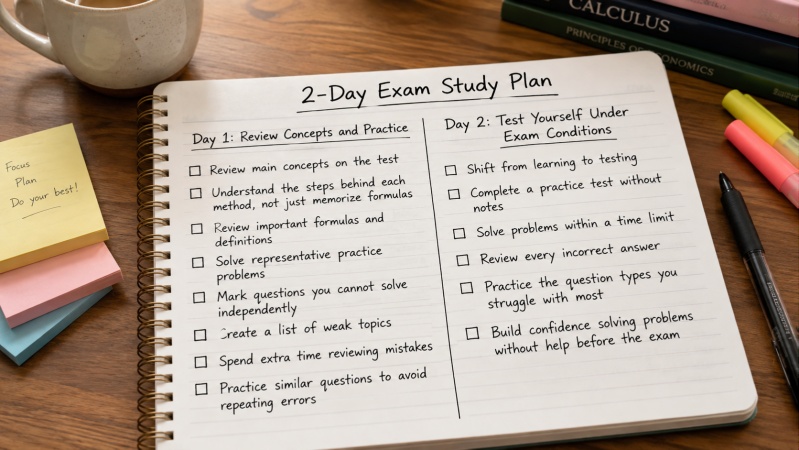
If you have two days before your math test, you still have enough time to create a focused review plan. Avoid trying to cover every chapter equally. Instead, identify the topics that appear most often on homework, quizzes, and review materials.
Day 1: Review Concepts and Practice
Start by reviewing the main concepts that will appear on the test. Focus on understanding the steps behind each method instead of only memorizing formulas.
Your study session should include:
-
Reviewing important formulas and definitions
-
Solving representative practice problems
-
Marking questions you cannot solve independently
-
Creating a list of weak topics
Spend extra time on mistakes because they show where your understanding needs improvement. Reviewing incorrect problems and practicing similar questions can help prevent repeating the same errors during the exam.
Day 2: Test Yourself Under Exam Conditions
On the second day, shift from learning to testing.
Try to:
-
Complete a practice test without notes
-
Solve problems within a time limit
-
Review every incorrect answer
-
Practice the question types you struggle with most
The goal is to make your brain comfortable with solving problems without help before the actual exam.
How to Study for a Math Test in One Day
When you only have one day left, you need to prioritize instead of attempting to master everything.
Start by reviewing the exam topics and ranking them:
-
Topics you often make mistakes on
-
Topics worth many points
-
Topics that require memorizing formulas or steps
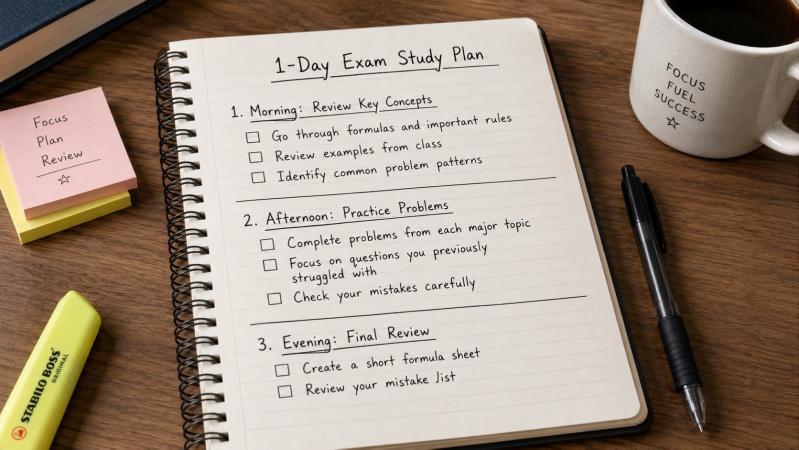
A practical one-day plan:
Morning: Review Key Concepts
-
Go through formulas and important rules
-
Review examples from class
-
Identify common problem patterns
Afternoon: Practice Problems
-
Complete problems from each major topic
-
Focus on questions you previously struggled with
-
Check your mistakes carefully
Evening: Final Review
-
Create a short formula sheet
-
Review your mistake list
-
Complete a short practice quiz
Avoid spending the entire day passively reading notes. Math requires active problem-solving, so most of your study time should involve working through questions .
How to Study for a Math Test the Night Before
Studying the night before a math test can feel stressful, but a focused approach can still help you improve your preparation.
The most important thing is to avoid starting completely new topics . Instead, focus on reinforcing what you already have some knowledge of.
Your priorities should be:
-
1. Review Important Formulas
Create or review a formula sheet and make sure you understand when each formula should be used.
-
2. Practice Common Question Types
Solve several examples of problems that are likely to appear on the test. Focus on understanding the solving process rather than memorizing individual answers.
-
3. Review Your Previous Mistakes
Look back at homework, quizzes, and practice tests. Questions you previously got wrong are often the most valuable areas to review.
- 4. Prepare for Tomorrow
Before going to sleep:
-
Organize your materials
-
Prepare necessary tools
-
Review key points briefly
-
Get enough rest
A tired brain may have difficulty recalling information and solving problems under pressure, so staying up all night is usually not the most effective strategy.
How to Study for a Math Test in One Hour
With only one hour left, do not attempt to learn everything. Focus on the areas that can bring the biggest improvement.
A simple one-hour plan:
First 15 minutes: Review Formulas and Key Concepts
Quickly go through important formulas, rules, and problem-solving methods.
Next 30 minutes: Solve Practice Problems
Choose several common question types and solve them without looking at the answers.
Last 15 minutes: Review Mistakes
Check where you made errors and remind yourself of the correct steps.
At this stage, your goal is not to build complete knowledge but to improve accuracy and confidence.
How to Study for a Math Test in 30 Minutes
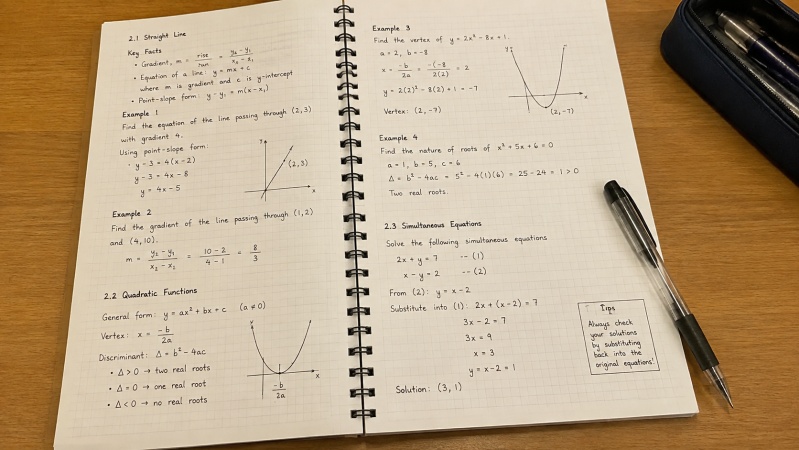
If you only have 30 minutes before your math test, focus on quick review instead of trying to learn new material.
Use this time to:
-
Review your formula sheet
-
Look over common mistakes
-
Solve one or two representative problems
-
Recall important steps for difficult question types
Avoid opening completely unfamiliar topics because this can increase stress without providing enough time to understand them.
Before entering the exam, take a few minutes to organize your thoughts. Staying calm can help you apply the knowledge you already have more effectively.
How to Study for a Math Placement Test
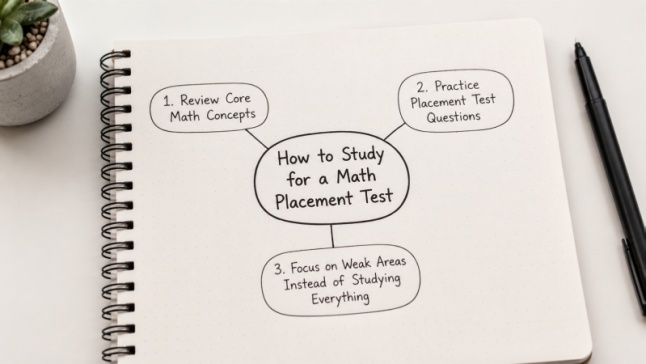
A math placement test is different from a regular class exam. Instead of testing only the material from one unit, it usually measures your overall math ability and helps determine which course level is suitable for you. Therefore, preparing for a placement test requires reviewing a wide range of topics instead of focusing on only one chapter.
Review Core Math Concepts
Start by checking the official test information or study guide to understand which topics may appear. Different placement tests may cover different levels of math, but common areas often include:
-
Arithmetic operations
-
Fractions and decimals
-
Algebra equations
-
Functions and graphs
-
Geometry concepts
-
Trigonometry or advanced topics, depending on the test level
Create a checklist of topics and mark which areas you feel comfortable with and which ones require more review.
Practice Placement Test Questions
Practice tests are one of the most effective ways to prepare because they help you understand the question format and identify knowledge gaps.
When practicing:
-
Complete questions without looking at solutions first
-
Use a timer to simulate test conditions
-
Review every incorrect answer
-
Repeat similar questions until you understand the method
The goal is not only to get answers right but also to understand why a solution works.
Focus on Weak Areas Instead of Studying Everything
Because placement tests usually cover a broad range of math skills, trying to review every topic equally can waste time.
After completing practice questions, focus your remaining study time on:
-
Topics where you make repeated mistakes
-
Basic concepts needed for advanced problems
-
Question types that slow you down
A targeted review plan is usually more effective than randomly studying different chapters.
The Best AI Math Solver to Help You Study for a Math Test

No matter whether you prepare for a math test one week in advance or only have 30 minutes left before the exam, one thing remains important: practicing problems and reviewing mistakes. Math scores are ultimately improved by your ability to solve questions, not by simply reading notes or memorizing formulas.
However, analyzing mistakes, understanding solutions, and finding enough practice questions can take a lot of time. The less time you have before the test, the more important efficient practice becomes.
Tenorshare AI Math is an AI math solver designed to help students solve problems, understand step-by-step solutions, and practice more effectively. It helps speed up the review process by explaining mistakes, clarifying difficult concepts, and providing related practice questions without requiring students to search for them manually.
Key Features:
-
Multiple Input Options: Supports text questions, images, and PDF files, allowing students to quickly upload problems from different study materials.
-
Step-by-Step Solution Explanations: Breaks down solving processes and explains the reasoning behind each step instead of only showing the final answer.
-
AI-Generated Video Explanations: Provides visual explanations to help students better understand difficult mathematical concepts.
-
Practice Question Generation: Creates similar exercises after solving problems, helping students reinforce weak areas and improve problem-solving skills.
Using an AI math solver does not replace practicing problems yourself. The most effective way to prepare for a math test is still to solve questions, review mistakes, and understand the concepts behind each solution. However, Tenorshare AI Math can make this process faster by reducing the time spent searching for explanations and creating additional practice materials.
Conclusion: How to Effectively Study for a Math Test
Knowing how to study for a math test effectively depends on how much time you have before the exam. If you start preparing days in advance, focus on building strong fundamentals, practicing different problem types, and improving weak areas. If your test is approaching quickly, prioritize high-value activities such as reviewing mistakes, practicing common questions, and strengthening the concepts most likely to affect your score.
No matter when you start studying, solving problems is the key to improving your math performance. To make this process more efficient, tools like Tenorshare AI Math can help students quickly review incorrect answers, understand difficult concepts, and generate additional practice questions.

Tenorshare AI Math
- Solve math from text, images & PDFs at 98% accuracy
- Deliver step-by-step answers with detailed logic breakdown
- Access video explanations for deeper math concept understanding
- Generate matching practice tests to solidify knowledge

FAQs
-
What Is the Best Way to Prepare for a Math Test?
The best way to prepare for a math test is to combine concept review, problem-solving practice, and mistake analysis. Focus on understanding key topics, practicing different types of questions, and reviewing incorrect answers instead of only rereading notes, because math tests require applying knowledge to solve problems.
-
How Long Should I Study for a Math Test?
The ideal study time depends on your current understanding, test difficulty, and the amount of material you need to review. If possible, start preparing several days before the exam and study consistently in shorter sessions, but if you have limited time, focus on important topics and active practice instead of spending hours on passive review.
-
How Many Hours Should You Study for a Math Test?
There is no fixed number of hours that works for every student. A more effective approach is to focus on whether you can solve problems independently, understand your mistakes, and complete questions confidently rather than simply counting study hours.
-
How Can I Get an A in Maths?
Getting an A in maths requires strong fundamentals, regular practice, and careful review of mistakes. Focus on mastering basic concepts, practicing challenging problems, improving accuracy, and learning from errors instead of only completing more questions.
-
How Do You Memorize Math Formulas Quickly?
The best way to memorize math formulas is to understand when and why each formula is used instead of memorizing it without context. Writing formulas from memory, applying them in different problems, and practicing related questions can help improve recall and make formulas easier to use during exams.
-
Can You Pass a Math Test Without Studying?
It is possible to pass a math test without studying if you already understand the material, but it is not a reliable strategy. Even a short review session can help you refresh important concepts, identify common mistakes, and practice the question types that are most likely to appear on the exam.
You Might Also Like
- How to Get Better at Math Fast: 8 Strategies to Improve Your Skills
- How to Solve a Hard Math Problem: A Simple Guide for Students
- How to Take Math Notes: The Ultimate Guide to Handwritten and Digital Notes
- How to Use Desmos for SAT 2026: Master the Digital SAT Calculator
- 15 Hardest Digital SAT Math Questions With Answers & Strategies
- How to Be Good at Math: A Complete Guide to Improve Your Math Skills

Tenorshare AI Math: Solve any math problems with AI
Turn math questions into clear solutions, tutorial videos & targeted practice setsTenorshare AI Math: Instant Solutions
Steps, videos & practice for every problem
Tenorshare AI Math: Solve any math problems with AI