
AI Advances in Math: A Guide to the 2026 Latest Breakthroughs
AI can already solve difficult math problems. The more interesting question in 2026 is: how far has it moved beyond solving problems into doing mathematics itself?
Recent AI advances in math include research-level reasoning, theorem proving, formal verification, and progress on long-standing open problems. Some systems are now being tested not just on questions with known answers, but on problems that professional mathematicians are still investigating.
This guide looks at what has actually changed. You'll learn about the most important AI math breakthroughs in 2026, how AI is being used in mathematical research, what it can and cannot solve reliably, and what these advances mean for students, teachers, and the future of math learning.
What Are AI Advances in Math?
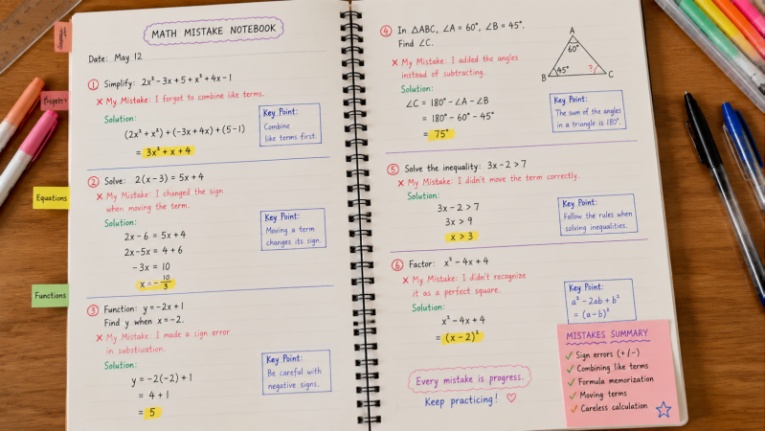
AI advances in math refer to improvements in the ability of artificial intelligence systems to understand, solve, verify, and explore mathematical problems.
Earlier AI math tools were mainly useful for calculations, symbolic algebra, or well-defined textbook problems. Modern systems can work with much longer reasoning chains and more complex mathematical language. Some combine large language models with code execution, search, reinforcement learning, multiple AI agents, or formal proof systems such as Lean.
This has expanded AI's role from answering math questions to several more advanced tasks:
-
Solving difficult competition and research-level problems
-
Constructing mathematical proofs
-
Checking whether proofs are formally valid
-
Searching for counterexamples
-
Exploring large numbers of possible approaches
-
Connecting ideas from different areas of mathematics
-
Generating conjectures and new mathematical constructions
The important change is therefore not simply that AI has become a faster math solver . Increasingly, AI systems are being tested as tools for mathematical research and discovery .
What Are the Latest AI Breakthroughs in Math?
The recent history of AI in mathematics shows a rapid progression from competition problems toward open-ended research.
From Math Competitions to Research-Level Mathematics
Mathematical competitions provided an early way to measure advanced AI reasoning.
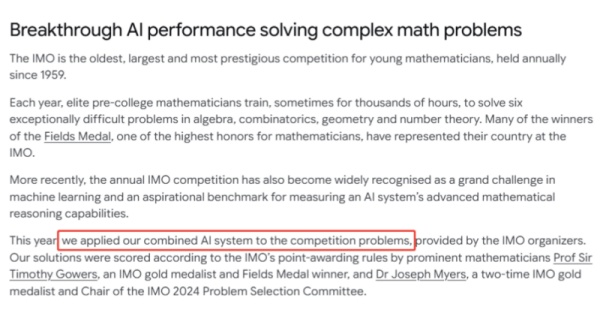
In 2024, Google DeepMind's AlphaProof and AlphaGeometry 2 solved four of the six problems from that year's International Mathematical Olympiad (IMO), scoring 28 out of 42 points and reaching silver-medal standard. AlphaProof used reinforcement learning and the Lean formal language, while AlphaGeometry 2 combined neural and symbolic methods for geometry.
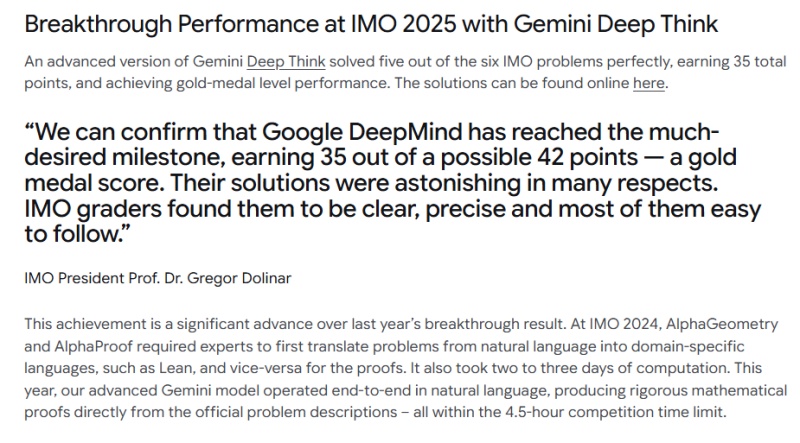
Progress continued in 2025. An advanced version of Gemini Deep Think solved five of six IMO problems for 35 points, reaching gold-medal standard. Unlike the 2024 systems, it worked directly from the natural-language problem statements and produced proofs within the competition's normal time limit.
Competition mathematics, however, is different from research. IMO problems are deliberately designed to have solutions. Researchers may instead spend months or years investigating a question without knowing whether their original approach will work.
That is why the shift toward research-level mathematics in 2026 is significant. Google DeepMind reports that its Aletheia research agent has worked on hundreds of open problems and contributed to several research results, including autonomous solutions to some questions in the Erdős problem database.
AI Advances in Theorem Proving and Mathematical Discovery
Theorem proving has become one of the clearest examples of AI progress in mathematics.
AI systems can now generate possible proof steps and use formal systems to check whether those steps logically follow from established rules. This creates a useful separation between generating a proof and verifying that the proof is valid.
AlphaProof demonstrated this approach by training an AI system to construct proofs in Lean. More recent research systems combine natural-language reasoning, code, search, specialized agents, and formal verification.
AI is also increasingly being used for discovery rather than proof alone. Google DeepMind's AlphaEvolve , for example, combines generative models with automated evaluators to search for improved algorithms and mathematical constructions. DeepMind has reported applications ranging from optimization problems to work connected with Erdős problems.
The result is a broader AI workflow:
generate ideas → test them → find counterexamples → revise → verify the result
This process is closer to mathematical research than simply asking a chatbot to produce one answer.
AI Tackles Long-Standing Open Math Problems
Some of the most notable AI breakthroughs in math in 2026 involve questions that were already being studied by professional mathematicians.
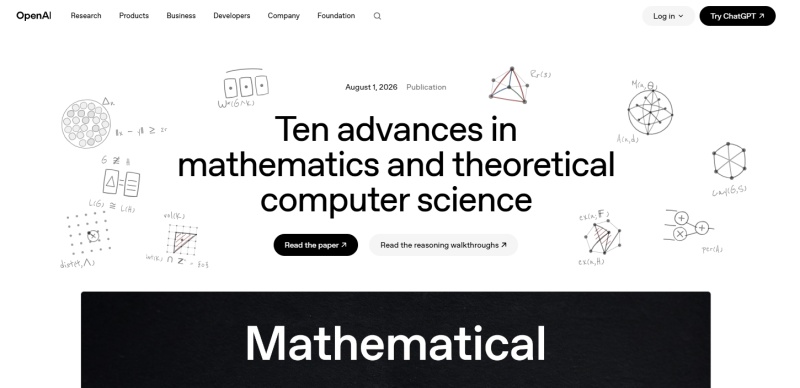
In May 2026, OpenAI reported an AI-generated disproof of a conjecture related to the Erdős unit-distance problem. In August, OpenAI published ten additional results produced by an internal version of its Astra research model. According to OpenAI, these results either resolved or made substantial progress on long-standing questions in areas including high-dimensional geometry, coding theory, group theory, operator algebras, quantum complexity, lattice cryptography, and combinatorics. The arguments were later formalized as Lean certificates.
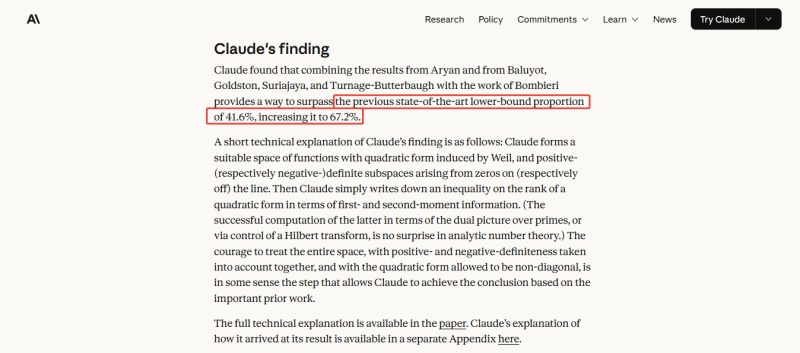
Anthropic reported another notable result in August 2026. A research version of Claude was asked to attempt the Riemann hypothesis. It did not solve the Riemann hypothesis, but it found an improvement on a related problem concerning zeros of the Riemann zeta function, raising a previous lower bound from 41.6% to 67.2% . Anthropic says the process involved roughly 60 AI subagents, numerical testing, literature searches, proof review, and later examination by human mathematicians.
These cases show why current AI progress in math is attracting attention: AI is no longer being evaluated only on problems for which the solution is already known.
How Is AI Being Used in Mathematics?
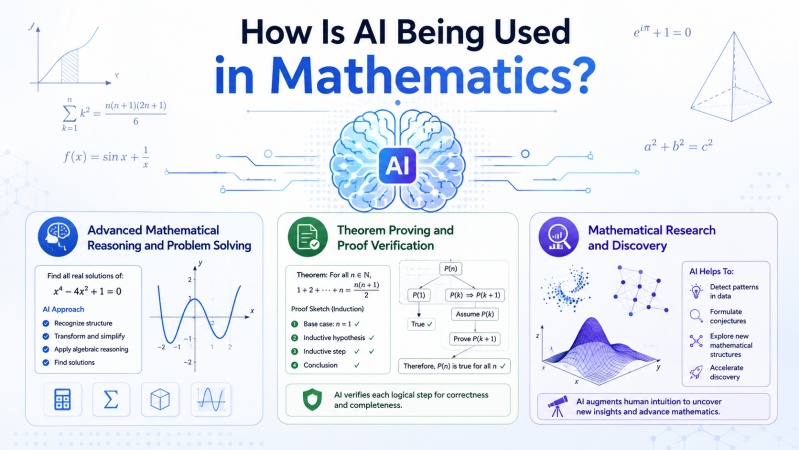
AI has several different roles in modern mathematics. The most useful distinction is between solving problems, verifying proofs, and helping researchers explore new mathematics.
Advanced Mathematical Reasoning and Problem Solving
Large reasoning models can analyze problems, explore alternative approaches, manipulate equations, write code for numerical experiments, and revise an answer when an approach fails.
Modern research systems can also use more computation at inference time. Instead of immediately producing one response, they may explore many candidate solutions or divide work among multiple agents.
Gemini Deep Think, for example, uses parallel reasoning techniques to examine several possible approaches. Anthropic's Riemann-related experiment similarly used many subagents performing different roles, including generating ideas, testing arguments, and checking results.
This makes AI useful not only for obtaining an answer but also for exploring a large solution space more quickly.
Theorem Proving and Proof Verification
A convincing-looking proof is not necessarily a correct proof. For this reason, verification is especially important when AI is used for mathematics.
Formal proof assistants such as Lean convert mathematical arguments into expressions that can be checked against precise logical rules. If a formal proof passes verification, the proof checker provides much stronger assurance that each logical step is valid.
Systems such as AlphaProof were built directly around formal mathematical reasoning, while OpenAI says its recent research results were subsequently formalized in Lean.
Formal verification does not solve every reliability problem. A formal proof still depends on correct definitions and an accurate statement of what is being proved. But it gives researchers an important way to distinguish a mathematically valid argument from fluent but incorrect AI-generated text.
Mathematical Research and Discovery
AI can also serve as a research assistant.
Possible uses include:
-
Searching mathematical literature
-
Generating possible lemmas or conjectures
-
Testing numerical examples
-
Looking for counterexamples
-
Writing code for experiments
-
Comparing different proof strategies
-
Formalizing completed arguments
-
Finding connections between different mathematical fields
Google DeepMind describes Aletheia as a system designed to generate, verify, and revise research-level mathematical work. Its reported 2026 experiments include both autonomous research and collaborations in which mathematicians guided the AI.
This suggests that one likely near-term role for AI is not replacing the entire research process, but accelerating individual parts of it.
Also Read: 5 Best AI Tools for Advanced Math Proofs & Proof-Based Math (2026)
Can AI Solve Unsolved Math Problems?
Short answer: sometimes it can contribute, but it cannot reliably solve open problems end-to-end.
AI in 2026 is no longer limited to textbook exercises or competition-style questions. In some cases, it has already contributed to real mathematical research. However, these successes are still selective and require human validation.
What AI Can Do
AI systems are increasingly able to assist in research workflows and even contribute to previously open problems. This does not usually mean fully independent discovery, but rather meaningful partial or collaborative progress.
Examples (2026):
-
OpenAI: results on multiple open problems, including work related to the Erdős unit-distance problem
-
DeepMind: Gemini Deep Think and Aletheia used in research-level and collaborative discoveries
-
Anthropic: new result on the distribution of zeros of the Riemann zeta function
-
First Proof Project: independent benchmark for testing AI on unpublished research problems
Overall, AI is already being used in real mathematical research workflows, not just for solving known textbook problems.
What AI Cannot Do Reliably
Despite these advances, AI is still far from being a fully autonomous mathematician. Its performance remains inconsistent, especially on truly novel or high-stakes problems.
-
Solve any open problem on demand
-
Guarantee fully correct proofs without errors
-
Consistently avoid logical gaps or incorrect citations
-
Decide which problems are truly important in mathematics
Common issues include:
-
Plausible but incorrect reasoning that looks mathematically valid
-
Missing, incorrect, or hallucinated references
-
Overfitting to known patterns instead of genuine discovery
-
Incomplete proofs that fail under formal verification
Key Takeaway
AI is becoming a powerful research assistant for mathematics , not a replacement for mathematicians. It can accelerate exploration, generate useful insights, and even contribute to new results---but its outputs still require careful human review, especially when dealing with new or high-impact mathematical claims.
What Do AI Advances in Math Mean for Students and Education?
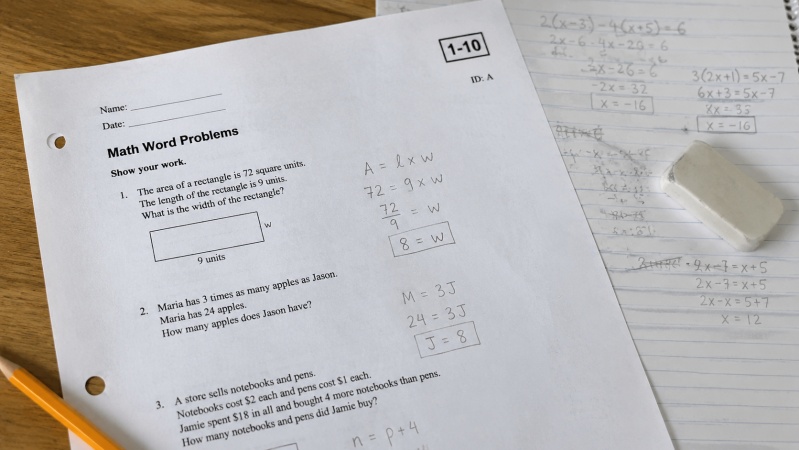
AI is no longer just a research tool---it is already changing how students learn math. Today, students can use AI to get step-by-step explanations, solve equations, analyze uploaded problems, generate practice questions, and receive instant feedback.
The key question is no longer whether AI will be used in learning, but how to use it effectively without losing real understanding.
How AI Is Changing Math Learning
Instead of one fixed explanation, students can get multiple ways to understand the same problem
-
Complex problems can be broken down step by step on demand
-
Extra practice questions can be generated instantly
-
Learning becomes more personalized and interactive rather than one-size-fits-all
AI is also becoming a support tool for teachers, helping with lesson preparation, feedback, and adapting explanations to different student levels.
Benefits and risks
AI makes math learning faster and more accessible, especially when students are stuck or studying alone. It can help clarify difficult steps and provide immediate guidance.
But there is a clear risk: overreliance. If students only copy answers, they miss the thinking process that actually builds math ability.
A simple rule helps keep learning effective:
Use AI to understand the solution, not to replace your thinking.
Students should still attempt problems first, check each step carefully, and practice similar questions without assistance to build real understanding.
To Understand Math Better, Try Tenorshare AI Math
As AI becomes a bigger part of education, students, parents, and teachers will all need to learn how to use it effectively. For students in particular, the goal should not be to avoid AI or use it simply to finish homework faster. It should be to use AI in a way that strengthens understanding.
That connects directly to the rule above:
Use AI to understand the solution, not to replace your thinking.
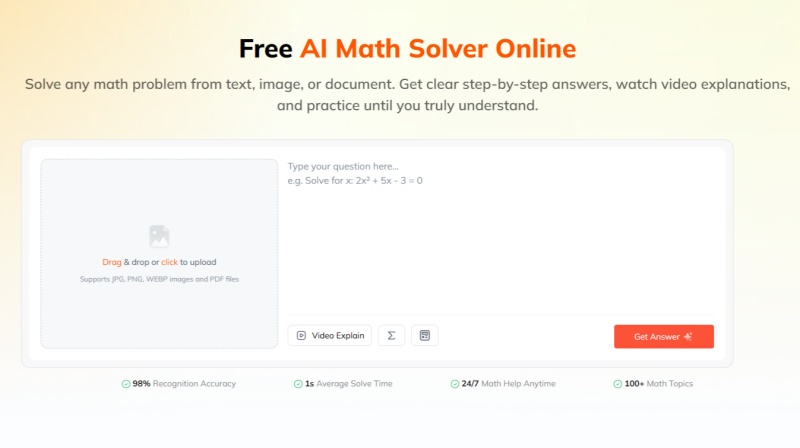
This is where Tenorshare AI Math fits in. It is designed for students who want to understand the logic behind a math problem instead of only getting the final answer. Rather than ending the learning process once a problem is solved, it connects solving with explanation and further practice.
Its key learning features include:
-
Scan text, images, and PDFs: Enter a question directly or upload math problems from homework, worksheets, screenshots, and PDF files.
-
Step-by-step solutions: Break down the solving process and explain the reasoning behind each step.
-
Video explanations: Turn solutions into visual explanations when written steps alone are difficult to follow.
-
Practice tests: Generate similar problems so students can apply the same method independently and check whether they really understand it.
Together, these features create a simple learning cycle:
Solve → Understand → Practice
Instead of using AI only to get an answer, students can use Tenorshare AI Math to identify how a problem is solved, review difficult concepts, and then practice the same skills on new questions. This makes AI a learning aid rather than a shortcut.
Conclusion
AI advances in math are moving quickly---from competition-level problem solving to theorem proving, formal verification, and even progress on open research problems. But AI is still not fully reliable, and human judgment remains important in both mathematical research and education.
For students, the practical takeaway is simple: use AI to understand math, not just to get answers. Tools like Tenorshare AI Mat h can support this approach with step-by-step solutions, explanations, and practice, helping students turn AI assistance into real learning.

Tenorshare AI Math
- Solve math from text, images & PDFs at 98% accuracy
- Deliver step-by-step answers with detailed logic breakdown
- Access video explanations for deeper math concept understanding
- Generate matching practice tests to solidify knowledge

FAQs
-
Can AI Prove Mathematical Theorems?
Yes. AI can now generate formal mathematical proofs, and systems like AlphaProof can work inside proof languages such as Lean, even reaching competition-level performance. However, results are not always reliable, so any AI-generated proof still needs human or formal verification.
-
What Is the Best AI for Advanced Math?
There is no single best model. Research systems like Gemini Deep Think are stronger for advanced problem solving, while learning-focused tools are better for step-by-step explanations and practice. The right choice depends on whether you are doing research, studying, or checking calculations.
-
Is AI Replacing Mathematicians?
No. AI can speed up parts of mathematical work like searching literature, testing ideas, and generating proofs, but it cannot replace core human roles such as choosing problems, building theory, and judging significance. It is best seen as a tool that supports mathematicians rather than replaces them.
-
Will AI Replace Math Teachers?
Unlikely. AI can help explain concepts, give practice, and provide feedback, but teachers still play a key role in guiding learning, understanding student needs, and managing classroom context. AI is more likely to assist teaching than replace it.
-
How Accurate Is AI at Solving Math Problems?
It depends on the model and problem type. Some systems perform at very high levels on competition math, but errors still occur, especially in complex reasoning. AI answers should be treated as helpful guidance, not guaranteed correctness, and important results should always be checked.
You Might Also Like
- What Happened to Microsoft Math Solver? Why It Was Discontinued and What to Use Instead
- How to Study for a Math Test: From 7 Days Before to the Night Before
- How to Get Better at Math Fast: 8 Strategies to Improve Your Skills
- How to Solve a Hard Math Problem: A Simple Guide for Students
- How to Take Math Notes: The Ultimate Guide to Handwritten and Digital Notes
- 15 Hardest Digital SAT Math Questions With Answers & Strategies

Tenorshare AI Math: Solve any math problems with AI
Turn math questions into clear solutions, tutorial videos & targeted practice setsTenorshare AI Math: Instant Solutions
Steps, videos & practice for every problem
Tenorshare AI Math: Solve any math problems with AI