
How to Get Better at Math Fast: 8 Strategies to Improve Your Skills
Improving at math is not about having a special talent or being naturally good with numbers. Most people become better at math by building strong foundations, practicing effectively, understanding mistakes, and developing better problem-solving habits.
Whether you are a student trying to improve your grades, an adult rebuilding your math skills, or someone preparing for a math exam, the right strategies can help you make steady progress.
This guide explains how to get better at math with 8 proven strategies, including how to practice smarter, improve your problem-solving skills, and use an AI math solver to understand math concepts more effectively.
Also Read: How to Be Good at Math: A Complete Guide to Improve Your Math Skills
Catalogs:
Can You Actually Get Better at Math?
Yes, anyone can improve their math skills with the right approach. Math ability is not fixed. While some people may learn certain concepts faster, consistent practice and effective learning methods can help anyone make progress.
Many people struggle with math because they focus only on memorizing formulas or completing exercises without understanding the ideas behind them. Improving at math requires learning how concepts work, applying them in different situations, and correcting mistakes over time.
The key is not simply doing more math problems. It is learning how to practice math in a smarter way .
Why You Struggle With Math
Many people struggle with math because they have gaps in basic knowledge, rely too much on memorization, or lack an effective practice method.
A weak foundation is one of the most common reasons why math becomes difficult. Math concepts build on each other, so problems with basic skills such as arithmetic, fractions, decimals, or algebra can make advanced topics harder to understand.
Memorizing formulas without understanding the logic behind them can also limit your progress. While memorization may help in short-term situations like exams, understanding why a formula works allows you to apply it to different types of problems.
Ineffective practice is another common obstacle. Repeating the same type of questions without reviewing mistakes does not always lead to improvement. Effective practice requires solving different problems, identifying errors, and adjusting your learning approach.
Math anxiety can also affect performance. Fear of making mistakes may prevent you from thinking clearly, but building confidence through consistent practice can gradually improve your ability.
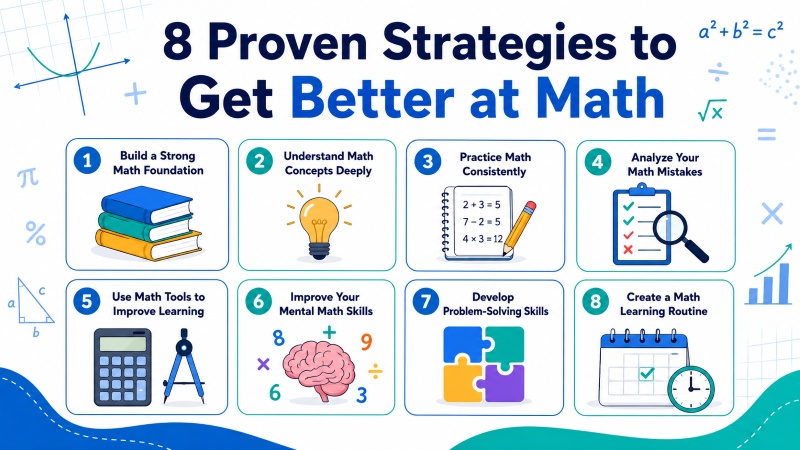
8 Proven Strategies to Get Better at Math
Build a Strong Math Foundation
A strong foundation is the first step to improving your math skills. Before learning advanced topics, make sure you understand basic concepts.
Start by reviewing areas where you frequently make mistakes, such as:
-
Basic arithmetic
-
Fractions and decimals
-
Percentages
-
Negative numbers
-
Algebra fundamentals
Instead of rushing into difficult problems, spend time strengthening weak areas. A solid foundation makes future learning easier and helps you solve problems with more confidence.
Understand Math Concepts Deeply
Getting better at math requires more than memorizing formulas. You need to understand why a method works and when to use it.
For example, instead of only memorizing the quadratic formula, try to understand:
-
What type of problems require this formula
-
How the formula connects to other algebra concepts
-
Why each step produces the final answer
Concept-based learning helps you recognize patterns and solve new problems more effectively.
A useful habit is to explain a math concept in your own words. If you can teach the idea to someone else, you likely understand it well.
Practice Math Consistently
Regular practice is one of the most important ways to improve at math. Short, consistent study sessions are usually more effective than studying for many hours once a week.
A good practice routine includes:
-
Reviewing previous concepts
-
Solving new problems
-
Practicing different question types
-
Increasing difficulty gradually
Instead of only checking whether your answer is correct, focus on understanding the solving process.
Consistency helps your brain recognize mathematical patterns and improves your speed over time.
Analyze Your Math Mistakes
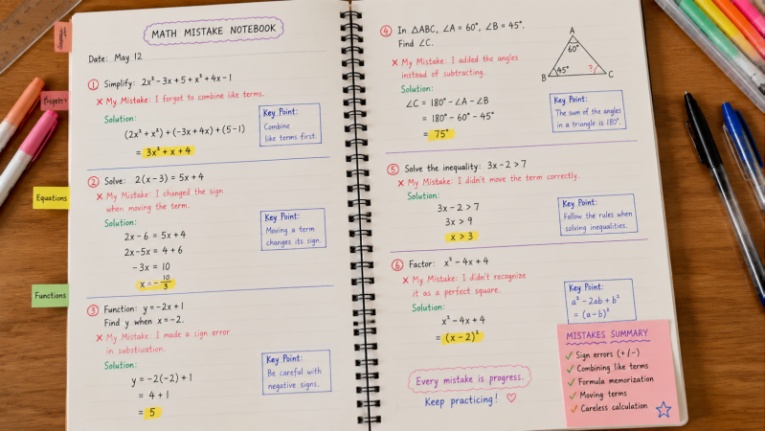
Making mistakes is a normal part of learning math. However, improvement happens when you understand why the mistake occurred.
After solving a problem incorrectly, ask:
-
Did I misunderstand the question?
-
Did I use the wrong formula?
-
Did I make a calculation error?
-
Did I skip an important step?
Keeping a mistake journal can help you identify repeated problems and prevent making the same errors again.
Many students improve faster by reviewing mistakes than by simply completing more exercises.
Use Math Tools to Improve Your Learning
Using the right math tools can help you solve problems faster and understand difficult concepts more efficiently. Different tools serve different purposes, from explaining concepts to providing step-by-step solutions.

General AI assistants like ChatGPT can help explain math concepts and answer learning questions, while AI math solvers such as Tenorshare AI Math can provide detailed solution steps for specific problems, helping you spend more time understanding methods instead of getting stuck on calculations.
The key is choosing tools based on your learning needs. For exam preparation, calculators and practice tools can help improve speed and accuracy. For topics like geometry, functions, and graphs, visualization tools can make complex relationships easier to understand.
Improve Your Mental Math Skills
Mental math helps you calculate faster and develop stronger number sense.
You can improve your mental math ability by practicing:
-
Quick addition and subtraction
-
Multiplication patterns
-
Estimation techniques
-
Percentage calculations
For example, instead of immediately using a calculator for simple calculations, try estimating the answer first.
Regular mental math practice improves confidence and makes many everyday calculations easier.
Develop Your Problem-Solving Skills
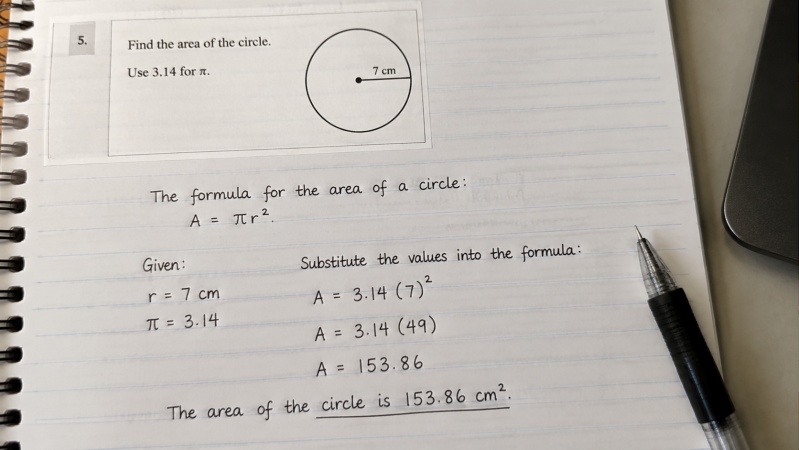
Math is not only about calculation. Many challenging problems require logical thinking and strategy.
To improve problem-solving skills:
-
Read the problem carefully
-
Identify what information is given
-
Break complex problems into smaller steps
-
Try different approaches when needed
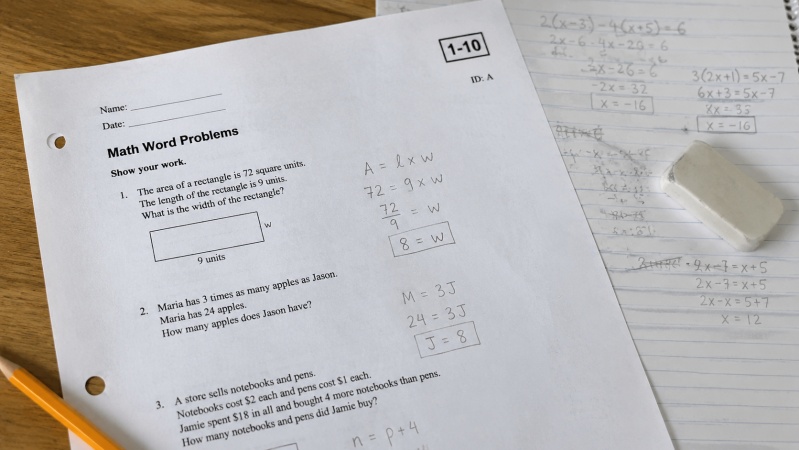
For word problems, focus on understanding the situation before writing equations.
Strong problem-solving skills help you handle unfamiliar questions in exams and real-world situations.
Create a Math Learning Routine
Long-term improvement requires a consistent learning routine.
Create a schedule that includes:
-
Regular practice time
-
Weekly review sessions
-
Clear learning goals
-
Progress tracking
For example, you might spend 30 minutes each day practicing math and reviewing mistakes.
A structured routine helps you stay consistent and prevents learning gaps from building over time.
How to Get Better at Math Fast: Try an AI Math Solver
Many students search for quick ways to improve their math skills, such as how to pass a math exam in one day or how to memorize formulas quickly before a test. These methods may help you handle an urgent situation, but they usually do not create long-term improvement. Without a structured learning approach, the knowledge and techniques you gain may disappear soon after the exam.
If you want to truly become better at math, the goal should not only be getting a higher score in a short period of time. A better approach is to build an effective math learning workflow that helps you understand concepts, practice regularly, review mistakes, and develop better problem-solving habits.
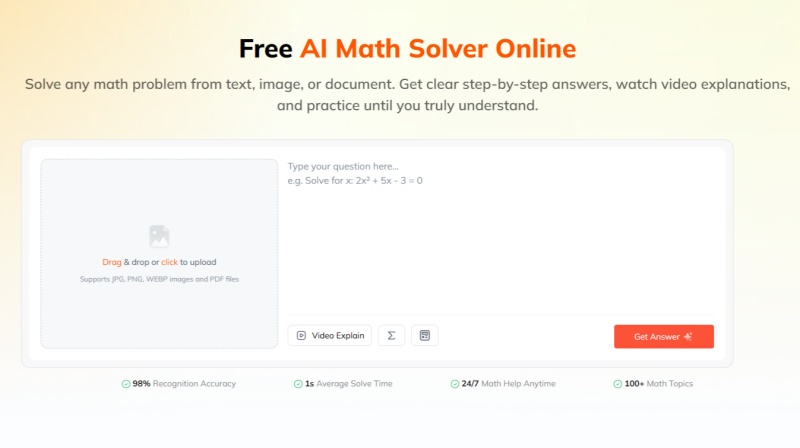
Tenorshare AI Math can help you build this type of learning workflow by combining problem solving, concept explanation, and practice support in one platform. Instead of only providing answers, it helps you understand how a solution is developed and creates a more organized way to learn math.
It key features include:
-
Solve problems with step-by-step guidance: Break down complex questions into clear solving processes.
-
Learn from different types of materials: Support multiple input formats, including text, images, and documents.
-
Understand difficult concepts visually: Use AI-powered explanations and visual learning methods to make abstract topics easier to understand.
-
Strengthen skills through targeted practice: Generate related practice questions after solving problems, allowing you to immediately apply what you learned and reinforce your understanding.
By adding an AI math solver to your learning routine, you can spend less time searching for solutions and more time building the skills needed to solve problems independently. The purpose of using technology is not to replace practice, but to make your learning process more efficient and consistent.
Final Verdict
Getting better at math is a gradual process that requires more than memorizing formulas or searching for quick solutions before an exam. The most effective way to improve your math skills is to build a consistent learning system that combines strong fundamentals, concept understanding, regular practice, mistake analysis, and effective problem-solving strategies.
If you are wondering how to get better at math , the answer is to focus on improving the way you learn instead of only increasing the amount of time you spend studying. By developing better learning habits and using helpful resources such as AI math tools when needed, you can make your practice more efficient and continue improving over time.
There is no single shortcut that can make everyone good at math instantly. However, with the right strategies, consistent effort, and a structured learning routine, anyone can gradually become more confident and capable in mathematics.

Tenorshare AI Math
- Solve math from text, images & PDFs at 98% accuracy
- Deliver step-by-step answers with detailed logic breakdown
- Access video explanations for deeper math concept understanding
- Generate matching practice tests to solidify knowledge

FAQs
-
How to Get Better at ACT Math
To get better at ACT Math, focus on improving both your mathematical knowledge and your ability to solve problems under time pressure. Start by reviewing key topics such as algebra, geometry, functions, and statistics, then practice ACT-style questions regularly to become familiar with the exam format. Reviewing mistakes after each practice session is also important because it helps you identify weak areas and avoid repeating the same errors.
-
How to Get Better at Math in 6th Grade
Students in 6th grade can improve their math skills by building strong foundations and developing good study habits early. At this stage, it is important to understand core topics such as fractions, decimals, ratios, percentages, and basic equations rather than simply memorizing steps. Regular practice, asking questions when confused, and reviewing mistakes can help students build confidence and prepare for more advanced math topics.
-
How to Get Better at Basic Math
To improve basic math skills, start by strengthening essential concepts and practicing them consistently. Focus on improving accuracy with calculations, understanding number relationships, and becoming comfortable with everyday math tasks such as percentages, fractions, and mental calculations. Building these fundamental skills creates a strong foundation for learning more advanced mathematics in the future.
-
How to Get Better at Competition Math
Getting better at competition math requires developing deeper problem-solving abilities rather than only learning more formulas. Practice challenging problems regularly, learn different solution approaches, and focus on understanding the reasoning behind each step. Over time, solving unfamiliar problems will help you develop stronger mathematical thinking and improve your ability to recognize patterns.
-
How to Get Better at Darts Maths
Improving at darts maths mainly depends on developing faster mental calculations and becoming familiar with common scoring combinations. Regularly practicing quick subtraction, number combinations, and possible finishing scores can help players make faster decisions during games. Strong mental math skills can improve both accuracy and confidence when calculating scores.
-
How to Get Better at Discrete Math
To improve at discrete math, focus on developing logical thinking and understanding mathematical structures rather than memorizing isolated concepts. Topics such as logic, sets, combinatorics, graph theory, and proofs require you to analyze relationships and apply reasoning skills. Practicing different types of problems and understanding why each solution works can help you build stronger discrete math abilities.
You Might Also Like
- 15 Hardest Digital SAT Math Questions With Answers & Strategies
- How to Be Good at Math: A Complete Guide to Improve Your Math Skills
- How to Solve Math Word Problems Step by Step: Strategies, Tips & Tool
- What Happened to Microsoft Math Solver? Why It Was Discontinued and What to Use Instead
- How to Take Math Notes: The Ultimate Guide to Handwritten and Digital Notes
- How to Use Desmos for SAT 2026: Master the Digital SAT Calculator

Tenorshare AI Math: Solve any math problems with AI
Turn math questions into clear solutions, tutorial videos & targeted practice setsTenorshare AI Math: Instant Solutions
Steps, videos & practice for every problem
Tenorshare AI Math: Solve any math problems with AI