
How to Isolate a Variable: Definition, Step-by-Step Tutorial & Common Mistakes
You may know that the goal is to get x by itself, but knowing that is often easier than knowing what to do next. Should you add or subtract first? What if the variable appears on both sides, inside parentheses, or as part of a fraction?
These are common challenges when isolating a variable in algebra. The good news is that the process follows a few consistent rules. In this guide, you'll learn how to isolate a variable step by step , with examples covering common equations, formulas, and more challenging cases.
Catalogs:
What Does It Mean to Isolate the Variable?
What Is an Isolated Variable?
An isolated variable is a variable that appears by itself on one side of an equation.
For example:
x + 5 = 12
After subtracting 5 from both sides: x = 7
The variable x is now isolated because nothing else is attached to it.
In algebra, isolating a variable means rearranging an equation to get a chosen variable alone. Depending on the problem, the final result may be a number, such as x = 7, or an expression involving other variables, such as x = 3y + 2.
The basic idea is to undo the operations surrounding the variable until only the variable remains on one side.
Is Isolating a Variable the Same as Solving an Equation?
They are closely related, but they are not exactly the same.
Isolating a variable describes the process of getting the target variable by itself. Solving an equation usually means completing the necessary steps to determine the value or expression for that variable.
For example:
3x + 5 = 20
First, isolate the variable: 3x = 15
Then divide by 3: x = 5
Here, isolating x is part of the overall process of solving the equation. When an equation contains multiple variables, isolating one variable may produce an expression rather than a single numerical answer.
How Do You Isolate a Variable?
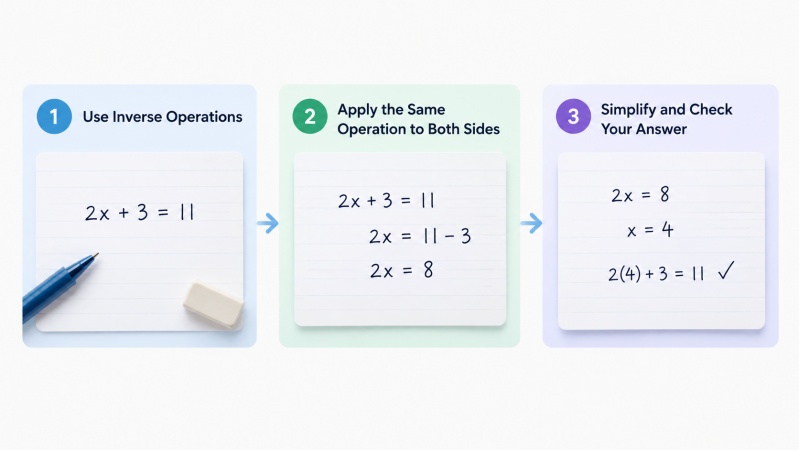
If you are wondering how do you isolate a variable , the basic process is to identify the operations applied to the variable and undo them in reverse order.
Use Inverse Operations
Inverse operations undo each other:
-
Addition ↔ Subtraction
-
Multiplication ↔ Division
-
Squaring ↔ Square root
For example, consider:
For multiplication: x + 8 = 15
Because 8 is added to x, subtract 8 from both sides:
x + 8 - 8 = 15 - 8
x = 7
For multiplication:
4x = 20
Divide both sides by 4:
4x / 4 = 20 / 4
x = 5
This is the basic principle behind isolating variables in algebra : identify what is being done to the variable and use the inverse operation to undo it.
Apply the Same Operation to Both Sides
An equation represents equality between two sides. To preserve that equality, any operation used to isolate the variable must be applied to both sides.
For example:
2x + 6 = 18
First subtract 6 from both sides:
2x + 6 - 6 = 18 - 6
2x = 12
Then divide both sides by 2:
2x / 2 = 12 / 2
x = 6
This is why simply "moving" a number across the equal sign can be misleading. The sign changes because an inverse operation is being applied, not because terms physically move from one side to the other.
Simplify and Check Your Answer
Continue simplifying until the target variable is alone. Then substitute your answer into the original equation to check it.
For example:
3x - 4 = 11
Add 4 to both sides: 3x = 15
Divide by 3: x = 5
Check the result:
3(5) - 4 = 11
15 - 4 = 11
The original equation is true, so x = 5 is correct.
Checking the original equation is especially useful when isolating a variable involves several operations, negative numbers, fractions, or parentheses.
How to Isolate a Variable in an Equation
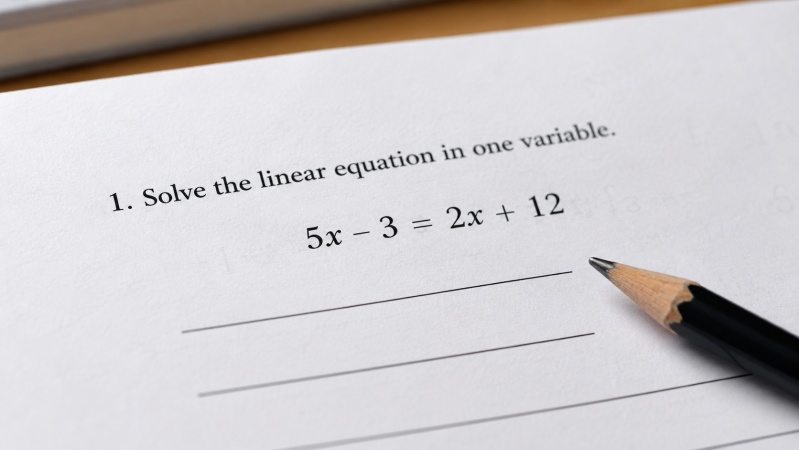
The same basic method works across different equation types, but more complicated equations may require several inverse operations or additional simplification.
One-Step and Two-Step Equations
A one-step equation usually requires one inverse operation.
For example:
x - 9 = 4
Add 9 to both sides: x = 13
A two-step equation requires two operations. Consider: 3x + 4 = 19
First subtract 4: 3x = 15
Then divide by 3: x = 5
When solving these equations, work backward through the operations applied to the variable. If a number was multiplied by x and then a constant was added, remove the constant first and the coefficient second.
Equations With Variables on Both Sides
When a variable appears on both sides, first use addition or subtraction to put the variable terms on one side.
For example:
5x + 2 = 2x + 14
Subtract 2x from both sides: 3x + 2 = 14
Subtract 2: 3x = 12
Divide by 3: x = 4
This approach is useful when learning how to isolate a variable in a linear equation because it keeps all the target-variable terms together before the final division.
Equations With Fractions or Parentheses
Fractions and parentheses can add extra steps to an equation.
For an equation with a fraction:
x/4 + 3 = 8
Subtract 3: x/4 = 5
Multiply both sides by 4: x = 20
For parentheses: 2(x + 3) = 14
Divide both sides by 2: x + 3 = 7
Subtract 3: x = 4
In more complicated problems, you may first need to use the distributive property, clear fractions, or combine like terms before you can fully isolate the variable.
How to Isolate a Variable in a Formula
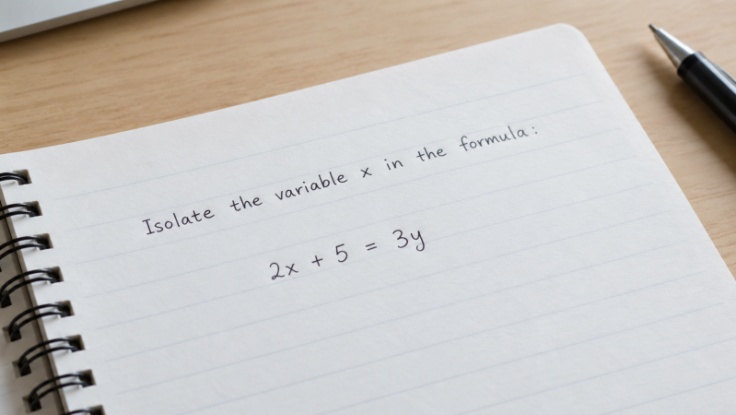
Isolating a variable in a formula follows the same basic principles as solving an equation. The difference is that a formula may contain several variables, and the goal is to rearrange it for one specific variable. This process is also commonly called solving for a variable or solving a literal equation.
Rearrange a Formula to Isolate One Variable
Start by identifying the variable you need to isolate. Then determine which operations are connected to that variable and undo them using inverse operations.
For example, consider:
A = lw
To isolate w, divide both sides by l: A/l = lw/l
So: w = A/l
The other variables do not need to disappear. The goal is simply to get the target variable by itself.
This method is useful when rearranging equations in geometry, physics, science, and other subjects where formulas contain several variables.
Example: Isolating a Variable in a Formula
Consider the area formula for a triangle:
A = 1/2bh
Suppose you need to isolate h.
First multiply both sides by 2: 2A = bh
Then divide both sides by b: 2A/b = h
Therefore: h = 2A/b
The same principle applies: identify the operations applied to h and reverse them in the appropriate order. Educational algebra resources use this same inverse-operation approach when teaching students how to solve formulas for a specified variable.
Common Mistakes When Isolating Variables
Knowing the rules is only part of learning isolating variables. Many errors happen when students skip a step or apply an operation incorrectly.
Using the Wrong Inverse Operation
Choose the operation that actually undoes the one attached to the variable.
For example:
x - 6 = 10
The inverse of subtracting 6 is adding 6, so:
x = 16
Subtracting another 6 would move the equation farther from the isolated form.
Changing Only One Side of the Equation
An equation must remain balanced. If you subtract 5 from the left side, subtract 5 from the right side as well.
Incorrect:
x + 5 = 12
x = 12 - 5
Although this shortcut can produce the correct result when understood properly, writing the operation explicitly on both sides helps prevent errors in more complicated equations.
Correct:
x + 5 - 5 = 12 - 5
x = 7
The same principle applies when multiplying, dividing, adding, or subtracting from an equation.
Forgetting to Reverse an Inequality
When isolating a variable in an inequality, the basic balancing principle still applies. However, there is an important additional rule:
If you multiply or divide both sides by a negative number, reverse the inequality sign.
For example:
2x > 8
Divide both sides by -2 and reverse > to <: x < -4
Forgetting to reverse the sign changes the solution set.
Need Help Isolating a Variable? Try Tenorshare AI Math
Isolating a variable can become tricky when an equation has several steps, variables on both sides, fractions, or parentheses. It is easy to apply the wrong inverse operation, change only one side, or lose track of a step while simplifying. In these cases, an AI math solver with step-by-step explanations can help you review not only the answer, but also how the equation was rearranged.
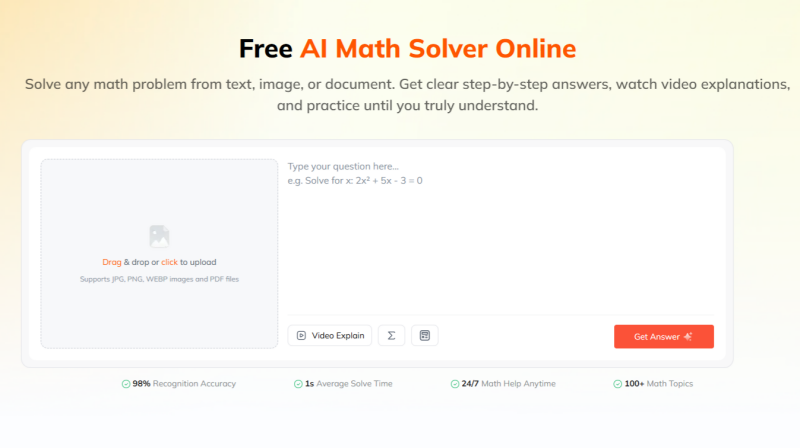
Tenorshare AI Math lets you enter a problem as text or provide it through an image or PDF. Its key features include:
-
Step-by-step solutions: Breaks down the operations used to isolate the target variable, making it easier to identify where a mistake occurred.
-
Text, image, and PDF input: Works with typed equations as well as problems from worksheets, screenshots, or PDF documents.
-
AI-generated video explanations: Provides visual walkthroughs for problems that are harder to follow from written steps alone.
-
Similar practice questions: Generates related problems so you can practice applying the same isolation rules to new equations.
-
Built-in math calculator: Handles routine calculations that appear during multi-step algebra problems.
Rather than replacing the algebra rules, these features can help you check your work, understand each step, and practice isolating variables when a particular equation is difficult to work through on your own.
Conclusion: How to Isolate a Variable
Learning how to isolate a variable comes down to applying inverse operations, making the same change to both sides of an equation, and simplifying each step carefully. Whether you are working with a one-step equation, variables on both sides, fractions, parentheses, or a formula, keeping the target variable alone is the key goal.
The most common mistakes are usually simple but easy to overlook, such as using the wrong inverse operation or changing only one side of an equation.
When you are unsure about a particular step, Tenorshare AI Math can help you review the problem with step-by-step explanations, making it easier to see how the equation is rearranged and where an error may have occurred.

Tenorshare AI Math
- Solve math from text, images & PDFs at 98% accuracy
- Deliver step-by-step answers with detailed logic breakdown
- Access video explanations for deeper math concept understanding
- Generate matching practice tests to solidify knowledge

FAQs About Isolating Variables
-
How to Isolate a Variable in a Formula?
To isolate a variable in a formula, use inverse operations to move other terms away from the target variable. Apply the same operation to both sides and simplify until the variable stands alone.
-
How to Isolate a Variable in an Exponent?
If the variable is in the exponent, use logarithms to bring it down from the exponent position. For example, in (2^x=8), taking the logarithm of both sides allows you to solve for (x).
-
How to Isolate a Variable in an Inequality?
Isolate a variable in an inequality by using inverse operations on both sides, just as you would with an equation. Remember to reverse the inequality sign when multiplying or dividing both sides by a negative number.
-
How to Isolate a Variable in a Linear Equation?
To isolate a variable in a linear equation, simplify the equation first, then use inverse operations to remove constants and coefficients around the variable. Continue until the target variable is alone on one side.
-
How to Isolate a Variable in a Trig Function?
First isolate the trigonometric function containing the variable, then use the corresponding inverse trigonometric function, such as sine inverse or cosine inverse. Check the required angle range because trigonometric equations can have multiple solutions.
You Might Also Like
- Why Is AI Bad at Math? Understand AI Math Mistakes & Pick a Trustworthy AI Math Tool
- Can ChatGPT Do Math? Here's What It Gets Right and Wrong
- How to Improve Math Skills: 5 Practical Ways to Get Better at Math 2026
- How to Solve Linear Equations in 5 Easy Steps [2026 Guide]
- AI Advances in Math: A Guide to the 2026 Latest Breakthroughs
- How to Study for a Math Test: From 7 Days Before to the Night Before

Tenorshare AI Math: Solve any math problems with AI
Turn math questions into clear solutions, tutorial videos & targeted practice setsTenorshare AI Math: Instant Solutions
Steps, videos & practice for every problem
Tenorshare AI Math: Solve any math problems with AI