
How to Take Math Notes: The Ultimate Guide to Handwritten and Digital Notes
Your math notebook is full of formulas, but can you actually use it to solve a problem?
For many students, taking math notes means copying everything from the board as quickly as possible. The pages may look organized, but when exam time comes, those notes often fail to answer the most important questions: Why does this formula work? When should I use it? How do I solve a similar problem?
Effective math notes are not just a record of what happened in class. They are a learning tool that helps you understand concepts, review mistakes, and build problem-solving skills.
In this guide, you will learn how to take math notes by hand, create digital math notes on different devices, organize your materials, and use an AI math solver to improve your math study process.
Catalogs:
Why Are Math Notes Different From Other Subjects?
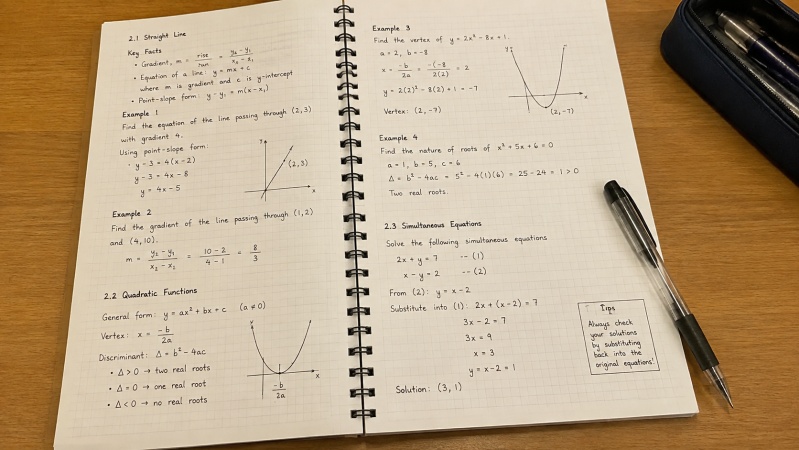
Math notes are different because mathematics is not only about remembering information. It is about understanding relationships between concepts and applying methods to solve problems.
A useful math note should include more than formulas. For example, instead of only writing:
a² + b² = c²
you should also record:
-
What the formula means
-
When you should use it
-
How to apply it in a problem
-
Common mistakes to avoid
Many students make the mistake of copying every equation from the board without understanding the process. However, math learning depends heavily on recognizing patterns and practicing problem-solving steps.
Effective math notes usually focus on:
-
Key definitions
-
Important formulas
-
Theorems and rules
-
Worked examples
-
Problem-solving strategies
-
Questions and mistakes
A good note is not a complete copy of a lesson. It is a personal learning resource that helps you understand the topic later.
What Should You Write Down in Math Notes?
When taking math notes, focus on information that helps you understand and solve problems. A well-organized math note usually includes four important parts: concepts, formulas, examples, and reflections .
Definitions and Key Concepts
Definitions are the foundation of mathematics. If you do not understand a definition, it becomes difficult to apply related formulas or methods.
When writing definitions, include:
-
The meaning of the concept
-
Important conditions or limitations
-
Related concepts
-
Simple examples
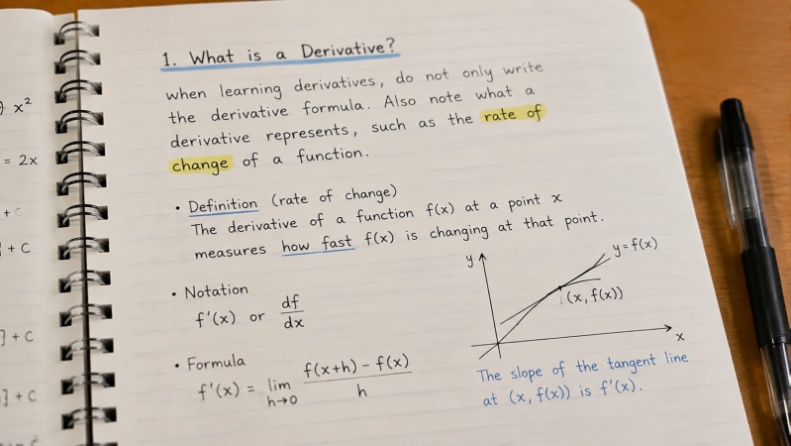
For example, when learning derivatives, do not only write the derivative formula. Also note what a derivative represents, such as the rate of change of a function.
Adding short explanations in your own words can make future reviews much easier.
Formulas, Theorems, and Rules
Formulas are important, but memorizing them alone is usually not enough.
For each formula or theorem, try to record:
-
The formula itself
-
The meaning of each variable
-
When to use it
-
Any special conditions
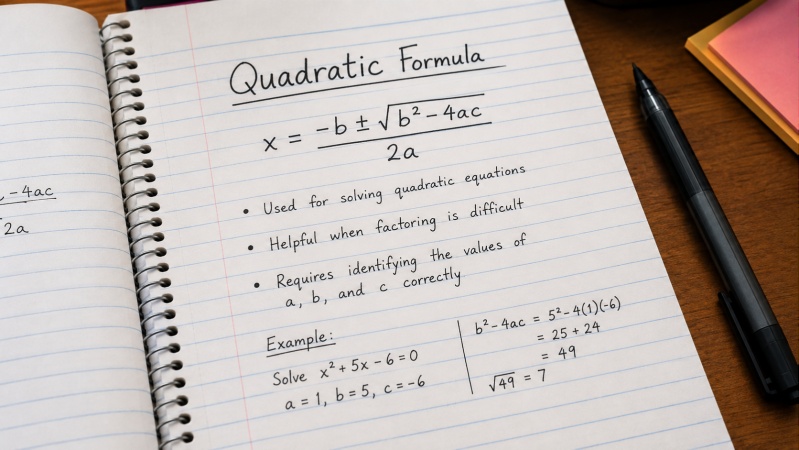
For example:
Quadratic Formula
Formula: x = (-b ± √(b² - 4ac)) / 2a
Also include:
-
Used for solving quadratic equations
-
Helpful when factoring is difficult
-
Requires identifying the values of a, b, and c correctly
This additional context helps you understand the purpose of the formula instead of just memorizing symbols.
Worked Examples and Problem-Solving Steps
Examples are one of the most valuable parts of math notes because they show how concepts are applied.
A useful example should include:
-
The original problem
-
Each calculation step
-
The reason behind each step
-
The final answer
Instead of writing: Solve equation → x = 5
write:
-
Move the constant term
-
Divide both sides by the coefficient
-
Check the solution
Some math note methods recommend organizing notes into columns, such as concept, example, and explanation. This structure helps connect formulas with their practical use.
Mistakes, Questions, and Important Notes
Your mistakes are also valuable learning materials.
Add notes about:
-
Steps you found confusing
-
Common calculation errors
-
Questions to ask your teacher
-
Problems you want to practice again
For example:
Mistake: Forgot to change the sign when moving the term.
Remember: Check negative numbers before finalizing the answer.
Reviewing mistakes regularly can help prevent repeating the same errors during exams.
How to Take Math Notes by Hand
Handwritten math notes remain popular because writing equations, symbols, and diagrams by hand is often faster and more natural than typing them.
For many students, handwritten notes are especially useful during lectures because they allow them to follow the teacher's explanation while recording important steps.
However, effective handwritten notes should focus on understanding rather than writing everything down.
How to Take Good Notes in Math Class
During a math class, avoid trying to copy every word or equation. Instead, focus on the teacher's explanation and problem-solving process.
A good approach is:
Before class
Prepare:
-
Previous notes
-
Textbook sections
-
Important questions
During class
Write down:
-
New concepts
-
Important formulas
-
Example problems
-
Teacher explanations
-
Areas you do not understand
After class
Spend a few minutes:
-
Filling missing information
-
Reviewing confusing steps
-
Adding explanations
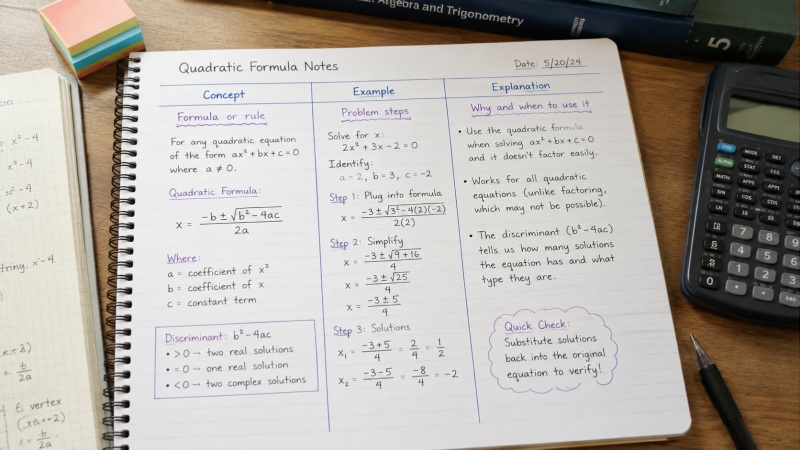
A three-column note format is a common method for math classes:
| Concept | Example | Explanation |
|---|---|---|
| Formula or rule | Problem steps | Why and when to use it |
This structure helps connect mathematical ideas with actual problem-solving.
How to Take Math Notes From a Textbook
Taking notes from a math textbook is different from copying every page.
Instead of rewriting the entire chapter, focus on:
-
Important definitions
Write down key terms and concepts.
-
Main formulas and theorems
Record the formula and explain its purpose.
-
Example problems
Choose examples that demonstrate a useful method.
-
Questions
Mark sections that need further explanation.
A useful textbook note workflow is:
Read → Understand → Summarize → Practice
The goal is not creating a shorter version of the textbook. The goal is creating notes that help you solve problems independently .
How to Take Math Notes Online or Digitally
As digital learning becomes more common, many students are choosing online and digital math notes to make their study materials easier to organize, access, and review. Compared with traditional paper notes, digital notes offer more flexibility for editing, searching, and managing large amounts of information.
However, taking math notes digitally requires more than simply typing formulas into a document. Students need to choose the right tools and create a structure that keeps concepts, equations, examples, and problem-solving steps easy to follow.
In this section, you will learn how to take neat math notes digitally on different devices, including laptops , computers , iPads , and online platforms like Google Docs .
How to Take Math Notes on a Laptop or Computer
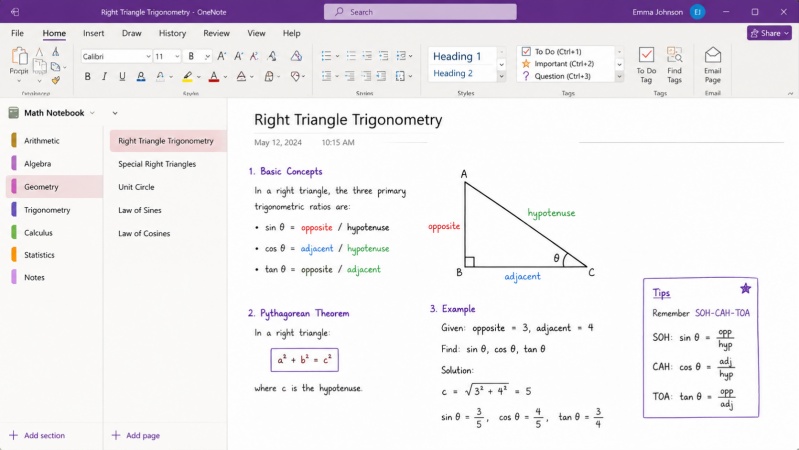
Taking math notes on a laptop or computer works well for students who prefer typed explanations, organized documents, or advanced mathematical formatting. It is especially useful for reviewing textbook chapters, creating study guides, and managing large amounts of information.
When taking math notes on a computer, focus on creating a clear structure instead of writing long paragraphs. A simple format can include:
-
Topic
-
Key Concepts
-
Important Formulas
-
Example Problems
-
Common Mistakes
-
Review Questions
Useful tools include:
-
Microsoft OneNote : Good for combining typed notes, drawings, screenshots, and equations in one notebook.
-
Notion : Useful for organizing chapters, formulas, and study schedules with a clean layout.
-
Google Docs : A simple option for creating shareable math notes and collaborative study documents.
-
Overleaf : A good choice for students who need well-formatted mathematical equations, especially in higher-level courses.
For advanced math subjects such as calculus, linear algebra, or statistics, students may use a combination of tools. For example, they might write explanations in Notion or OneNote while using LaTeX for complex equations.
A practical workflow is:
-
Create a page for each chapter or topic.
-
Add definitions and formulas first.
-
Include example problems with complete solution steps.
-
Add personal notes about difficult concepts or mistakes.
-
Review and update notes after completing exercises.
How to Take Math Notes on iPad
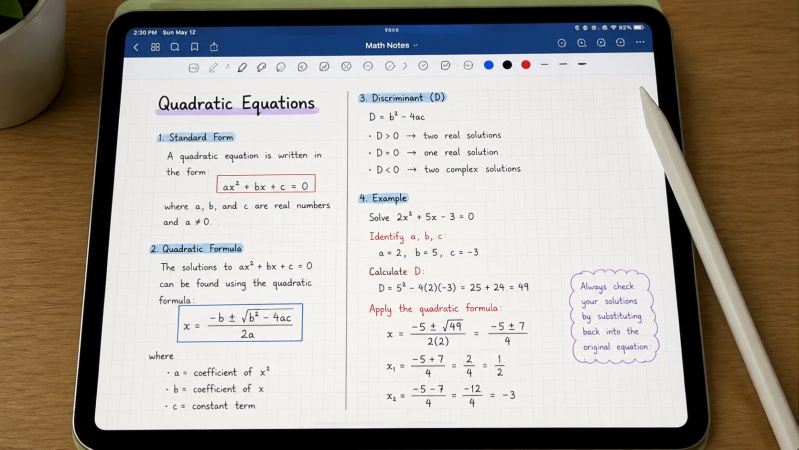
An iPad provides a balance between handwritten and digital note-taking. With a stylus, students can write equations, draw graphs, and annotate materials while keeping everything organized digitally.
For many math students, iPad notes work well because mathematical symbols and diagrams are often faster to write by hand than type.
Popular iPad note-taking apps include:
-
Goodnotes : Commonly used for handwritten math notes, PDF annotation, and organizing notebooks by subject.
-
Notability : Useful for handwriting, recording lectures, and reviewing class materials.
-
OneNote: Suitable for students who want their notes to sync across multiple devices.
When taking math notes on an iPad, consider this workflow:
-
Write important formulas, diagrams, and examples by hand.
-
Use colors or highlights to separate concepts, formulas, and mistakes.
-
Add screenshots or textbook pages when necessary.
-
Organize notes into folders by course, chapter, or topic.
-
Review notes regularly and add additional explanations.
To keep iPad math notes effective, avoid focusing too much on decoration. A neat layout should make information easier to understand, not simply make notes look attractive.
How to Take Math Notes on Google Docs
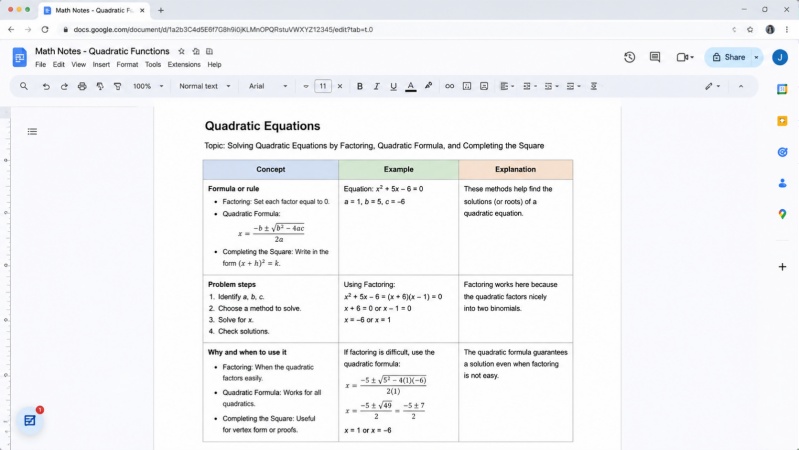
Google Docs is a simple and accessible option for students who prefer creating organized online math notes. It works especially well for written explanations, study summaries, and collaborative projects.
When using Google Docs for math notes, create a consistent structure for every topic:
-
Topic title
-
Definitions and key concepts
-
Formulas and rules
-
Example problems
-
Step-by-step explanations
-
Summary and review questions
Google Docs can be useful because it allows students to:
-
Access notes from different devices
-
Share notes with classmates
-
Add comments and suggestions
-
Edit and update study materials easily
For mathematical expressions, Google Docs provides an equation editor that can help insert basic formulas. However, for advanced equations or complex mathematical writing, dedicated tools such as LaTeX editors may provide better formatting.
A practical Google Docs workflow is:
-
Create one document for each course or subject.
-
Use headings to separate chapters and topics.
-
Add formulas together with explanations instead of formulas alone.
-
Include example problems that demonstrate how concepts are applied.
-
Update notes after studying to keep them accurate and useful.
Whether you use a laptop, iPad, or online document platform, the most important part of digital math notes is not the tool itself . The goal is to create a system that helps you understand concepts, review efficiently, and apply what you have learned.
To Review Effectively, Try Tenorshare AI Math

Creating math notes is only the first step. The real purpose of notes is helping you review concepts, understand difficult problems, and prepare for exams. However, even carefully written notes may contain information that you later forget or concepts that remain unclear.
This is where an AI math solver can provide additional support. Tenorshare AI Math is an AI math-solving tool designed to help students better understand mathematical concepts and problem-solving processes.
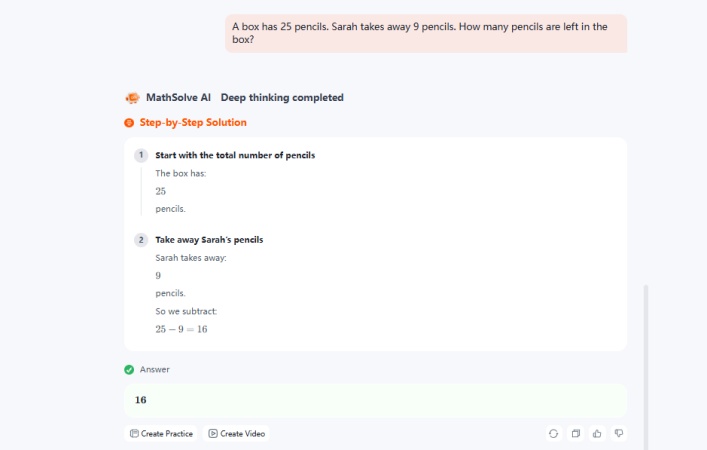
Instead of only showing an answer, it helps explain the steps from the original problem to the final solution. Students can upload or enter a math problem and quickly receive step-by-step explanations without needing to create complicated prompts.
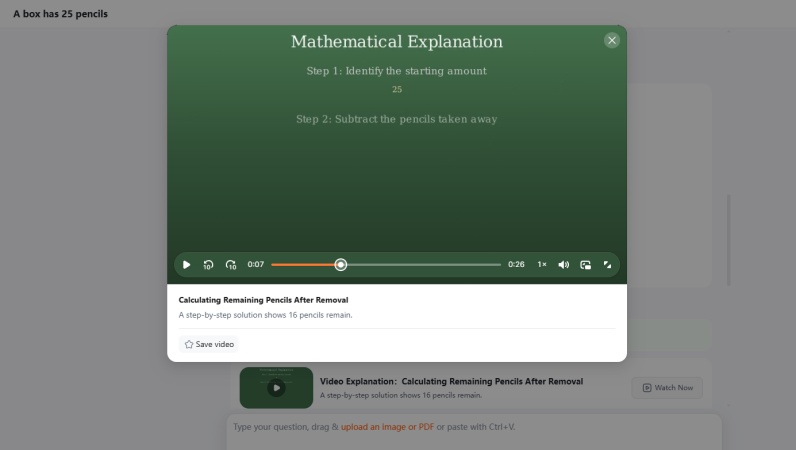
The tool also supports video generation , providing a more visual way to understand mathematical ideas. Visual explanations can help students connect abstract concepts with practical examples.

After reviewing a topic, students can generate related exercises to test their understanding and practice applying the concept.
Conclusion
Learning how to take math notes effectively can help you better understand concepts, organize formulas, and improve your problem-solving skills. Whether you prefer handwritten notes, digital notes on an iPad or computer, or online tools, the key is creating a note-taking system that supports learning and review.
Good math notes should not only record information but also help you identify difficult concepts, review important methods, and prepare for exams. When you need extra support understanding a problem or checking your learning progress, tools like Tenorshare AI Math can help explain solutions step by step, provide clearer concept explanations, and create practice opportunities to strengthen your understanding.

Tenorshare AI Math
- Solve math from text, images & PDFs at 98% accuracy
- Deliver step-by-step answers with detailed logic breakdown
- Access video explanations for deeper math concept understanding
- Generate matching practice tests to solidify knowledge

FAQs
-
What Is the Best Way to Take Math Notes?
The best way to take math notes is to focus on understanding instead of simply copying information. Include key concepts, formulas, worked examples, and problem-solving steps. Good math notes should explain not only what method to use but also why it works, making future review more effective.
-
Should I Write or Type Math Notes?
Both handwritten and digital notes can be effective. Handwritten notes are useful for quickly recording equations and following problem-solving steps, while digital notes are easier to organize, edit, and search. Many students combine both methods by writing notes during class and organizing them digitally afterward.
-
How Do I Organize My Math Notes?
Organize your math notes by topic, chapter, or concept, and separate formulas, examples, and explanations clearly. Adding notes about common mistakes or difficult steps can make your notes more useful when reviewing before exams.
-
Are Digital Math Notes Better Than Handwritten Notes?
Digital math notes are not always better than handwritten notes. Digital tools provide better organization and accessibility, while handwritten notes can feel more natural for equations and diagrams. The best choice depends on your learning style and the type of math you are studying.
-
How Do You Take Math Notes From a Textbook?
When taking notes from a math textbook, focus on important definitions, formulas, theorems, and example problems instead of copying every page. Summarize concepts in your own words and include explanations of problem-solving steps so you can apply the knowledge later.
-
How Can I Make My Math Notes Neat and Easy to Review?
Keep your math notes simple and structured. Use clear headings, leave enough space between sections, and separate formulas from examples and explanations. Highlighting important formulas or marking mistakes can help you find key information faster during review.
-
Can AI Help Me Study Math From My Notes?
AI can help you review math notes by explaining difficult concepts, providing step-by-step solutions, and creating additional practice questions. However, AI should be used as a learning assistant rather than a replacement for practice. Solving problems yourself is still essential for building math skills.
You Might Also Like
- How to Be Good at Math: A Complete Guide to Improve Your Math Skills
- How to Solve Math Word Problems Step by Step: Strategies, Tips & Tool
- What Happened to Microsoft Math Solver? Why It Was Discontinued and What to Use Instead
- How to Use Desmos for SAT 2026: Master the Digital SAT Calculator
- Tenorshare AI Math Review 2026: Is It a Good AI Math Solver?
- 15 Hardest Digital SAT Math Questions With Answers & Strategies

Tenorshare AI Math: Solve any math problems with AI
Turn math questions into clear solutions, tutorial videos & targeted practice setsTenorshare AI Math: Instant Solutions
Steps, videos & practice for every problem
Tenorshare AI Math: Solve any math problems with AI