
How to Become Good at Math Overnight: 8 Practical Tips That Actually Work
Have a math test tomorrow but still struggle with certain concepts? Or perhaps you understand your teacher's explanations but cannot solve similar problems on your own. When time is limited, figuring out what to study and how to practice can feel overwhelming.
While you cannot master an entire math course overnight, you can make meaningful progress by focusing on your weakest areas, reviewing essential concepts, and practicing the right types of problems. The key is to study strategically rather than spend hours rereading notes or memorizing formulas.
This guide explains how to become good at math overnight with eight practical strategies, a three-hour study plan, and useful math tools to help you review mistakes and check your answers.
Also Read: How to Study for a Math Test: From 7 Days Before to the Night Before
Catalogs:
How to Become Good at Math Overnight: 8 Practical Tips
- Set a Clear Goal for What You Can Learn Tonight
- Prioritize Topics Based on Your Upcoming Test
- Skip Topics That Are Too Difficult to Master in One Night
- Review Essential Formulas and Rules First
- Use Worked Examples to Learn Common Problem Types
- Practice Representative Problems Under Time Limits
- Fix Repeated Mistakes Instead of Starting New Topics
- Stop Studying in Time and Get Enough Sleep
Can You Really Become Good at Math Overnight?

Becoming good at math takes time because mathematical knowledge builds on previously learned concepts. For example, understanding algebra often requires a solid foundation in fractions, negative numbers, and basic arithmetic. You cannot fully develop these skills in a single night.
However, that does not mean you cannot improve your math performance quickly. If you already understand some of the material, focused revision can help you remember important formulas, recognize familiar problem types, and avoid common mistakes.
What you can realistically accomplish overnight includes:
-
Refresh important concepts: Reviewing key definitions, formulas, and rules can help you recall information more easily during a test.
-
Improve problem-solving efficiency: Practicing common question types helps you recognize which methods to use and how to approach similar problems.
-
Identify and correct mistakes: Reviewing incorrect answers can prevent you from repeating the same calculation or reasoning errors.
-
Build confidence: Successfully solving problems independently can make unfamiliar questions feel less intimidating.
If you are wondering how to get smarter in math overnight , start by setting a realistic goal. Instead of trying to learn everything, focus on understanding a few important concepts and applying them correctly.
How to Become Good at Math Overnight: 8 Practical Tips
If you're wondering how can I get better at math overnight , spending hours reviewing every chapter is unlikely to help. You need to make deliberate choices about what to study, which problems deserve more attention, and when to move on.
The following strategies can help you make better use of limited study time and improve your performance on the math topics that matter most.
Set a Clear Goal for What You Can Learn Tonight
Before opening your textbook, take a moment to decide what you actually want to achieve . Trying to improve in every area of math at once can leave you jumping between topics without making meaningful progress. Instead, identify two or three specific goals that you can realistically work toward in one evening.
For example, if you have a math test tomorrow, your goals might be to understand quadratic equations, improve your accuracy with fractions, and learn how to solve common word problems. These goals give your study session a clear direction and help you avoid spending too much time on topics that are not immediately relevant.
Prioritize Topics Based on Your Upcoming Test
When time is limited, not all math topics deserve equal attention. Start with your teacher's review sheet, recent homework, and previous quizzes to identify which concepts are most likely to appear on the test . Pay particular attention to topics that show up repeatedly or serve as the foundation for several other types of questions.
You can divide your study materials into three levels:
| Priority | Topics to Focus On | Study Approach |
|---|---|---|
| High | Frequently tested concepts and foundational skills | Review formulas and practice common questions |
| Medium | Topics you partly understand but often get wrong | Review explanations and solve similar problems |
| Low | Rare or advanced topics that require extensive preparation | Review the basics only if time allows |
This approach helps you spend more time improving skills that are both important and manageable instead of treating every chapter as equally urgent.
Skip Topics That Are Too Difficult to Master in One Night
It may seem counterintuitive, but knowing when to move on is an important part of last-minute studying. Some math concepts depend on several earlier skills, and trying to master them from scratch in one evening can consume time that would be better spent strengthening your existing knowledge.
A practical way to decide is to give each unfamiliar topic a short trial period . Spend around 10--15 minutes reviewing the explanation and following one worked example. If you can understand the basic method, continue with a practice question. If the underlying concept is still unclear, mark it for later and focus on another topic first.
The goal is not to avoid every challenging question. It is to distinguish between topics that require a little more practice and those that would take much longer to understand properly.
Review Essential Formulas and Rules First
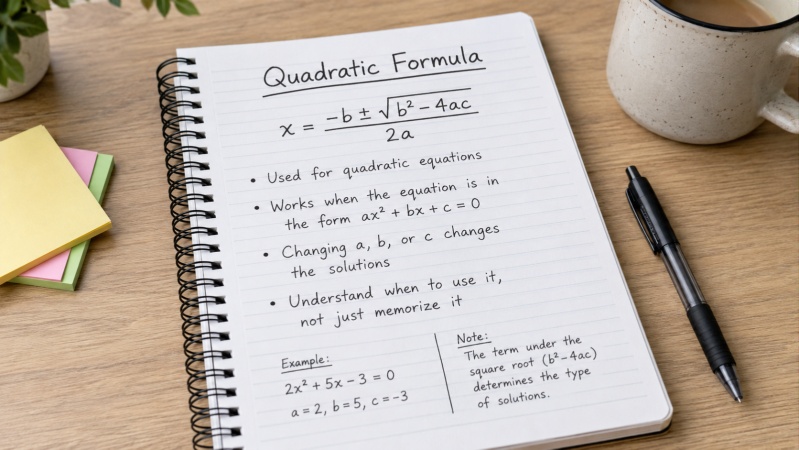
For many math problems, knowing which formula or rule to apply is half the battle. Before working through practice questions, review the essential formulas for your priority topics. However, simply memorizing a list of equations may not help if you cannot recognize when to use them.
When reviewing each formula, pay attention to three things:
-
What it means: Understand the relationship described by the formula rather than memorizing symbols without context.
-
When to use it: Learn what information in a question tells you that the formula is relevant.
-
How to apply it: Follow one example to see how the values are substituted and how the calculation is completed.
You can put these formulas into a short reference sheet for quick review. Afterward, cover the sheet and try to recall the formulas from memory. This helps you check whether you can retrieve the information without relying on your notes.
Use Worked Examples to Learn Common Problem Types
If you are unfamiliar with a particular type of math question, immediately attempting a large number of exercises may not be the most efficient approach. Start with a worked example that shows the complete solution. Following an example allows you to see how a concept is applied and how individual steps connect to produce the final answer.
Rather than just reading the calculations, try to identify the reasoning behind each step:
-
How is the information in the question translated into a mathematical expression?
-
Why is a particular formula or solving method chosen?
-
What changes between one step and the next?
If a solution skips an important step or uses a method you do not understand, a step-by-step math solver can help fill the gap. For example, Tenorshare AI Math provides detailed solutions and supports follow-up questions, allowing you to clarify confusing steps instead of repeatedly searching for explanations.
Practice Representative Problems Under Time Limits

Once you understand how a problem is solved, try applying the method without looking at the example. This is important because recognizing a solution while reading it is not the same as being able to reproduce the process independently. With limited study time, however, you do not need to complete every exercise in your textbook.
For each important topic, choose a few questions with different levels of difficulty:
-
A basic question: Check whether you can apply the main formula or rule.
-
A variation: See whether you can recognize the same concept when the question is presented differently.
-
A challenging question: Test whether you can combine the concept with other skills, if time allows.
Set a reasonable time limit for each problem, especially if you are preparing for an exam. If you remain stuck, review the solution and identify the missing step rather than spending another 20 minutes repeating an unsuccessful approach.
Fix Repeated Mistakes Instead of Starting New Topics
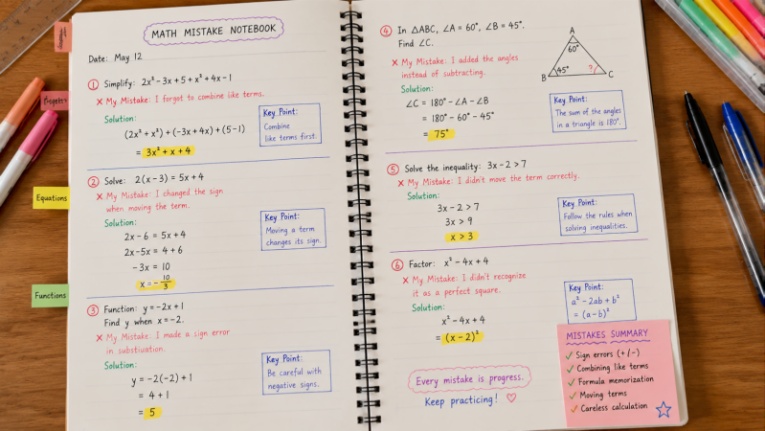
When reviewing your practice answers, do not focus only on how many questions you got right. Your mistakes can show whether you have misunderstood a concept, forgotten a rule, or simply made a calculation error. Identifying the cause is more useful than immediately moving on to another set of exercises.
For example, you can organize common mistakes into the following categories:
| Type of Mistake | What It May Indicate | How to Improve |
|---|---|---|
| Incorrect signs or fractions | Weakness in basic arithmetic rules | Review the relevant rules and redo similar calculations |
| Choosing the wrong formula | Difficulty recognizing question types | Compare examples and identify when each formula applies |
| Missing or mixing up steps | Incomplete understanding of the solving process | Follow a worked example and repeat the procedure |
| Correct method but incorrect answer | Calculation or attention errors | Check each operation and verify the final result |
After identifying a repeated mistake, solve one or two similar questions to see whether you have corrected it. This targeted review can be more valuable than rushing through unfamiliar material without addressing the problems that are already affecting your performance.
Stop Studying in Time and Get Enough Sleep
It is tempting to stay up all night when you feel unprepared, but more study time does not always mean better results. Fatigue can make it harder to concentrate, remember formulas, and avoid simple calculation errors.
If you have an exam the next day, getting enough sleep should be part of your study plan rather than something you sacrifice to finish every exercise.
Before ending your study session, spend 10--15 minutes reviewing your formula sheet, key problem-solving steps, and mistakes from practice. Avoid starting a completely unfamiliar topic at this point. You will get more value from consolidating what you have already learned than trying to absorb a large amount of new information when you are exhausted.
A 3-Hour Math Study Plan to Follow Tonight
If you have a math test tomorrow or need to review several difficult topics, a structured schedule can help you decide what to do first.
The following three-hour plan combines concept review, worked examples, independent practice, and mistake analysis.
| Time | Study Task | What to Do |
|---|---|---|
| 0:00–0:20 | Identify Weak Points | Review recent homework and tests to find two or three difficult topics |
| 0:20–1:00 | Review Essential Concepts | Study important formulas, definitions, and foundational rules |
| 1:00–1:50 | Practice Key Problems | Work through examples and solve similar questions independently |
| 1:50–2:00 | Take a Short Break | Step away from your desk and rest |
| 2:00–2:40 | Test Yourself | Complete practice questions without notes or solution guides |
| 2:40–3:00 | Review Mistakes | Check incorrect answers and revisit the concepts behind them |
A few tips to make this plan more effective:
-
First, do not try to cover every topic in your textbook . Choose the material that is most relevant to your upcoming test or current assignments.
-
Second, spend more time solving problems than reading explanations. Mathematics requires you to apply concepts, not just recognize them.
-
Finally, avoid sacrificing sleep to extend your study session . If you have an exam tomorrow, getting sufficient rest is part of preparing effectively.
Can an AI Math Solver Help You Improve Faster?
If you have accumulated a long list of mistakes to review or need extra practice on the topics covered in an upcoming test, a reliable AI math solver can make your study session more efficient. Instead of searching for separate explanations and practice questions, you can use one tool to understand solutions, revisit difficult problems, and reinforce what you have learned.
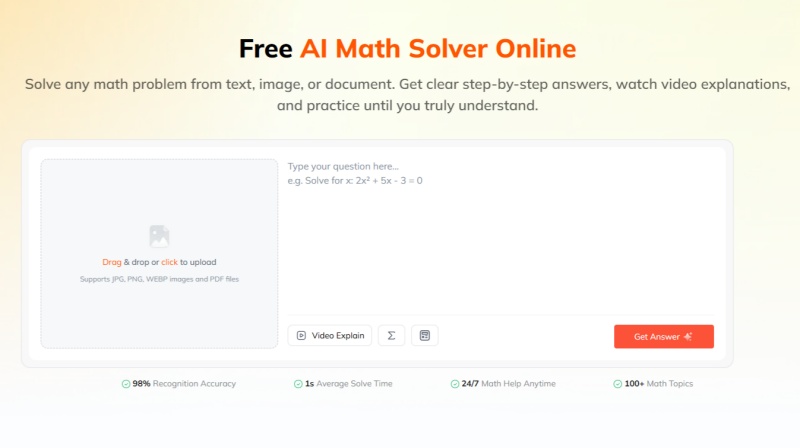
Tenorshare AI Math brings several math-learning tools together to make last-minute revision more efficient. Instead of switching between different resources, you can solve problems, review explanations, and practice related questions in one place.
Its key features include:
-
Multiple Input Options: Enter math questions directly or upload JPG, PNG, WEBP images, and PDF files.
-
Step-by-Step Solutions: Review the formulas, calculations, and reasoning behind each answer.
-
Video Explanations: Learn difficult concepts through visual explanations and guided lessons.
-
Follow-Up Questions: Ask for clarification when you do not understand a particular step.
-
Practice Tests: Generate similar questions to check whether you can apply the method independently.
These features are particularly useful when you need to review several topics in a short period. You can use step-by-step explanations to understand your mistakes, video explanations to revisit confusing concepts, and generated practice questions to test your understanding. Rather than spending the entire evening searching for answers, you can keep your review and practice activities in one place.
Conclusion
Learning how to become good at math overnight is less about studying everything and more about making the most of the time you have.
By prioritizing important topics, reviewing worked examples, practicing common problem types, and correcting repeated mistakes, you can make meaningful progress even with limited preparation time. You may not master every concept in one night, but a focused study plan can help you build confidence and perform better on your next math test.
Start with the topics you find most challenging, use helpful learning tools when you get stuck, and keep practicing to turn short-term improvements into lasting math skills.

Tenorshare AI Math
- Solve math from text, images & PDFs at 98% accuracy
- Deliver step-by-step answers with detailed logic breakdown
- Access video explanations for deeper math concept understanding
- Generate matching practice tests to solidify knowledge

FAQs
-
Can I Become a Math Genius Overnight?
If you're wondering how to become a math genius overnight, it's important to set realistic expectations. You cannot master all of math in one night, as mathematical ability takes time to develop. However, you can make noticeable progress in a few hours by focusing on difficult concepts, practicing common problem types, and correcting mistakes.
-
Is Math Ability Something You're Born With?
No. Although people may have different starting abilities, math skills can improve through practice, effective learning strategies, and a better understanding of mathematical concepts. Struggling with math does not mean you lack the ability to get better.
-
What Is the Fastest Way to Get Good at Math?
The fastest way to get good at math is to identify your weak areas, review the concepts behind them, and practice representative problems. Learning from worked examples and correcting repeated mistakes can help you make progress more efficiently.
-
How Long Does It Take to See Improvement in Math?
You may notice improvements in specific topics after a few focused study sessions, but building strong math skills takes longer. Regular practice and reviewing mistakes are essential for making that progress last.
-
Why Do I Understand Math in Class but Struggle on Tests?
Understanding a teacher's explanation is different from solving problems independently under time pressure. You may need more practice recognizing question types, choosing the right methods, and completing calculations without looking at examples.
You Might Also Like
- 15 Best Majors That Don't Require Math: Good Career Options for Students
- Can DeltaMath Detect Cheating? What Teachers Can Actually See 2026
- 2026 ACT vs SAT Math: 8 Key Differences and How to Choose
- What Is a Term in Math? A Beginner-Friendly Explanation [2026]
- Is Discrete Math Hard? Why Students Struggle and How to Make It Easier
- How to Do Math in Your Head: 5 Mental Math Techniques for Faster Calculations

Tenorshare AI Math: Solve any math problems with AI
Turn math questions into clear solutions, tutorial videos & targeted practice setsTenorshare AI Math: Instant Solutions
Steps, videos & practice for every problem
Tenorshare AI Math: Solve any math problems with AI