
Is Discrete Math Hard? Why Students Struggle and How to Make It Easier
You may have done well in algebra or calculus, only to find yourself struggling with logic and mathematical proofs in discrete mathematics. So, is discrete math hard , or does it simply require a different way of thinking?
The answer depends on your mathematical background and the topics covered in your course. This guide explores why students struggle with discrete math, how its difficulty compares to calculus and other math courses, and practical ways to make learning easier.
Catalogs:
How Hard Is Discrete Math?
For many students, discrete math feels difficult at first, but usually not because the calculations are advanced. The bigger shift is learning to think in terms of logic, proofs, patterns, and abstract relationships rather than simply applying a formula.
A quick way to understand the difficulty is to look at what the course asks you to do:
| What you may already know | What discrete math may ask you to do |
|---|---|
| Apply a formula | Decide which reasoning method fits a problem |
| Solve for an unknown | Prove that a statement is always true |
| Follow calculation steps | Build a logical argument |
| Work mainly with numbers | Work with sets, graphs, statements, and structures |
For beginners, the hardest parts are often:
-
Proofs: You may need to explain why a statement is true, not just find an answer.
-
Abstract reasoning: Problems can involve logic, sets, relations, and structures that are less familiar than numbers and functions.
-
Problem interpretation: Some questions require you to identify the right approach before doing any calculation.
-
Combinatorics: Counting problems can look simple but become tricky when several conditions must be considered at once.
That does not mean discrete mathematics is harder for everyone. Students who are comfortable with logical puzzles, structured reasoning, or programming may find some topics intuitive, while students with strong calculus skills may still need time to adjust to proof-based thinking.
The course also varies by school. One class may emphasize practical problem-solving, while another may place much more weight on formal proofs. So when asking how hard is discrete math, the most useful question is not simply whether the subject is hard, but which parts are likely to challenge you and what skills the course expects you to develop.
Why Is Discrete Math So Hard?
Discrete mathematics introduces a different approach to solving mathematical problems. Three areas are particularly challenging for students encountering the subject for the first time.
Abstract Concepts and Logical Reasoning
Discrete math involves concepts such as sets, relations, functions, and propositional logic. Unlike arithmetic problems, these topics often require students to work with symbols and abstract relationships rather than specific numbers.
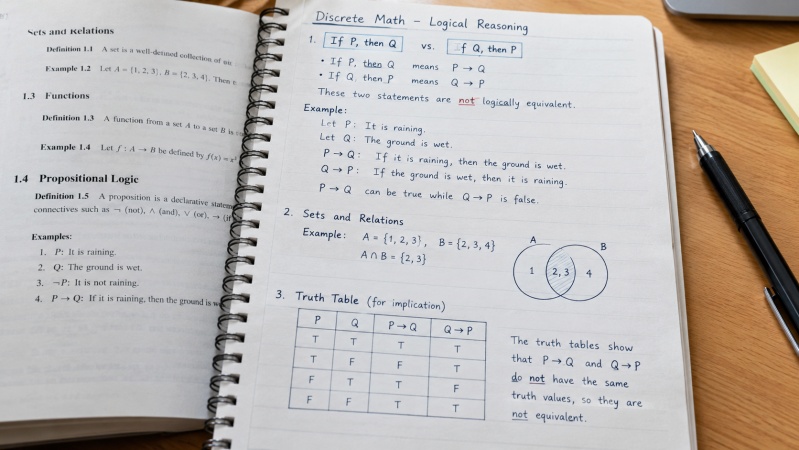
For example, understanding the difference between "if P, then Q" and "if Q, then P" is essential for logical reasoning. Although these statements look similar, they are not logically equivalent.
Students must learn to interpret mathematical notation carefully and understand how different statements relate to one another.
Mathematical Proofs and Induction
Mathematical proofs are among the biggest challenges in discrete mathematics. Instead of calculating an answer, students must demonstrate that a statement is true under specified conditions.
Common proof techniques include direct proof, proof by contradiction, proof by contrapositive, and mathematical induction.
For example, mathematical induction can establish that a formula holds for every positive integer. Students must prove the initial case and then demonstrate that the statement remains true for the next integer.
The calculations may be straightforward, but choosing an appropriate proof method and presenting a logically complete argument requires practice.
Combinatorics and Problem-Solving
Combinatorics deals with counting, arrangements, selections, and combinations. Although many problems use basic arithmetic, identifying the correct counting method can be difficult.
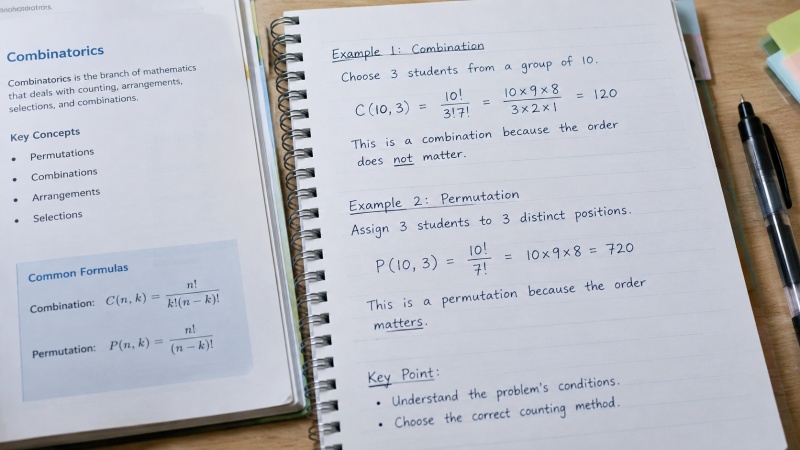
For example, choosing three students from a group of ten is different from assigning three students to three distinct positions. The first problem involves combinations, while the second involves permutations.
Students must understand the problem's conditions before applying a formula. More complicated questions may combine several counting principles, making careful reasoning particularly important.
Is Discrete Math Harder Than Calculus?
There is no universal answer to whether discrete math is harder than calculus. The two subjects emphasize different mathematical skills, and students may find one more challenging depending on their strengths and previous experience.
Discrete Math vs. Calculus: Key Differences
The main difference between discrete mathematics and calculus lies in the types of problems they study and the methods used to solve them.
| Aspect | Discrete Math | Calculus |
|---|---|---|
| Main focus | Discrete structures, logic, and proofs | Continuous change and accumulation |
| Core topics | Logic, sets, graphs, combinatorics | Limits, derivatives, integrals |
| Main skills | Logical reasoning and proof writing | Algebraic manipulation and analytical reasoning |
| Common challenges | Abstract notation and constructing proofs | Understanding limits and applying integration techniques |
| Typical applications | Computer science, algorithms, cryptography | Physics, engineering, economics |
Calculus frequently involves calculating derivatives, evaluating integrals, and interpreting continuous functions. Discrete mathematics focuses more on logical relationships, finite structures, and mathematical arguments.
Both subjects require conceptual understanding, although the balance between calculation and proof varies by course.
Which Course Might Be Harder for You?
When comparing discrete math vs. calculus, consider your mathematical strengths and learning experience.
Students who enjoy algebraic manipulation, formulas, and graphical interpretation may find calculus more familiar. Those who enjoy puzzles, logical reasoning, and understanding mathematical structures may prefer discrete mathematics.
However, prior experience matters . A student who has completed calculus but never written a mathematical proof may still struggle with introductory discrete math. Conversely, someone familiar with programming and logic may find some discrete mathematics topics more intuitive.
Neither course is inherently harder for every student. The difficulty depends on the specific syllabus, teaching approach, and individual preparation.
How Does Discrete Math Compare to Other Math Courses?
Beyond calculus, students frequently compare discrete mathematics with linear algebra and statistics. These courses share some mathematical foundations but develop different skills.
Discrete Math vs. Linear Algebra
Both discrete mathematics and linear algebra are foundational college-level math courses, but they develop different types of mathematical thinking.
Linear algebra mainly studies vectors, matrices, linear transformations, and systems of equations. Discrete mathematics focuses more on logic, proofs, counting, graphs, and finite structures.
| Aspect | Discrete Math | Linear Algebra |
|---|---|---|
| Main topics | Logic, proofs, combinatorics, graph theory, sets | Matrices, vectors, transformations, vector spaces |
| Common skills | Logical reasoning and proof writing | Algebraic manipulation and mathematical modeling |
| Typical challenges | Understanding abstract concepts and constructing arguments | Visualizing higher-dimensional concepts and applying matrix methods |
| More familiar to students who enjoy | Logic puzzles, programming, structured reasoning | Calculations, equations, geometric interpretations |
For many beginners, discrete math may feel more unfamiliar because it often introduces formal proofs and logical arguments earlier. However, advanced linear algebra can become highly abstract, especially when studying vector spaces and theoretical concepts.
When comparing discrete math vs. linear algebra, neither subject is universally harder. Students who prefer step-by-step calculations may find introductory linear algebra more comfortable, while those who enjoy reasoning and patterns may adapt more easily to discrete mathematics.
Discrete Math vs. Statistics

Discrete mathematics and statistics overlap in some areas, especially probability and data analysis, but they approach problems from different perspectives.
Statistics focuses on using data to understand patterns, make predictions, and draw conclusions. Discrete mathematics focuses on understanding mathematical structures, relationships, and logical systems.
| Aspect | Discrete Math | Statistics |
|---|---|---|
| Main focus | Mathematical structures and logical reasoning | Data analysis and uncertainty |
| Common topics | Logic, proofs, counting, graphs | Probability, distributions, inference, regression |
| Main challenge | Building and understanding mathematical arguments | Interpreting data and choosing appropriate methods |
| Typical problem style | "Why is this statement true?" | "What does this data tell us?" |
Students who enjoy real-world applications may find introductory statistics more intuitive because many problems are connected to practical situations. However, statistics also requires careful reasoning, especially when working with probability, hypothesis testing, and interpreting results.
Students asking is discrete math harder than statistics may find that the answer depends on their strengths. Those comfortable with abstract reasoning may prefer discrete mathematics, while those who enjoy working with data and real-world examples may prefer statistics.
The two subjects are also connected. For example, combinatorics and discrete probability from discrete mathematics provide important foundations for understanding probability concepts used in statistics.
How to Make Discrete Math Easier?
Learning discrete mathematics becomes easier when you focus on building the right problem-solving habits. Instead of memorizing definitions and formulas, try to understand why a method works, practice different types of problems, and review where your reasoning breaks down.
Strengthen Your Logic and Proof Skills
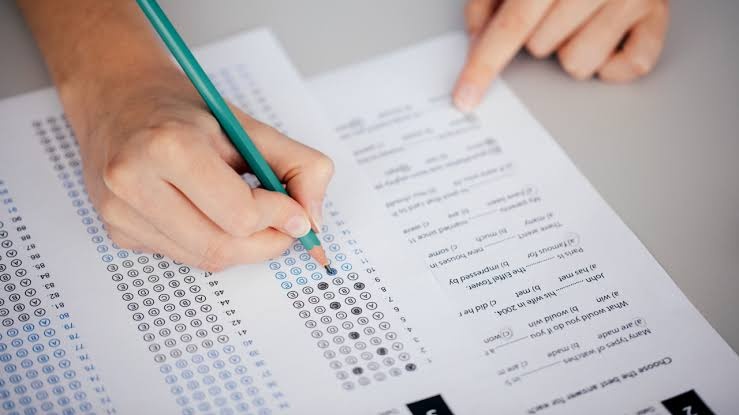
A strong foundation in logic is essential for learning discrete mathematics. Before moving to more advanced topics, make sure you understand concepts such as propositions, logical operators, sets, relations, and functions.
For proof-based topics, focus on understanding the structure of an argument rather than memorizing examples. When studying a proof, ask yourself:
-
What statement is being proven?
-
What assumptions are given?
-
Why does each step follow from the previous one?
-
Which proof method is being used?
Practicing simple proofs, such as direct proofs, contradiction, and mathematical induction, can gradually improve your ability to write and understand more complex arguments.
Practice Discrete Math Through Targeted Problem Solving
Discrete mathematics requires more than completing a large number of exercises. The goal of practice is to recognize patterns and understand when to use different approaches.
For more effective practice, choose resources based on your learning goals rather than simply completing more exercises. Different types of materials can help you improve different skills:
| Learning Goal | Useful Resources | How to Use Them |
|---|---|---|
| Understand new concepts | Textbooks, lecture notes, video courses | Review definitions and examples before attempting problems |
| Improve proof skills | Proof exercises and worked solutions | Compare your reasoning with complete proofs and identify missing steps |
| Practice problem-solving | Problem sets and past exams | Solve under time limits and review mistakes afterward |
| Explore advanced topics | University course materials and open resources | Study additional examples when a topic remains unclear |
When using practice materials, avoid checking solutions too quickly. Try to solve the problem independently first, then compare your approach with the solution to understand where your reasoning differs.
Free university resources such as MIT OpenCourseWare's Mathematics for Computer Science and similar online courses can provide structured lessons, examples, and exercises covering topics such as logic, proofs, combinatorics, and graph theory. These resources are especially useful for students who want a more organized learning path outside of class.
Learn With Step-by-Step AI Math Solvers
When studying discrete mathematics independently, checking the final answer is often not enough. Many students need to understand why a solution uses a specific method, where their reasoning went wrong, or how to approach a similar problem.
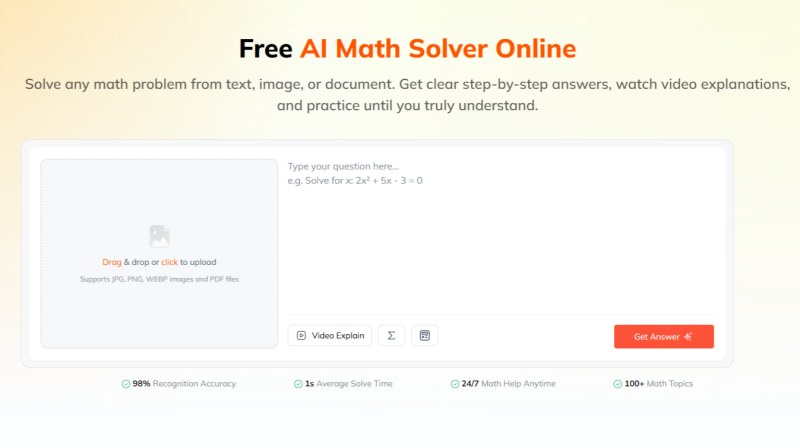
Step-by-step AI math solvers are becoming useful learning tools because they can break down problems, explain solution processes, and provide additional practice opportunities. Some AI math solvers, such as Tenorshare AI Math , combine step-by-step solutions with features designed to support math learning, including:
-
Step-by-step solutions: Explain the process behind solving supported math problems rather than only providing the final result.
-
Video explanations: Offer additional visual explanations for mathematical concepts and solution methods.
-
Practice problems: Help reinforce understanding by generating similar exercises.
-
Follow-up questions: Allow students to ask for clarification when a step or concept is unclear.
These tools can be particularly helpful for calculation-based topics in discrete mathematics, such as combinatorics, sequences, and probability. However, for proof-based questions, students should still evaluate the logic of each argument carefully and use AI explanations as a supplement to developing their own reasoning skills.
Final Thoughts: Is Discrete Mathematics Hard?
So, is discrete math hard ? The answer depends on your background, the course structure, and your familiarity with logical reasoning and mathematical proofs. Discrete mathematics can feel challenging at first because it requires a different way of thinking from calculation-focused math courses, but it does not necessarily require advanced calculus.
Students can make discrete mathematics easier by building a solid foundation in logic, practicing proof techniques, and working through different types of problems regularly. Learning resources and tools such as Tenorshare AI Math can also support independent study by helping students review solution steps, understand problem-solving methods, and practice related questions.
With consistent practice and the right approach, many of the concepts that initially seem abstract can become more familiar and manageable.

Tenorshare AI Math
- Solve math from text, images & PDFs at 98% accuracy
- Deliver step-by-step answers with detailed logic breakdown
- Access video explanations for deeper math concept understanding
- Generate matching practice tests to solidify knowledge

FAQs
-
Is Discrete Structures Hard?
Discrete Structures is often another name for a discrete mathematics course, particularly in computer science programs. Its difficulty depends on the syllabus, but common challenges include mathematical logic, proofs, combinatorics, and graph theory. Courses that emphasize rigorous proofs may be more demanding for beginners.
-
Is Discrete Math Harder Than Calculus 2?
Calculus 2 typically covers integration techniques, sequences, series, and sometimes parametric equations. Discrete mathematics focuses more on logic, proofs, and discrete structures. Students comfortable with calculations may prefer Calculus 2, while those who enjoy logical reasoning may find discrete math more approachable. Neither is universally harder.
-
Is Discrete Math Harder Than Differential Equations?
Differential equations generally require a foundation in calculus and involve solving equations that describe changing quantities. Discrete mathematics often has fewer calculus prerequisites but places greater emphasis on logical reasoning and proofs. Their relative difficulty depends on your mathematical background and the depth of each course.
-
Is Discrete Math a Higher-Level Math Course?
Discrete mathematics is commonly taught as an introductory college-level course, particularly in computer science. Although some topics involve advanced mathematical reasoning, introductory courses do not necessarily require calculus. More advanced courses may explore mathematical logic, graph theory, or combinatorics in greater depth.
-
Do You Need Calculus Before Taking Discrete Math?
Most introductory discrete mathematics courses do not require calculus. A solid understanding of algebra and basic mathematical reasoning is generally sufficient. However, prerequisites vary between institutions, so check your school's course requirements before enrolling.
You Might Also Like
- Why Is Statistics So Hard to Understand? 5 Real Reasons
- Is AP Statistics Hard? A Complete Guide to AP Stats Difficulty [2026]
- How to Isolate a Variable: Definition, Step-by-Step Tutorial & Common Mistakes
- Geometric Terms List: 30+ Geometry Terms You Should Know
- Is Geometry Hard? What Makes Geometry Difficult & How to Simplify It
- Why Is AI Bad at Math? Understand AI Math Mistakes & Pick a Trustworthy AI Math Tool

Tenorshare AI Math: Solve any math problems with AI
Turn math questions into clear solutions, tutorial videos & targeted practice setsTenorshare AI Math: Instant Solutions
Steps, videos & practice for every problem
Tenorshare AI Math: Solve any math problems with AI