
What Is a Term in Math? A Beginner-Friendly Explanation [2026]
When learning algebra, many students encounter unfamiliar math terms that make expressions and equations seem more complicated than they really are. Words like term, factor, coefficient, and expression often appear together, making it difficult to understand what each part means and how they work in a problem.
Understanding terms in math is an important step toward reading and solving algebraic expressions correctly. Once you know how to recognize a term, identify its parts, and distinguish it from related concepts, topics such as simplifying expressions, combining like terms, and solving equations become much easier to follow.
In this guide, you will learn the math term definition, how to identify terms in different mathematical expressions, common math terms and examples, and the differences between terms, factors, coefficients, expressions, and equations.
Catalogs:
What Is a Math Term?
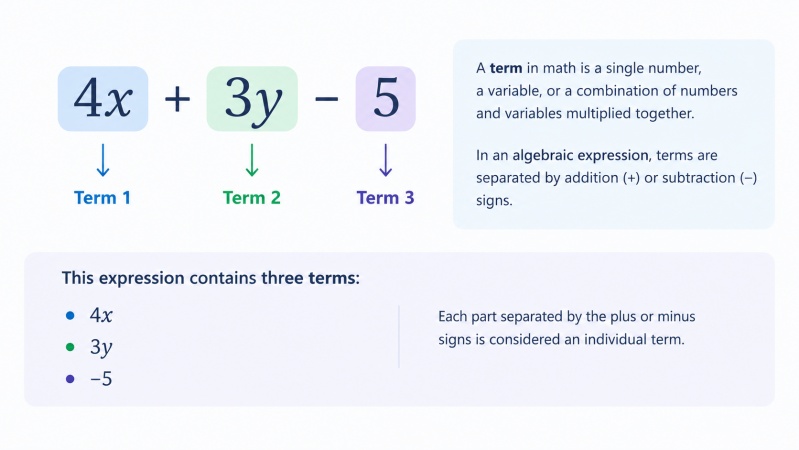
A term in math is a single number, a variable, or a combination of numbers and variables multiplied together. In an algebraic expression, terms are separated by addition (+) or subtraction (-) signs.
For example:
4x + 3y - 5
This expression contains three terms:
-
4x
-
3y
-
5
Each part separated by the plus or minus signs is considered an individual term.
A term can contain different components. For example, in the term 6x:
-
6 is the coefficient
-
x is the variable
-
6x as a whole is the term
A term can also contain multiple variables. For example:
3xy
is one term because the variables x and y are multiplied together. It is not separated into multiple terms because there is no addition or subtraction sign between them.
The key idea behind the definition of mathematical terms is that a term represents a single part of an expression. When students learn how expressions are organized, identifying terms becomes an important first step before combining like terms, simplifying expressions, or solving equations.
For example:
x + 7
contains two terms:
-
x
-
7
The plus sign separates the expression into two different parts. However:
7x
contains only one term because multiplication does not separate terms.
How to Identify Terms in a Mathematical Expression
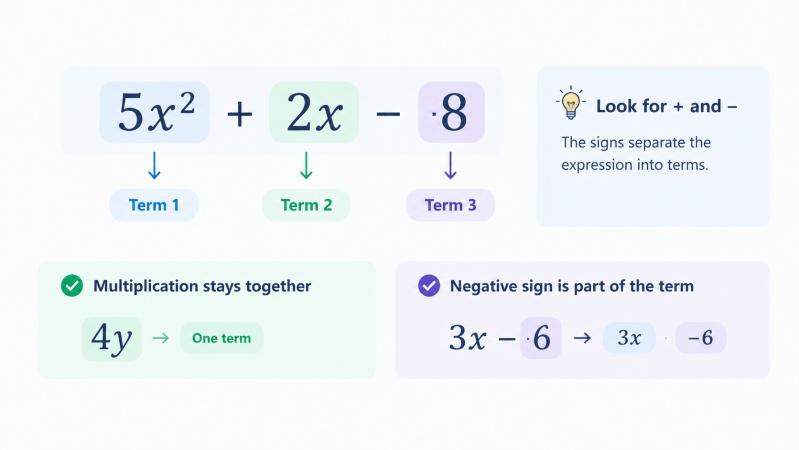
To identify terms in a mathematical expression, look for the addition and subtraction signs that divide the expression into separate parts. Each section between these signs represents one term.
For example:
5x² + 2x - 8
To find the terms, separate the expression at the plus and minus signs:
-
5x²
-
2x
-
8
Therefore, this expression has three terms.
One common mistake is separating numbers and variables that are multiplied together. For example:
4y
is one term, not two terms. Although it contains both the number 4 and the variable y, they are connected by multiplication.
Another important detail is that negative signs are usually included as part of the term that follows them. For example:
3x - 6
contains the terms:
-
3x
-
6
The negative sign changes the value of the second term, so it should not be ignored when identifying terms.
A simple way to remember how to find terms is:
Addition and subtraction separate terms, while multiplication keeps parts together inside one term.
This rule helps students recognize terms in expressions of different levels of difficulty.
Different Types of Terms in Math
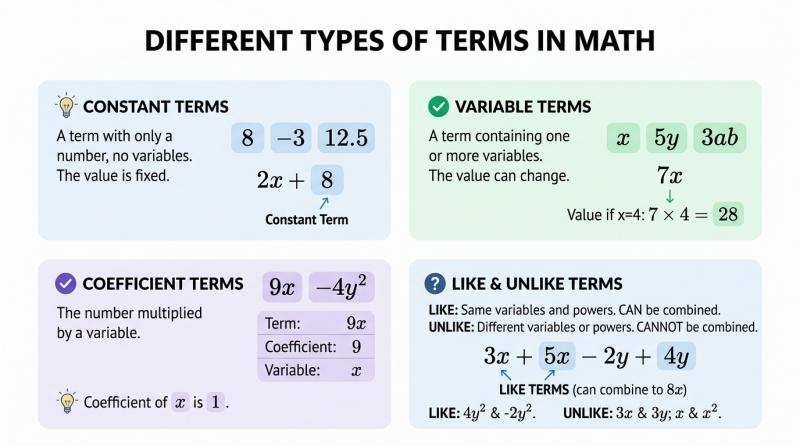
Terms can be classified based on the components they contain and how they are used in mathematical expressions. Understanding different types of terms makes it easier to analyze algebra problems and recognize the role of each part.
Constant Terms
A constant term is a term that contains only a number and does not include any variables. The value of a constant remains unchanged, which is why it is called a constant.
For example:
8, 3, 5
are all constant terms.
In the expression:
2x + 8
the number 8 is the constant term because it does not depend on the value of x.
Constant terms appear frequently in algebraic expressions and equations. Recognizing them helps students separate fixed values from changing quantities represented by variables.
Variable Terms
A variable term contains one or more variables. A variable represents a value that can change depending on the situation or problem.
Examples of variable terms include:
- x
- 5y
- 3ab
In the term:
7x
the variable is x, and the coefficient is 7. If the value of x changes, the value of the entire term changes as well.
For example, when x = 4:
7x = 7 × 4 = 28
Variable terms are an important part of algebra because they allow mathematical expressions to represent unknown values and relationships.
Coefficient Terms
A coefficient is the number that is multiplied by a variable in a term. Although the coefficient is part of a term, it only refers to the numerical value attached to the variable.
For example:
9x
In this term:
-
The term is 9x
-
The coefficient is 9
-
The variable is x
Another example:
4y²
The coefficient is -4 because it multiplies the variable part y².
When a variable does not have a visible number before it, the coefficient is understood to be 1. For example:
X
is the same as:
1x
Understanding coefficients is useful when simplifying expressions, especially when combining like terms.
Like Terms and Unlike Terms
Like terms are terms that have the same variables raised to the same powers. Because their variable parts match, they can usually be combined through addition or subtraction.
For example:
3x + 5x
are like terms because both contain x.
They can be combined:
3x + 5x = 8x
Another example:
4y² and -2y²
are also like terms because they contain the same variable with the same exponent.
Unlike terms have different variables or different powers, meaning they cannot be combined directly.
For example:
3x and 3y
are unlike terms because the variables are different.
Similarly:
x and x²
are unlike terms because the powers are different.
Understanding the difference between like and unlike terms is an important skill when simplifying algebraic expressions.
Math Terms and Examples You Should Know
Learning the meaning of mathematical terminology becomes easier when concepts are connected with real examples. Instead of only memorizing terms math definition, students can better understand terms by seeing how they appear in expressions, equations, and different areas of mathematics.
Examples of Terms in Algebraic Expressions
Consider the expression:
6x + 4y - 9
This expression contains three terms:
-
6x
-
4y
-
9
The first two terms contain variables, while the last term is a constant.
Another example is:
3a² + 2a + 7
The terms are:
-
3a²
-
2a
-
7
Here, 3a² and 2a are variable terms because they contain variables, while 7 is a constant term.
Expressions can also be named based on the number of terms they contain:
-
A monomial has one term.
-
A binomial has two terms.
-
A trinomial has three terms.
For example:
5x
is a monomial, while:
x + 4
is a binomial.
Understanding these examples helps students recognize how terms form larger mathematical structures.
Examples of Terms in Different Areas of Mathematics
Although terms are most commonly discussed in algebra, the idea of a term also appears in other areas of mathematics. The math terms meaning may change slightly depending on the context, but the main idea remains the same: a term is an individual component within a larger mathematical structure.
Understanding how terms are used in different areas can help students recognize that mathematical terminology is not limited to one type of problem.
Terms in Sequences
In a sequence, a term refers to each individual number or value in the ordered list.
For example:
2, 5, 8, 11, 14
Each number is a term in the sequence:
-
First term: 2
-
Second term: 5
-
Third term: 8
-
Fourth term: 11
-
Fifth term: 14
Unlike algebraic expressions, terms in sequences are not separated by addition or subtraction signs. Instead, they represent individual positions within a pattern.
For example, in a sequence formula:
an = 3n + 2
the value of each term depends on the position number n. This allows mathematicians to describe patterns and predict future values in a sequence.
Terms in Polynomials
Polynomials are algebraic expressions made up of one or more terms connected by addition or subtraction.
For example:
x³ + 4x² - 6x + 9
contains four terms:
-
x³
-
4x²
-
6x
-
9
Each term has a different role. Some terms contain variables with different powers, while others may be constants.
The number of terms in a polynomial also affects its name:
-
A polynomial with one term is called a monomial.
-
A polynomial with two terms is called a binomial.
-
A polynomial with three terms is called a trinomial.
Recognizing terms is essential when working with polynomials because many operations, such as adding, subtracting, or factoring polynomials, require students to understand how individual terms are organized.
Terms in Equations
Terms can also appear on both sides of an equation.
For example:
3x + 5 = 20
The left side contains two terms:
-
3x
-
5
The right side contains one term:
- 20
Although an equation has an equal sign that separates two expressions, the individual parts within those expressions can still be identified as terms.
Understanding terms in equations helps students solve problems more effectively because they can recognize which parts of an equation can be combined, simplified, or moved during the solving process.
Term vs Other Important Math Concepts
Terms are closely related to many other mathematical concepts. Because these ideas often appear together, students sometimes confuse their meanings. Understanding the differences between terms and other components of mathematics can make algebra much easier to follow.
Term vs Factor: What Is the Difference?
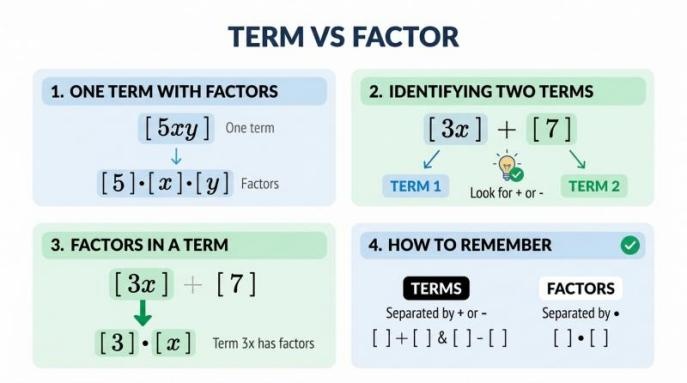
A term and a factor describe different parts of a mathematical expression.
A term is a complete part of an expression separated by addition or subtraction signs. A factor is one of the numbers or variables that are multiplied together to create a term.
For example:
5xy
is one term.
However, its factors are:
-
5
-
x
-
y
The entire expression 5xy is considered one term because there are no addition or subtraction signs separating its parts.
Another example:
3x + 7
has two terms:
-
3x
-
7
The term 3x contains two factors:
-
3
-
x
A simple way to remember the difference is:
-
Terms are separated by addition or subtraction.
-
Factors are separated by multiplication.
Term vs Coefficient: What Is the Difference?
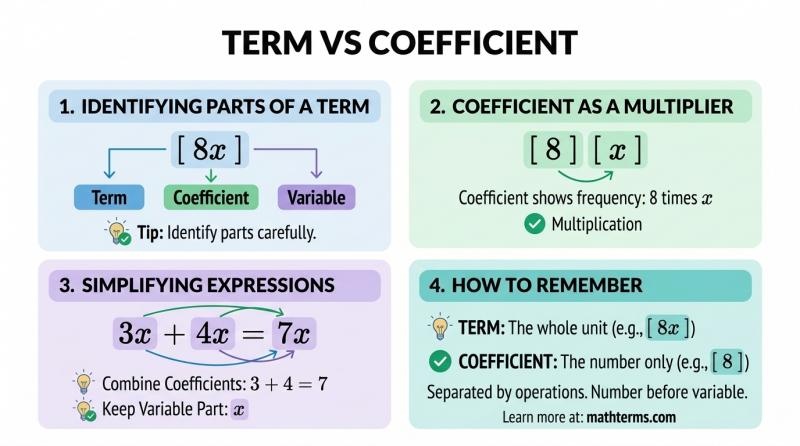
A coefficient is a specific part of a term, while a term can include both numbers and variables.
For example:
8x
The complete term is:
8x
The coefficient is:
8
The variable is:
x
The coefficient shows how many times the variable is multiplied. In this example, 8x means 8 multiplied by x.
Understanding the difference between a term and a coefficient is especially useful when simplifying algebraic expressions. For example, when combining like terms:
3x + 4x = 7x
students combine the coefficients while keeping the variable part unchanged.
Term vs Expression: What Is the Difference?
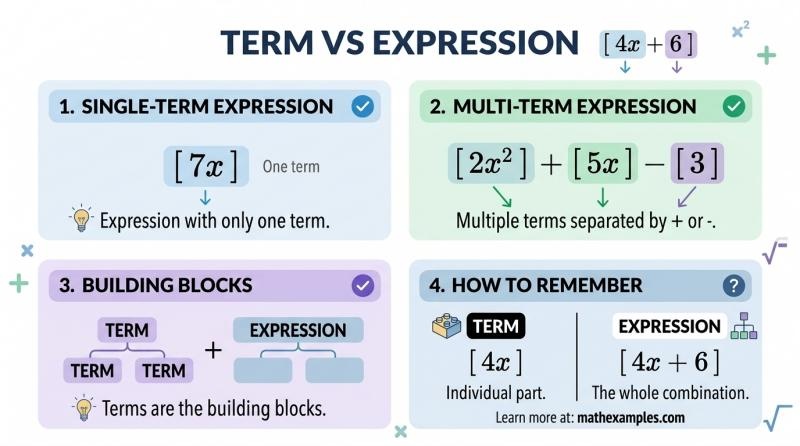
A term is one individual part of an expression, while an expression is a combination of one or more terms connected by mathematical operations.
For example:
4x + 6
is an expression.
It contains two terms:
-
4x
-
6
An expression can contain a single term:
7x
or multiple terms:
2x² + 5x - 3
The relationship between the two concepts is simple:
Terms are the building blocks of expressions.
Understanding this relationship helps students break down complicated expressions into smaller, easier-to-understand parts.
Term vs Equation: What Is the Difference?
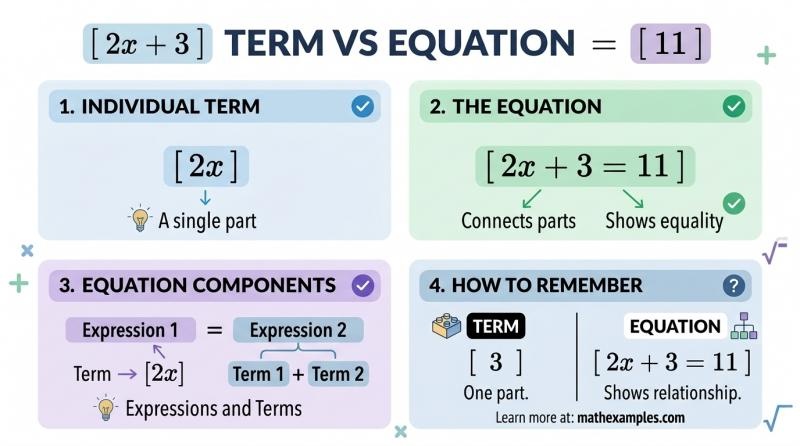
A term and an equation serve different purposes in mathematics.
A term is a component within an expression, while an equation is a mathematical statement showing that two expressions have the same value.
For example:
2x + 3 = 11
is an equation because it contains an equal sign.
The terms inside this equation are:
-
2x
-
3
-
11
The equation connects these terms and expressions to show a relationship that can be solved.
In simple terms:
-
A term is one part of a mathematical expression.
-
An equation compares two expressions using an equal sign.
How to Learn and Practice Math Terms More Effectively?
Learning math terms requires more than memorizing definitions. Many students can remember that a term is a number, variable, or combination of variables, but still struggle when they need to identify terms in real expressions or apply related concepts such as factors and coefficients.
A more effective approach is to learn mathematical terminology step by step: first understand the basic definitions, then practice identifying terms in different problems, and finally use guided tools to reinforce your understanding through real examples.
Step 1: Start With Basic Definitions and Related Concepts
Before practicing problems, make sure you understand the role of each basic concept and how they are connected.
For example, when learning about terms math, students should first understand:
-
A term is a part of an expression separated by addition or subtraction signs.
-
A coefficient is the number multiplied by a variable.
-
A factor is a number or variable multiplied together to create a term.
-
An expression is made up of one or more terms.
Learning these concepts together can prevent common mistakes. For example, in the expression:
5x + 3
students should recognize that 5x is one term, while 5 and x are factors within that term.
Building this foundation first makes it easier to analyze more complicated algebraic expressions later.
Step 2: Practice Identifying Terms in Different Types of Problems
After understanding the definitions, the next step is to practice recognizing terms in actual mathematical problems.
Start with simple expressions:
3x + 7
Then move to more complex examples:
4x² - 2xy + 6
For each expression, practice identifying:
-
How many terms it contains
-
Which terms are constants
-
Which terms contain variables
-
Which terms are like or unlike terms
It is also helpful to compare similar examples. For instance:
3x + 5x
can be simplified because the terms are like terms, while:
3x + 5y
cannot be combined because the variable parts are different.
Regular practice with different examples helps students recognize patterns instead of relying only on memorized definitions.
Step 3: Use Guided Tools to Practice With Step-by-Step Explanations
When students practice math terminology, the biggest challenge is often understanding why an answer is correct. Simply checking whether a term identification is right does not always explain the reasoning behind it.
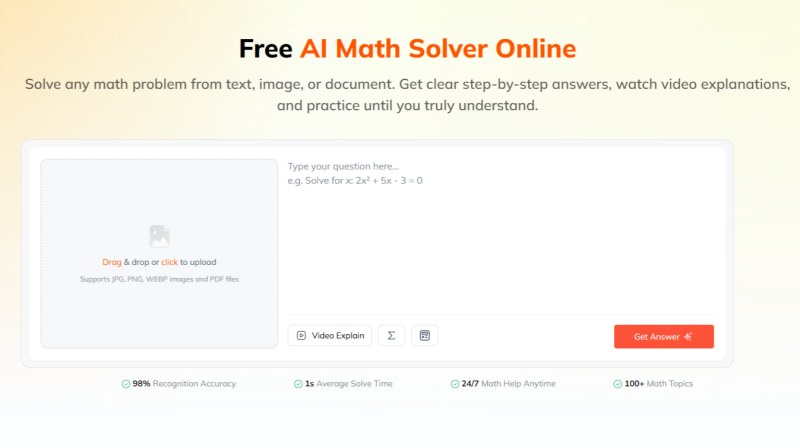
An AI math solver can be useful for this type of practice because it can break down unfamiliar expressions and show how each part is identified. For example, step-by-step solutions can explain why a specific number or variable belongs to a term, helping students understand the problem-solving process instead of only seeing the final result.
With Tenorshare AI Math, students can use features such as:
-
Step-by-step solutions to break down problem-solving processes and understand how mathematical expressions are analyzed.
-
Text, image, and PDF input for working with different study materials, such as homework questions, worksheets, or textbook examples.
-
AI-generated video explanations to provide additional visual guidance for more difficult concepts.
-
Similar practice questions to reinforce understanding and help students apply concepts to new problems.
Using these tools alongside regular practice can help students gradually build confidence with mathematical terminology and apply concepts more effectively in algebra problems.
Final Thoughts: Understanding Terms in Math
Understanding terms in math is an important step toward learning algebra and other mathematical concepts. Knowing how to identify terms and distinguish them from related ideas such as variables, coefficients, and factors helps students better understand expressions and equations.
Instead of memorizing a math term definition alone, students can improve their understanding by practicing with different math terms and examples and learning how these concepts work together in real problems. This foundation makes topics such as simplifying expressions and solving equations easier to follow.
For additional support, Tenorshare AI Math can help explain unfamiliar expressions with step-by-step solutions, allowing students to see how each part of a problem is analyzed. Combined with regular practice, it can help learners build confidence and develop a stronger understanding of mathematical terminology.

Tenorshare AI Math
- Solve math from text, images & PDFs at 98% accuracy
- Deliver step-by-step answers with detailed logic breakdown
- Access video explanations for deeper math concept understanding
- Generate matching practice tests to solidify knowledge

FAQs
-
What Is a Term in an Equation?
A term in an equation is a single number, variable, or combination of numbers and variables multiplied together that appears as part of an expression. Terms help represent the different components that make up each side of an equation.
-
How Do Terms Work in Polynomials?
Terms are the individual parts that form a polynomial. Understanding how terms are organized helps students perform operations such as simplifying, adding, subtracting, and factoring polynomials more effectively.
-
Can a Single Number Be a Term in Math?
Yes, a single number can be a term in math. A number without a variable is considered a constant term and can appear independently in expressions, equations, and polynomials.
-
Can a Term Have More Than One Variable?
Yes, a term can contain multiple variables as long as they are multiplied together. Terms with multiple variables are common in algebra and can represent relationships between different quantities.
-
What Are the Most Common Math Terms Students Should Know?
Common math terms students should understand include variables, constants, coefficients, factors, expressions, equations, polynomials, like terms, and unlike terms. Learning these basic concepts helps students understand more complex mathematical ideas.
You Might Also Like
- Geometric Terms List: 30+ Geometry Terms You Should Know
- How to Do Math in Your Head: 5 Mental Math Techniques for Faster Calculations
- How to Isolate a Variable: Definition, Step-by-Step Tutorial & Common Mistakes
- Geometry Proofs: How to Think Through and Solve Any Proof
- How to Solve Linear Equations in 5 Easy Steps [2026 Guide]
- AI Advances in Math: A Guide to the 2026 Latest Breakthroughs

Tenorshare AI Math: Solve any math problems with AI
Turn math questions into clear solutions, tutorial videos & targeted practice setsTenorshare AI Math: Instant Solutions
Steps, videos & practice for every problem
Tenorshare AI Math: Solve any math problems with AI