
How to Stop Using AI for Homework: 7 Practical Ways to Break the Habit
AI tools can explain difficult concepts, generate ideas, and help students check their work. However, when asking AI becomes the first step in every assignment, it can be harder to practice problem-solving and judge how well you understand a subject.
If you want to learn how to stop using AI for homework , you do not necessarily need to quit all AI tools at once. A more practical approach is to identify when you rely on them, try working independently before seeking help, and gradually build better study habits.
This guide covers why AI dependence develops, how to recognize when it becomes a problem, and seven practical ways to build independent study habits across math, writing, and other school tasks.
Catalogs:
Why Is It So Hard to Stop Relying on AI?
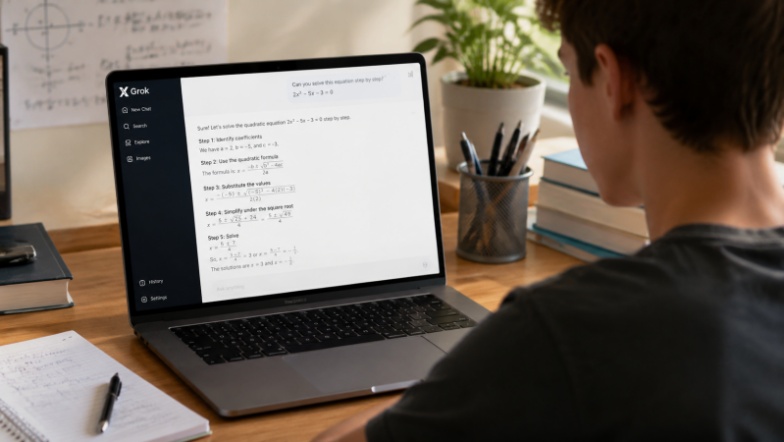
AI tools provide quick answers with little effort. When assignments feel difficult or deadlines are approaching, asking AI can seem easier than working through a problem independently.
Several factors can make this habit difficult to change.
-
Immediate answers feel rewarding. Getting a solution quickly can reduce the frustration of dealing with a difficult question.
-
Fear of making mistakes. Students who worry about incorrect answers or low grades may turn to AI before trying their own approach.
-
Heavy workloads and time pressure. When several assignments are due at once, AI can appear to be the fastest way to finish them.
-
Uncertainty about where to start. Students who do not understand a topic may struggle to identify the first step and use AI to fill that gap.
-
Repeated reliance becomes a routine. If AI is used for every difficult task, opening a chatbot can become an automatic response rather than a deliberate choice.
These factors do not necessarily mean a student is lazy or incapable of independent learning. They suggest that changing AI use may require adjustments to study routines, task management, and confidence in solving problems.
Is It Bad to Use AI for Homework?

Using AI for homework is not necessarily a problem. What matters is whether it helps you learn or does the work in your place . Before deciding to stop using AI entirely, consider two questions: whether your use follows academic rules and whether you can still complete assignments independently.
-
AI supports learning: Explaining difficult concepts, generating extra practice questions, or helping you review your reasoning.
-
AI replaces learning: Copying answers without understanding them or relying on generated work to complete assignments you are expected to do yourself.
These two distinctions help clarify when AI use becomes a concern.
Is Using AI for Homework Cheating?
It depends on your teacher's instructions and your school's academic integrity policy. Some courses allow AI for brainstorming, explanations, or grammar feedback but prohibit generated answers or complete essays. Others restrict its use more broadly or require students to disclose when they use it.
Before using AI, check the rules for the specific assignment. If they are unclear, ask your teacher what types of assistance are permitted. An accurate answer is not necessarily an acceptable submission.
Should Students Be Allowed to Use AI for Homework?
AI can support learning when it helps students understand difficult concepts or practice skills, but unrestricted use may make it harder to assess what they can do independently.
A balanced approach allows students to use AI for support while preserving opportunities for independent work. For example, students might ask for a simpler explanation or additional practice questions, then solve the assigned problems themselves. Tasks designed to assess independent writing, reasoning, or problem-solving may require stricter limits.
Rather than treating all AI use as either acceptable or harmful, schools should set clear expectations based on the learning objectives of each assignment.
How to Stop Using AI for Homework: 7 Practical Ways

You do not have to stop using AI overnight. The following strategies can help you build the habit of trying independently, asking for help more selectively, and checking whether you understand what you have learned.
Set a Time Limit Before Seeking Help
Before asking AI for homework answers, give yourself 10--20 minutes to work independently. Adjust the time based on the assignment's difficulty and deadline.
During that time, try to complete these steps:
-
Read the instructions and identify what the question is asking.
-
Review your class notes or textbook for relevant concepts.
-
Attempt at least one solution or approach.
-
Write down the exact point where you get stuck.
If you still need help, you will have a clearer question to ask. The goal is not to solve everything alone, but to give yourself a chance to think before receiving an answer.
Break Assignments Into Smaller Tasks
A large assignment can feel overwhelming, making it tempting to ask AI to complete the entire task. Breaking it into smaller steps gives you a more manageable starting point.
| Assignment type | Break it into smaller tasks |
|---|---|
| Research paper | Choose a topic → develop a question → find sources → outline → draft → revise |
| Math homework | Identify known values → choose a formula → work through calculations → check the result |
| Reading assignment | Read the passage → identify the main idea → find supporting details → write your response |
Try this: Choose just one step and complete it before moving on. If you get stuck, identify the specific difficulty instead of asking AI to do the whole assignment.
Write Your Own Ideas Before Using AI

When working on an essay or an open-ended question, record your own thoughts before looking at AI-generated suggestions. Your first attempt does not need to be polished.
Depending on the assignment, your starting point could be:
-
An essay: A rough outline or two possible arguments.
-
A short-answer question: A few sentences explaining your interpretation.
-
A research task: Questions you want to investigate and sources you plan to check.
Once you have a starting point, you can evaluate outside suggestions against your own reasoning. This makes it easier to identify which ideas you understand and which ones need further research.
Use Active Recall to Strengthen Understanding
Active recall, also called retrieval practice, means trying to retrieve information from memory instead of immediately looking at the answer. Research summarized by Carnegie Mellon University's Eberly Center explains how this practice can strengthen learning and help students retain information.
You can apply it to homework in three steps:
-
Close your notes. Try to recall the key concept, formula, or argument.
-
Work from memory. Solve a similar problem or explain the concept in your own words.
-
Check and correct. Compare your attempt with your notes or a reliable explanation, then retry any part you missed.
For example, after learning a quadratic equation method, try solving a new equation without looking at a worked example. If you cannot complete it, review the relevant step and try again.
Ask Teachers or Classmates When You Get Stuck
Reducing AI use does not mean you have to handle every difficulty alone. Teachers and classmates can help clarify instructions, explain unfamiliar concepts, and identify mistakes.
Instead of asking someone to complete the assignment, prepare a specific question.
| Instead of asking… | Try asking… |
|---|---|
| “Can you solve this for me?” | “I tried this method. Where does my reasoning go wrong?” |
| “Write my essay.” | “Does my argument answer the prompt? What needs more evidence?” |
| “What is the answer?” | “Which concept should I review to solve this problem?” |
Explaining what you have already tried makes it easier to get targeted feedback while keeping you involved in the work.
Track Your AI Use and Independent Progress
It can be difficult to notice a habit while it is happening. A short weekly record can help you see when and why you rely on AI.
After each assignment, note the following:
| What to track | Example |
|---|---|
| When you used AI | Before attempting the first question |
| Why you needed help | Forgot which formula to use |
| What you tried first | Reviewed notes and attempted one calculation |
| Whether you understood the answer | Could explain the steps without assistance |
Review your notes at the end of each week. If you repeatedly struggle with the same topic, revisit its foundations. If you tend to turn to AI because you feel rushed, try starting assignments earlier.
Measure progress by whether you can begin more tasks independently and explain more answers yourself, rather than by aiming for zero AI use immediately.
Practice Explaining Answers in Your Own Words
A correct answer does not necessarily mean you understand how to reach it. After finishing an assignment, explain the reasoning without looking at an AI response.
Use these prompts to check your understanding:
-
For math: Why did I choose this formula? How does each step lead to the answer?
-
For writing: What is my main argument? How does my evidence support it?
-
For reading: What is the main idea? Which details support my interpretation?
If you cannot explain an important step, return to your notes or textbook and review that part. You can also attempt a similar question to see whether you can apply the same concept independently.
The aim is to move beyond recognizing a correct answer and toward understanding why it is correct.
How to Stop Using AI for Different School Tasks
Reducing AI dependence looks different depending on the assignment. Focus on the skills each task is designed to develop, and use your own effort as the starting point.
How to Stop Using AI for Math Homework
Math requires you to practice choosing methods and working through each step, not just find the correct answer.
-
Attempt the problem first: Identify the known values, choose a formula, and show your work before seeking help.
-
Review the specific step you find difficult: Check your notes or textbook instead of requesting a complete solution.
-
Verify your understanding: After checking your answer, solve a similar problem without assistance.
When you need extra help understanding a difficult problem, a math-focused tool like Tenorshare AI Math can provide step-by-step explanations and similar practice questions. Use these resources to review your reasoning and strengthen your understanding, rather than relying on AI to complete the assignment for you.
How to Stop Using AI for Writing Assignments
Writing assignments help you develop your own arguments, organize ideas, and communicate clearly. Start with your own interpretation of the prompt before using outside assistance.
-
Write a rough outline with your main point and supporting ideas.
-
Draft the assignment in your own words, even if the first version is imperfect.
-
Revise for clarity and grammar using your notes, a writing guide, or permitted feedback.
Avoid asking AI to generate the entire essay. If you need help, identify a specific issue, such as organizing a paragraph or understanding a grammar rule, and follow your course's AI policy.
How to Stop Using AI for Research Assignments

Research assignments require you to find reliable sources, evaluate evidence, and develop your own conclusions. Practice these skills instead of relying on AI-generated summaries or arguments.
-
Find sources yourself: Begin with course materials, library databases, or credible websites.
-
Read the original material: Record key points and relevant evidence in your own notes before writing.
-
Evaluate and cite evidence: Check whether each source supports your argument, and verify quotations and references against the original.
If you are unsure what a source means, reread the relevant passage or ask your teacher for guidance. The goal is to build an argument you can explain and support independently.
Conclusion: Should I Stop Using AI Completely?
Learning how to stop using AI for homework does not necessarily mean giving up AI tools entirely. The goal is to rely less on AI for tasks you need to learn to do yourself, while using permitted assistance to clarify difficult concepts or reinforce your understanding.
Start by attempting assignments independently, asking for targeted help when needed, and practicing until you can explain your answers in your own words. Over time, these habits can help you become a more confident and independent learner.

Tenorshare AI Math
- Solve math from text, images & PDFs at 98% accuracy
- Deliver step-by-step answers with detailed logic breakdown
- Access video explanations for deeper math concept understanding
- Generate matching practice tests to solidify knowledge

FAQs
-
How Can I Stop Using AI for Everything?
Start by identifying the situations in which you use AI most often. Choose one recurring task to complete independently, such as drafting an email, planning a study session, or answering a question from your notes. Replace AI with a specific alternative, and expand the habit gradually rather than trying to change every behavior at once.
-
What Can I Do Instead of Asking AI for Homework Answers?
Review your class notes, textbook, and worked examples first. Break the question into smaller steps and write down what you already understand. If you still need help, ask your teacher or a classmate about the specific concept or step that is confusing instead of requesting a complete answer.
-
How Do I Know If I'm Too Dependent on AI?
Possible signs include struggling to start an assignment without AI, copying answers you cannot explain, or finding it difficult to solve similar problems independently. These signs do not establish a clinical condition, but they can indicate that your study habits need adjustment. Try completing selected tasks without AI and assess whether you can explain and apply what you learn.
-
Can I Use AI to Check My Homework Without Cheating?
In some cases, yes. If your teacher permits it, AI may help you review a solution, identify a possible error, or understand a concept. However, policies differ by course and assignment. Check the instructions, disclose AI use when required, and make sure the submitted work reflects your own understanding.
-
How Long Does It Take to Stop Relying on AI?
There is no fixed timeline. The time needed depends on how often you use AI, why you rely on it, and how comfortable you are with independent work. Focus on measurable progress, such as starting assignments without AI, explaining solutions in your own words, and completing more tasks independently. Adjust your approach as your confidence and skills improve.
You Might Also Like
- How to Do Math in Your Head: 5 Mental Math Techniques for Faster Calculations
- How to Get Better at Mental Math: Practical Strategies and Daily Practice
- How to Isolate a Variable: Definition, Step-by-Step Tutorial & Common Mistakes
- How to Solve Linear Equations in 5 Easy Steps [2026 Guide]
- How to Improve Math Skills: 5 Practical Ways to Get Better at Math 2026
- How to Study for a Math Test: From 7 Days Before to the Night Before

Tenorshare AI Math: Solve any math problems with AI
Turn math questions into clear solutions, tutorial videos & targeted practice setsTenorshare AI Math: Instant Solutions
Steps, videos & practice for every problem
Tenorshare AI Math: Solve any math problems with AI