
How to Show Your Work in Math in 2026 | Step-by-Step Guide & Examples
Getting the right answer in math is important, but showing how you arrived at it matters just as much. Whether you're completing homework, preparing for an exam, or helping a child with math, you may be asked to show your work instead of writing down only the final answer.
If you're unsure what to include, how many steps to write, or how to organize your calculations, you're not alone. This guide explains how to show your work in math with a simple step-by-step method, practical examples for different problem types, and useful tools to help you understand the solving process.
Catalogs:
Why Do You Need to Show Your Work in Math?

Showing your work in math means writing down the key calculations and reasoning behind your answer instead of providing only the final result.
For example, rather than writing x = 4, you would show how you solved the equation 2x + 6 = 14:
-
2x + 6 = 14
-
2x = 14 - 6
-
2x = 8
-
x = 4
This makes your solution easier to follow and helps others understand how you reached your answer. There are several other reasons why showing your work matters:
-
Earn Partial Credit: Some teachers and exams award points for correct methods and intermediate steps, even if the final answer is incorrect.
-
Identify and Correct Mistakes: Writing down each important step makes it easier to spot calculation errors, incorrect operations, or misunderstandings before submitting answers.
-
Demonstrate Your Understanding: Your calculations show that you understand which formulas or methods to use and how to apply them, rather than simply providing an answer.
-
Improve Your Problem-Solving Skills: Organizing your calculations into clear steps helps you develop a consistent approach to unfamiliar and more complicated problems.
How to Show Work in Math Step by Step
Although different math problems require different methods, you can follow a general process to make your solutions easier to understand.
Understand the Problem
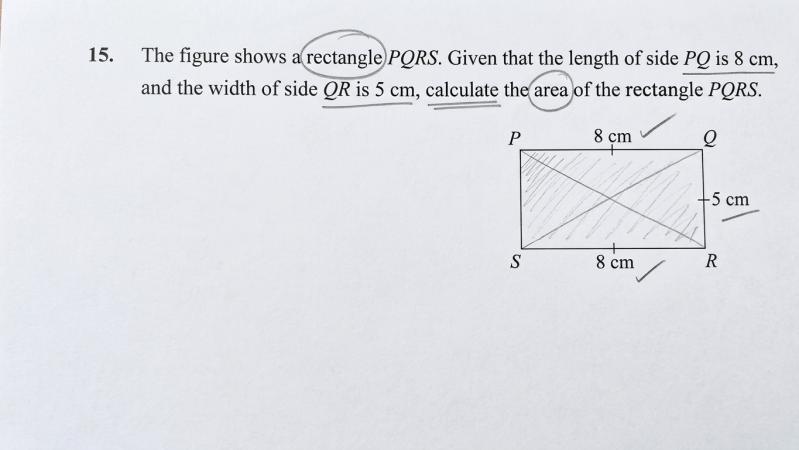
Start by reading the question carefully. Identify what information is provided and what you need to find.
For a word problem, you may need to underline important numbers, identify units, or rewrite the question in a simpler form. For an equation, determine which variable or expression you need to solve for.
Choose a Strategy or Formula
Decide which mathematical operation, rule, or formula can help you solve the problem.
For example, you may use multiplication for repeated groups, a formula for the area of a shape, or inverse operations to solve an equation.
Choosing the right method before calculating can help you avoid unnecessary steps.
Write Down the Setup
Before working through the calculations, show the original equation or formula you plan to use.
For example, if you need to calculate the area of a rectangle, write:
Area = length × width
This gives your solution a clear starting point and shows how the information in the question relates to the calculation.
Show Each Important Step
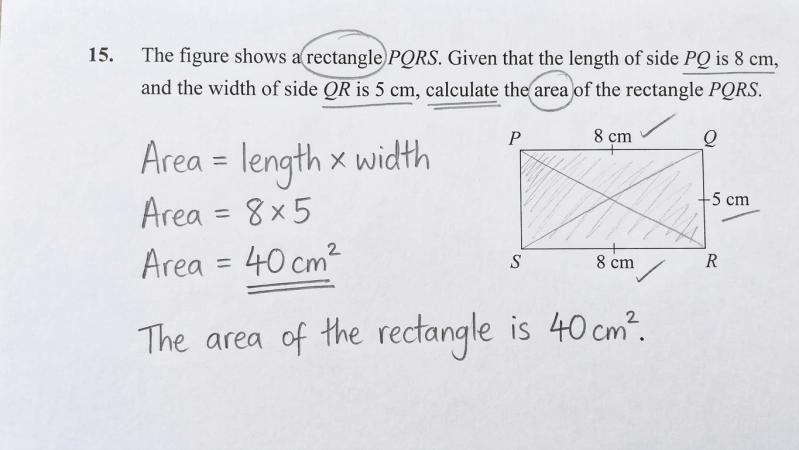
Work through the problem one step at a time. Keep related calculations together and put each major change on a new line.
For example, to find the area of a rectangle with a length of 8 cm and a width of 5 cm:
-
Area = length × width
-
Area = 8 × 5
-
Area = 40 cm²
You do not need to explain every basic arithmetic operation if it is obvious. Focus on showing the steps that demonstrate your method.
State the Final Answer
Make your final answer easy to identify. For questions involving measurements, include the correct unit. For word problems, write a short sentence that answers the original question.
For example:
The area of the rectangle is 40 cm².
Check Your Work
Review your calculations and make sure your answer makes sense.
Depending on the problem, you can substitute your result back into the original equation, use the opposite operation to check a calculation, or estimate whether the answer is reasonable.
Checking your work can help you catch mistakes before submitting your solution.
How to Show Work for Different Types of Math Problems
Different math problems require different ways of presenting your work. The key is to choose a format that makes your calculations and reasoning easy to follow while avoiding unnecessary steps.
Basic Arithmetic
For addition, subtraction, multiplication, and division, keep numbers properly aligned and show intermediate calculations when they help explain your method.
-
Use column alignment: When working with multi-digit numbers, line up digits by place value. For decimals, make sure the decimal points are aligned.
-
Show regrouping when needed: If you borrow or carry numbers, make these changes visible rather than jumping directly to the result.
-
Keep operations clear: For multi-step calculations, write each major operation on a separate line to avoid mixing up numbers.
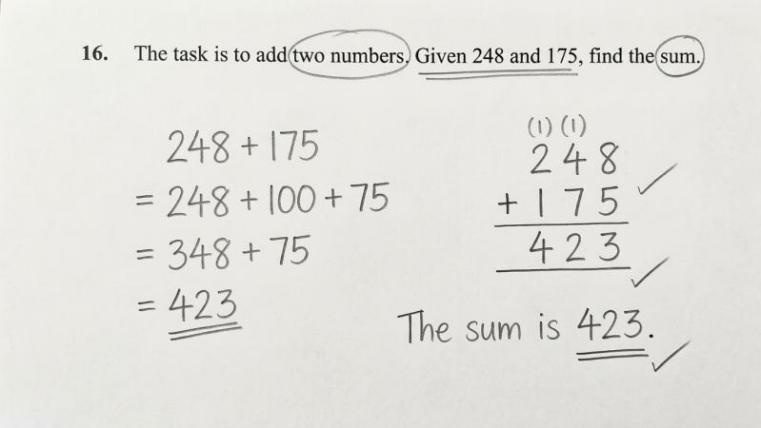
For example, when adding 248 and 175, use column addition and show any carrying. A common mistake is misaligning digits or forgetting to carry a number to the next column.
Algebra Equations
When solving algebra equations, show how you isolate the variable by applying the same operation to both sides. Write each major transformation on a new line so the progression is easy to check.
-
Keep both sides balanced: Whatever operation you apply to one side of an equation, apply it to the other side as well.
-
Show inverse operations: Make it clear how you move toward isolating the variable, such as subtracting a constant before dividing by a coefficient.
-
Handle negative signs carefully: Pay attention to signs when moving terms, multiplying, or dividing.
-
Avoid skipping important transformations: Writing only the initial equation and final value makes it difficult to identify mistakes.
For example, when solving 3x + 5 = 20, show the subtraction and division steps before writing x = 5. A frequent mistake is changing a term's sign incorrectly or dividing before removing the constant.
Fractions and Decimals
When working with fractions, make sure the denominators and numerators are handled correctly. For decimals, pay attention to place value and alignment.
-
Find a common denominator: Before adding or subtracting fractions, convert them to equivalent fractions with the same denominator.
-
Keep the denominator consistent: When adding or subtracting fractions, combine the numerators but do not add or subtract the denominators.
-
Show simplification: If you reduce a fraction, include the common factor used so the change is clear.
-
Align decimal points: When adding or subtracting decimals, use placeholder zeros when necessary to keep the place values aligned.
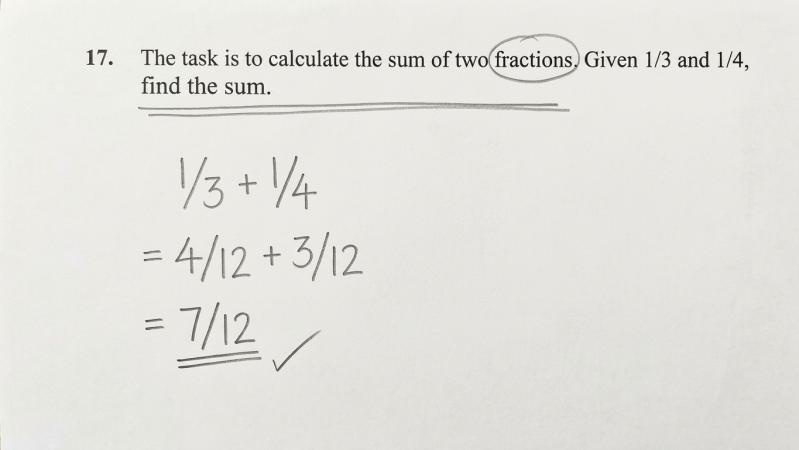
For example, to calculate 1/3 + 1/4, first rewrite both fractions with a denominator of 12, then add the numerators. Avoid adding the original denominators directly or dropping decimal places during calculations.
Geometry Problems
For geometry problems, combine written calculations with a clearly labeled diagram whenever the shape or measurements are relevant. This helps connect the given information to the formula you use.
-
Draw and label the diagram: Mark the given side lengths, angles, and other relevant measurements. Do not assume a drawing is to scale unless the question says so.
-
Write the formula first: State the formula before substituting values, such as Area = length × width for a rectangle.
-
Include the correct units: Use square units for area and cubic units for volume. Keep units consistent throughout the calculation.
-
Check which measurements are needed: For example, the height of a triangle must be perpendicular to its base. A slanted side cannot automatically be used as the height.
For example, when finding the area of a triangle, show the formula, substitute the base and perpendicular height, and calculate the result. A common mistake is using the wrong measurement or forgetting to include square units.
Math Word Problems
For word problems, focus on translating the written information into mathematical expressions before calculating. Your work should make it clear how the numbers relate to the situation.
-
Identify relevant information: Pick out the given values, units, and what the question asks you to find. Avoid using every number without checking its relevance.
-
Define variables when needed: For more complicated problems, use a variable to represent an unknown quantity and explain what it stands for.
-
Write an equation or expression: Show how the information in the question translates into mathematical operations.
-
Keep units consistent: Make sure quantities use compatible units before performing calculations.
-
Answer the actual question: Include a final sentence that explains what the result means in the context of the problem.
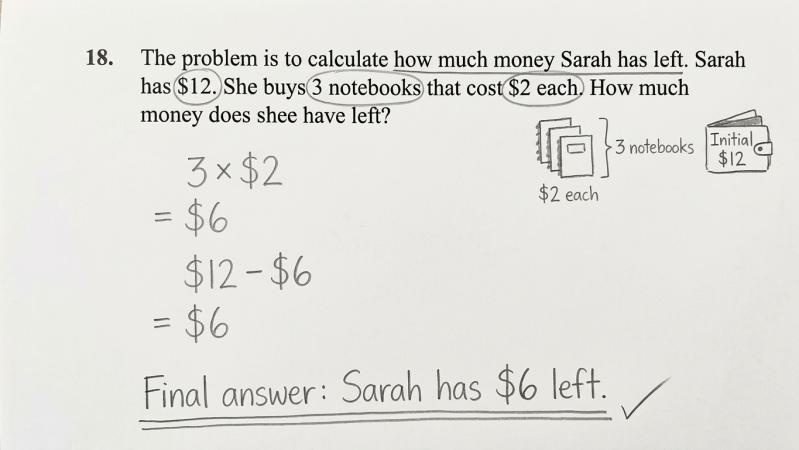
For example, if a question asks how much money remains after buying several notebooks, show the total cost first and then subtract it from the original amount. A common mistake is calculating the total cost correctly but forgetting to answer how much money is left.
Math Tools to Help You Practice Showing Your Work
The examples in this guide use relatively simple problems to demonstrate how to show working out in maths. However, actual homework and exam questions can be much more complicated , with multiple calculations, formulas, and reasoning steps. When you are unsure which steps matter or how to organize a solution, an AI math solver with detailed step-by-step explanations can help.
By reviewing worked solutions, you can identify the key steps needed to reach an answer, understand where you may earn method marks, and check whether your own calculations are correct. These explanations can also help you revisit unfamiliar formulas and connect individual steps to the underlying concepts, making it easier to solve similar problems independently.
The following tools offer different ways to review math solutions, depending on your preferred device, learning needs, and budget.
Here is a quick way to choose:
-
Choose Tenorshare AI Math if you prefer solving problems on a computer and want access to detailed step-by-step solutions without paying for them.
-
Choose Photomath if you mainly use your phone and want to scan math problems directly from textbooks or worksheets.
-
Choose Symbolab if you want more flexibility across web and mobile, especially for different math topics and specialized calculators. However, access to detailed step-by-step solutions requires a subscription.
Tenorshare AI Math: Best for Desktop Use

If you prefer completing math homework or reviewing problems on a computer, Tenorshare AI Math provides a browser-based workspace for understanding how solutions are developed. It offers free access to detailed step-by-step solutions , making it a useful option if you want to review the reasoning behind an answer without paying for that feature.
Key features include:
-
Multiple input methods: Enter a math question as text or upload an image or PDF.
-
Free Detailed step-by-step solutions: Review the calculations and reasoning behind each answer.
-
Additional learning support: Use video explanations, follow-up questions, and practice tests to explore a topic further.
-
Browser-based access: Solve problems directly on your computer without installing a dedicated desktop application.
This makes Tenorshare AI Math particularly suitable for students who regularly complete online homework or prefer reviewing detailed explanations on a larger screen.
Photomath: Best for Mobile Use

Photomath is a convenient choice if you prefer using your phone while studying. Instead of manually typing a long equation, you can point your camera at a printed or handwritten problem and scan it.
Key features include:
-
Camera-based problem scanning: Capture math questions from textbooks, worksheets, or handwritten notes.
-
Manual math input: Use the built-in keypad when scanning is inconvenient.
-
Step-by-step explanations: Review the solution process after scanning or entering a problem.
-
Additional learning features: Photomath Plus offers animated tutorials and more detailed explanations.
Photomath is especially useful when you are studying away from your computer or working through printed assignments. Basic step-by-step explanations are available for free, while some advanced learning features require Photomath Plus.
Symbolab: Best for Web and Mobile Use
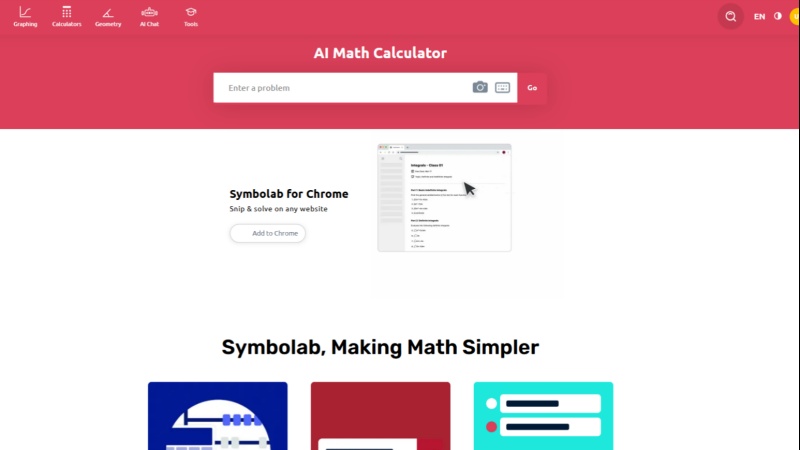
Symbolab is a flexible option if you want to work across different devices or need specialized calculators for a wider range of math topics. It is available on both web and mobile, with tools covering algebra, calculus, trigonometry, functions, and statistics.
Key features include:
-
Flexible problem input: Enter expressions through its web-based math input panel or use the mobile app to type or photograph questions.
-
Specialized calculators: Access tools for algebra, calculus, graphing, geometry, and other mathematical topics.
-
Cross-device access: Switch between the website and mobile app depending on where you study.
-
Step-by-step solutions: Review the working behind an answer, although access to detailed solution steps requires a subscription.
Symbolab is a good choice if you value a broad collection of math tools and flexible device access. However, if your main priority is getting detailed explanations without paying, its subscription requirement is worth considering.
Conclusion
Learning how to show your work in math is an important part of developing strong problem-solving skills. By writing down the key calculations, explaining your method, and checking your final answer, you can make your solutions easier to follow and identify mistakes more effectively.
Start with the basic process in this guide, then practice applying it to arithmetic, algebra, fractions, geometry, and word problems. If you need additional help understanding a solution, tools like Tenorshare AI Math, Photomath, and Symbolab can provide worked examples and explanations to support your learning. Try one that fits your study habits, and use the steps as a guide when solving problems independently.

Tenorshare AI Math
- Solve math from text, images & PDFs at 98% accuracy
- Deliver step-by-step answers with detailed logic breakdown
- Access video explanations for deeper math concept understanding
- Generate matching practice tests to solidify knowledge

FAQs
-
Do You Have to Show Every Step in Math?
No. You do not need to write down every small calculation or mental operation. However, you should include the important steps that explain your method, especially when a problem involves multiple operations, formulas, or changes to an equation. Follow your teacher's instructions if a specific level of detail is required.
-
How Much Work Should You Show in Math?
Show enough work for someone else to understand how you reached your answer. For a simple arithmetic question, one or two lines may be enough. For algebra, geometry, or multi-step word problems, include the formula or equation, the main calculations, and the final answer with the correct units when needed.
-
Can You Get Partial Credit Without Showing Your Work?
It depends on the teacher, exam, and grading rubric. Some assessments award partial credit for correct methods or intermediate steps, while others may focus mainly on the final answer. Showing your work gives the grader more information about your reasoning and may help you receive credit for the parts you completed correctly.
-
How to Show Your Work in Math for 2nd Grade?
For second-grade math, students can show their work using simple drawings, number lines, counters, or written calculations. For example, to solve 8 + 5, a student might draw eight circles, add five more, and count all 13. The goal is to show how they found the answer in a way they can understand and explain.
-
How to Get Students to Show Their Work in Math?
Teachers can help students develop this habit by demonstrating worked examples and explaining why each step matters. Asking students to describe their reasoning, compare different solution methods, and use drawings or equations can also make the process more approachable. Give feedback on the method they use, not just whether the final answer is correct.
-
How to Show Your Work in Math Online or on a Computer?
When completing math assignments online, you can use an equation editor, a digital notebook, or a document tool that supports mathematical symbols. Write each important step on a separate line, keep equations aligned where possible, and include diagrams when needed. If you are using a math-solving website, review its step-by-step explanation and make sure you can reproduce the method yourself.
You Might Also Like
- How to Do Math in Your Head: 5 Mental Math Techniques for Faster Calculations
- How to Stop Using AI for Homework: 7 Practical Ways to Break the Habit
- 2026 ACT vs SAT Math: 8 Key Differences and How to Choose
- Is Discrete Math Hard? Why Students Struggle and How to Make It Easier
- How to Get Better at Mental Math: Practical Strategies and Daily Practice
- How to Isolate a Variable: Definition, Step-by-Step Tutorial & Common Mistakes

Tenorshare AI Math: Solve any math problems with AI
Turn math questions into clear solutions, tutorial videos & targeted practice setsTenorshare AI Math: Instant Solutions
Steps, videos & practice for every problem
Tenorshare AI Math: Solve any math problems with AI